Wednesday, May 25, 2011

A Fetch of Dragonflies

In case you've ever wondered what a group of dragonflies is called ...

About a kilometer east of Tweed "the Trail" crosses a sand bottomed creek. Pools of standing or slowly moving water in shady forested areas are combined with open sunlit patches created by the trail. This medley of habitats, very different than the river, lake or marshes, has its own collection of odonate species.

While it was on the wing I mistook this immature female Chalk-fronted Corporal for a species of Baskettail. Although this one is perching on a twig these small dragonflies (40 mm long) are more often seen sitting on the ground or on rocks.


Habits can be a good way to identify or at least narrow down dragonfly species. Springtime Darners (Basiaeschna janata) prefer to hang vertically when resting. At about 60 mm in length it's relatively small for a darner. The colors and markings of the males are the same as the female's.


The Stream Cruiser (Didymops transversa) is about the same length as the darner above but much more robust. This dragonfly's habit of perching on an angle, like the female in the next two photos, is typical of its species.

Both of our two local species of cruiser have a pale facial stripe and only one lateral thoracic stripe, making them easy to spot in the field ... other large dragonflies, such as darners, have two thoracic stripes (if any).

Male and female Stream Cruisers are similarly patterned. The male can be distinguished by its slightly flared abdomen and pale claspers.

A mating pair of Stream Cruisers


This is an immature female Mustached Clubtail (Gomphus adelphus). The markings and length (at 45 mm it's small for a clubtail) agree with the species account in my field guide. The colors threw me off at first, but eyes will turn green and the bright yellow on the body will change to grayish-green as the dragonfly ages.

The "7"-shaped pale marks on the upper thorax, the broken middle thoracic stripe, and particularly – the heavy black markings on the face – are the characteristic field marks of this species.

Many species of clubtails prefer to stay low when at rest, adopting a horizontal position on the ground, rocks or leaves like these two immature males. In the field males can be differentiated from females by their clubbed tails and claspers, visible even from a distance on the male to the right.

A closeup of an immature male's facial markings. Clubtail species can be hard to tell apart and it's often necessary to get a detail shot of the terminal appendages for a positive I.D. In this case the bold black cross-stripes on the face are sufficient.

An older male Mustached Clubtail ... this photo was taken about one month later than the others. Note the changes in color.


Obvious field marks aren't good enough to sort out three of our local Baskettail species, all are similarly patterned and about 45 mm long. The only noticeable difference between them is the amount of pigmentation at the bases of the hindwings (which can vary) and the presence or absence of a "T"-shaped spot on the top of the frons (no images of the latter, the dragonflies weren't co-operating). So let's have a closer look ...

Baskettail # 1
The hindwings have a generous amount of black at their bases.

Looking at the terminal appendages: we see that the cerci are constricted at their bases but there's no evidence of any teeth. Taken in conjunction with the relatively large amount of hindwing pigmentation we have to conclude that this dragonfly is a Common Baskettail (Epitheca cynosura).

Baskettail #2
Some black pigmentation is visible at the bases of the hindwings.

Views of the claspers from a couple of slightly different angles. A ventral tooth is barely visible in the first image, but this isn't necessary for an I.D. What is clear in both photos is that the cerci turn down at the ends, and – they definitely possess dorsal teeth. This is sufficient to identify this dragonfly as a Beaverpond Baskettail (Epitheca canis).

Baskettail #3
The hindwings have a small amount of pigmentation at their bases.

A dorsal view would be helpful but it's unneccessary because luckily I was able to obtain a good image of the claspers – the cerci definitely have a sharp ventral tooth. As always, the claspers are the final word as to species. This dragonfly is Spiny Baskettail (Epitheca spinigera).


A teneral male Brush-tipped Emerald (Somatochlora walshii), length about 45 mm. As a rule it's not a good idea to handle a teneral odonate, especially by its delicate wings. But this one is gravely injured (likely by a beaver, a dog or a hiker) and won't survive much longer. A pity this dragonfly in such rough shape, as it would have made an excellent subject with its amber-tinted wings and a thorax that looks like it's made out of colored metal foil.

The hairy claspers (which sustained injury as well) are visible in the field and leave no doubt as to the identity of this dragonfly.

Tuesday, May 24, 2011

Changing with the Season

With the warmer weather of late spring and summer more species of dragonflies and damselflies are emerging and taking flight with each passing day. Depending on the species the larvae, called naiads, take from one to several years to mature. The flying adult most people are familiar with is the but final phase of the odonate's life; in a few weeks, before it dies, it must find a mate and start the cycle of life over again. The insects in the following images were photographed at the marsh bordering the Eastern Ontario Trail.

This small teneral dragonfly is a Whiteface. On the basis of habitat I'm tempted to say it's a Frosted Whiteface (Leucorrhinia frigida), but cannot rule out a Dot-tailed Whiteface (Leucorrhinia intacta). Both species are common in this area and I lack the experience to tell the tenerals apart.

Views of the exuviae; its length is 16 mm


Judging by the number of tenerals flying in the vegetation near our local marshes hordes of naiads are making the change every day, but actually catching them in the act of metamorphosing is difficult. The teneral insect's pale colors blend in with the low vegetation. This is a male Four-spotted Skimmer (Libellula quadrimaculata) and its exuviae.


As of late last year I had only Pauline Campbell's images to document a dragonfly undergoing the dramatic change from larva to adult. But having recently observed large numbers of tenerals along the shoreline of the marsh, this weekend seemed like a good time to go hunting for a naiad about to begin its final moult ... and it wasn't long before I got lucky.

The Four-spotted Skimmer (Libellula quadrimaculata) naiad in this next group of pictures was about fifteen feet from the water ... in fact, had already crossed the road and was heading for the marsh on the other side. Fortunately it didn't get stepped on by a hiker or run over by a four-wheeler.

Seeing opportunity knocking, I scooped the naiad into a baggie and took it to the garden where it could complete its metamorphosis in relative safety and I could take photos of the process in comfort. The dragonfly is extremely vulnerable to predators such as frogs and birds during this stage of its life. But turnabout is fair play; it's a good bet that this naiad has consumed a tadpole or two in its time ...

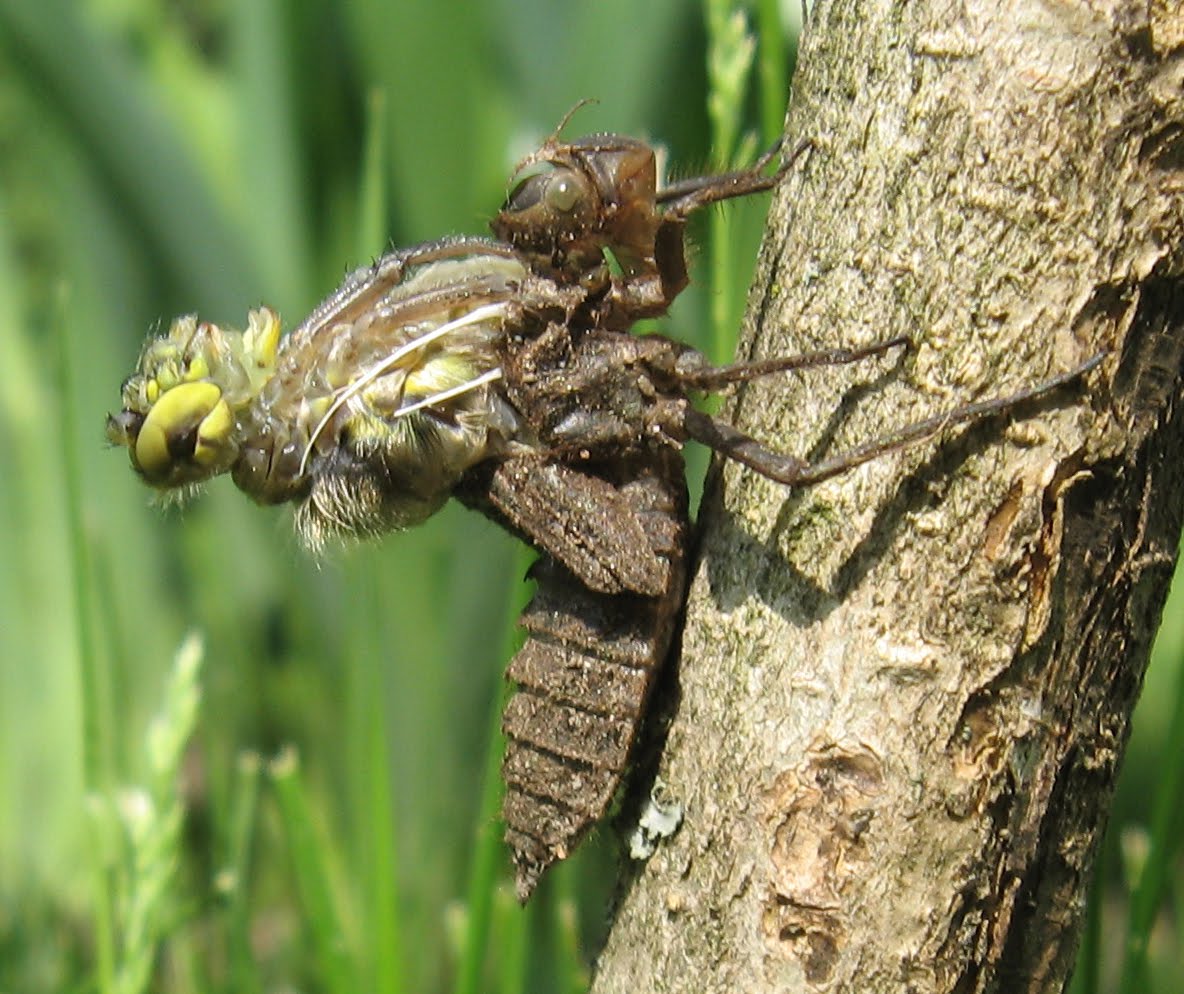
10:50 to 10:54 AM ... the naiad perching on a branch. The exoskeleton has been heaving and expanding as the adult dragonfly struggles to break out.

10:59 AM ... the outer integument has opened at the thorax; the eyes begin to show a few seconds later.

11:00 AM ... the eyes have emerged and more of the thorax is now free of the larval skin.

11:01 AM to 11:02 AM ... events are moving fast as the teneral adult begins to pull itself out.

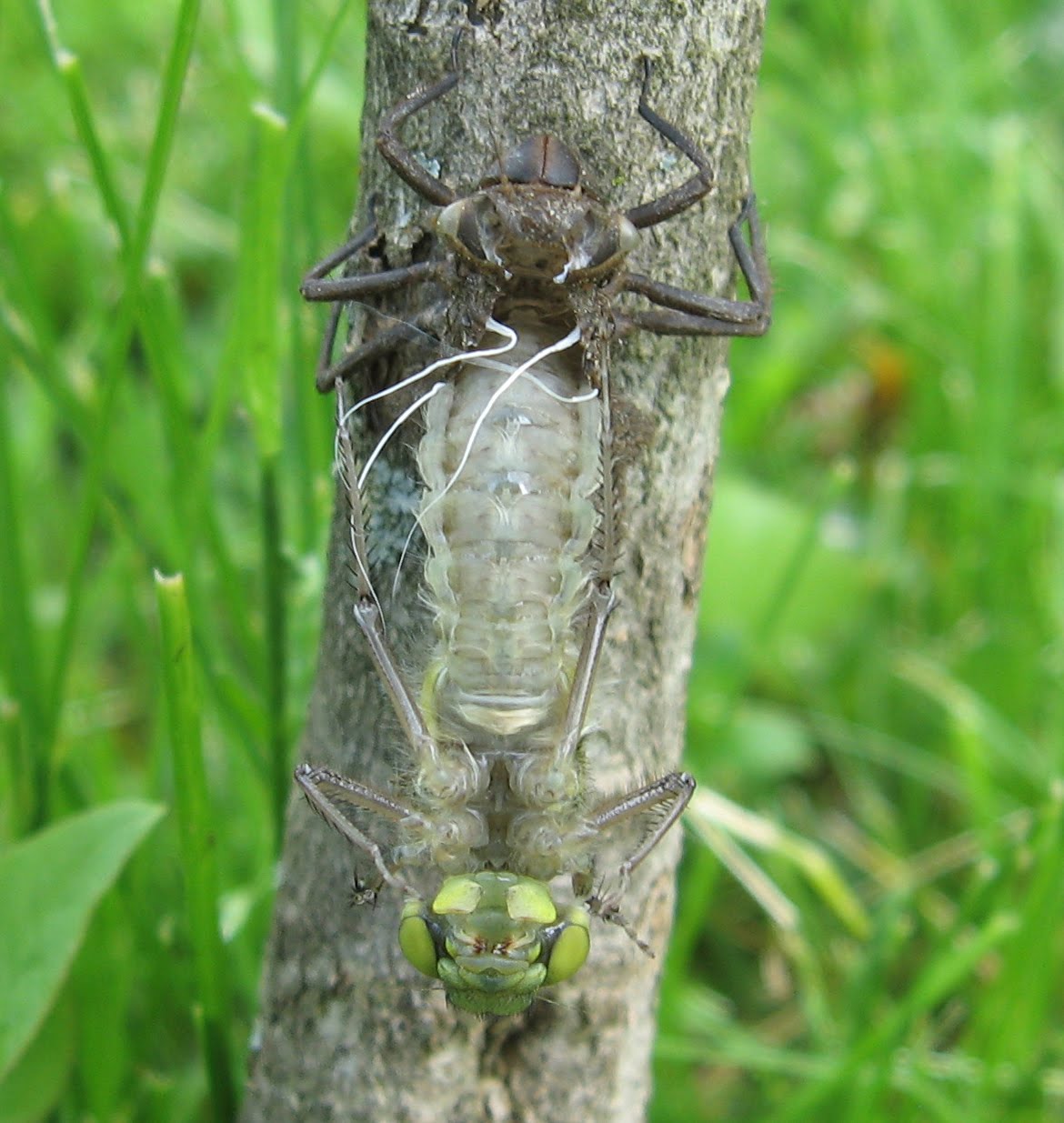
11:05 AM ... a ventral view of the dragonfly hanging head down, with only the end of its abdomen remaining inside the exoskeleton.

11:14 AM to 11:16 AM ... having been upside down to this point in time, the insect now tries to heave itself into an upright position. Imagine trying to do situps while hanging head down! Eventually it succeeds and follows suit by pulling its abdomen free of the larval skin as well. With the abdomen visible we can see that this is a female.

11:22 AM to 11:23 AM ... the wings have been expanding as haemolymph (insect circulatory fluid) flows into them, and the abdomen continues to lengthen as well.

11:26 AM ... the teneral adult climbs up the branch, leaving the cast-off larval skin (exuviae) behind.

11:27 AM ... the wings and exoskeleton are still very soft – especially the wings, which are so limp that they blow like a flags in the breeze.

11:56 AM ... the dragonfly's body is beginning to assume a more adult profile. Although the wings are still folded together over its back, they are now more rigid and almost clear and colorless, and the abdomen is much straighter.

12:15 AM ... the wing's first tentative flutters ...

... and a minute later at 12:16 AM the wings are held horizontally. Note the luster of the wings typical of teneral odonates (almost like plastic wrap). At 12:21 AM the dragonfly was capable of weak flight.

The time spanned by this sequence of images is one hour and twenty-seven minutes. In this relatively short interval the dragonfly has changed from a squat, brown, aquatic bottom crawler to a colorful winged incarnation (still predacious) capable of executing extraordinary aerial manoeuvers. The naiad was about 20 mm long, the length of the adult is about 40 mm. It's hard to believe they are one and the same entity, and except for this digital record of the transformation, all that's left is this little souvenier of our brief encounter ...

Phantom Crane Fly ( Bittacomorpha clavipes)

A common sight near wetlands but difficult subjects to photograph. In spite of their boldly contrasting black and white markings, when flying these insects seem to virtually disappear (they seldom seem to stop flying in any event), and due to their habit of flying low in the grasses they are easily overlooked.

The Phantom Crane Fly's mode of flight is interesting – the fly assumes a vertical position with the front legs extended straight up and back legs down, so its body is perpendicular to the direction of travel.

A mating pair, the female is the larger of the two flies, hauling the much smaller male along.

Saturday, May 21, 2011

Aurora Damsel (Chromagrion conditum)

Early season odonates are becoming a more frequent sight with each passing day. Teneral Four-spotted Skimmers and Whitefaces (probably Frosted Whitefaces) are abundant at the wetlands bordering the Eastern Ontario Trail.

Today I got a surprise: this teneral damselfly was looking for a safe place to rest and decided to perch on my hand. The camera was on "Auto" and I couldn't change the settings with only one hand so the image is a bit out of focus.

Although the colors and markings are still pale this is clearly a female Aurora Damsel (Chromagrion conditum) – the yellow area on the side of the thorax is diagnostic. At roughly 35 mm this damselfly is longer than the more commonly seen Enallagma bluets.

The wavy dark patch on the dorsal surface of the thorax is also characteristic of this species, as is the absence of shoulder stripes and postocular spots.


This male was encountered about a month later at a marsh on the Marlbank Road, just east of VanderWey Ct. Although members of the pond damselfly family, Aurora Damsels have a habit of holding their wings open at an angle in the manner of spreadwings when resting.

Thursday, May 19, 2011

Pickerel Frog (Rana palustris)

The Pickerel Frog is distinguished from the Leopard Frog by the two rows of rectangular spots between the dorsolateral ridges, whereas the Leopard Frog has a more random arrangement of smaller circular spots.

The background color of this frog is tan or light brown rather than green (although right now emerging Leopard Frogs don't look their best, at this season they are a dark brownish green – see image below) with yellow on the inner surfaces of the legs. This individual is about 70 mm long.

Leopard Frog (Rana pipiens), Early Spring

Ginormous Spider

Rain for the past week has made outdoor photography difficult to impossible and today when the sun finally peeked out it seemed like well past time to take a walk on the trail. About a kilometer east of town I came across a standing dead tree with the bark falling off and thought I'd peel it back some more to see what strange and weird critters might be lurking underneath, smiling and waiting to get their pictures taken. Well, I certainly got what I was looking for: I almost grabbed hold of the biggest spider I have ever encountered in my life! Despite its size it's almost invisible against the background of bark.

Based on the pattern of the eyes (zoom in on the next two images) and general appearance I think this a female Dark Fishing Spider (Dolomedes tenebrosus).

The spider was scurrying for cover so this lateral view is a bit out of focus but the photo serves to give an idea of how robust this arthropod is. It was in no way aggressive and once it got accustomed to my prescence I likely could have let it climb on my hand without fear of being bitten.

Just how large was this arachnid? The acorn cupule, the quarter (24 mm in diameter) and my thumb (the nail is 15 mm long) in the following images will give an idea of scale. With its legs extended the spider would have measured about three inches from front to back and easily spanned the palm of my hand.