It's mid-October and the end of odonate season is drawing nigh. As a rule the only species apt to be flying this late are Autumn Meadowhawks, with the odd White-faced Meadowhawk and Spotted Spreadwing for variety. There haven't been any hard frosts as yet and October 14th proved to be sunny with unseasonably warm temperatures near 25°C; a visit to a local field and marsh produced a few surprises.
West of Tweed (44.46667°, -77.31972°) is a dry field which supports short grasses, Staghorn Sumac, Sweetfern, Rubus spp and Hawkweeds, with a scattering of Eastern Red Cedars that are home to a small colony of Juniper Hairstreaks. At approporiate times of the year it's a good place to find odonates that like to forage far from water such as Four-spotted Skimmers, Halloween Pennants and Mosaic Darners (Aeshna spp). Of course the ubiquitous Autumn Meadowhawks (Sympetrum vicinum) are still present at this habitat, this is a male ...
... and a female with its distinctive triangular ovipositor.
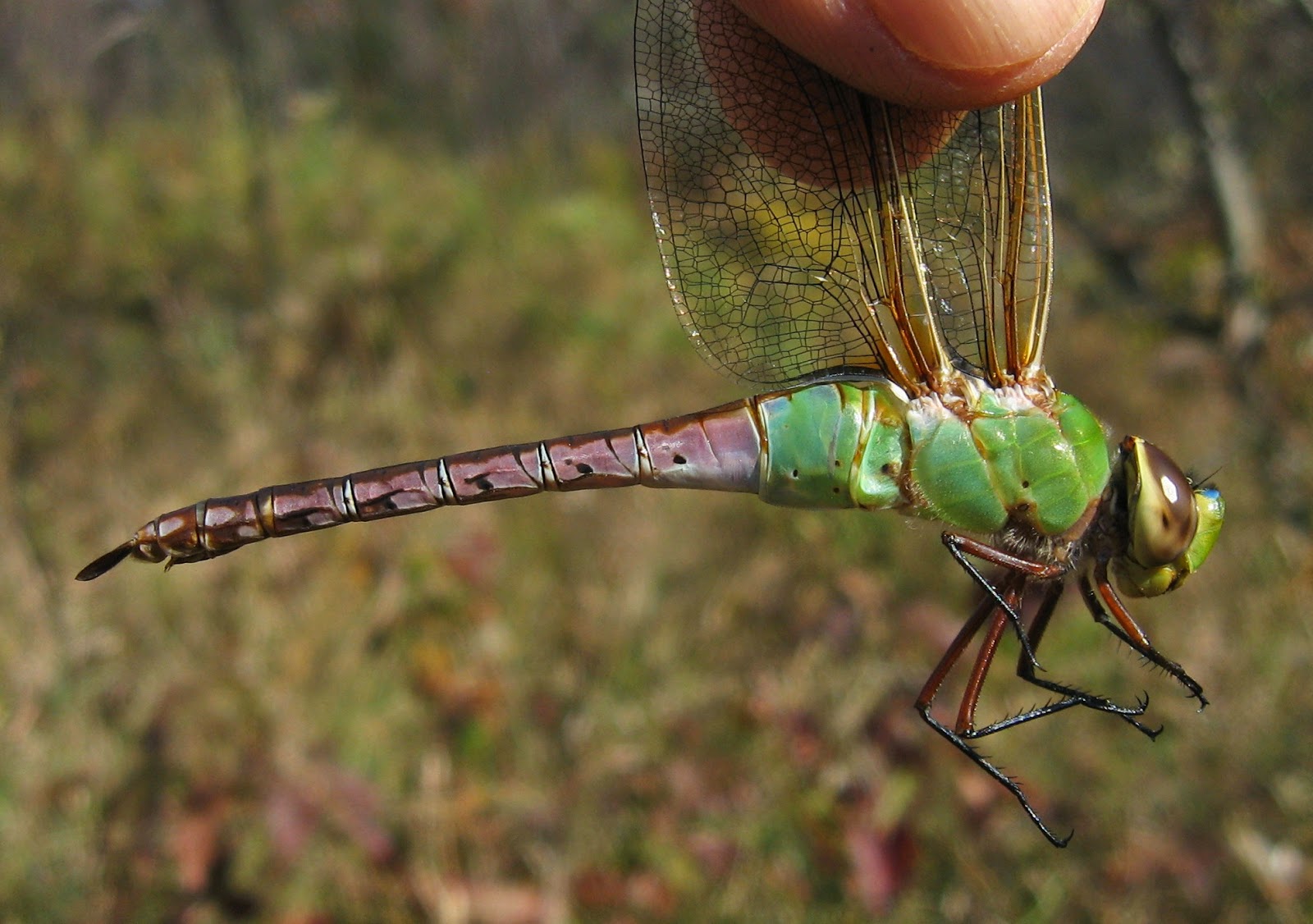
The three female Common Green Darners (Anax junius), however, were unexpected as most of their kind packed up and departed for more temperate climes two or three weeks ago. Shortly after the photo of the female in flight was taken the dragonfly angled sharply upward in pursuit of an Asian Lady Beetle, but on the verge of grasping it veered off and let it be. Ladybirds secrete a defensive chemical, an alkaloid called coccinellin, and the dragonfly seemed to recognize the beetle was potentially distasteful or toxic.


An even better find was a large (about 35 mm long) female Enallagma spp. This damselfly emerged fairly recently, its colors are bright and the black markings on its abdomen still have the glossy metallic sheen of youth. Study of the mesostigmal plates verified that this is a Familiar Bluet (Enallagma civile). A late flier indeed, the last local bluet (E. carunculatum) was encountered on September 24th. According to the
Field Guide to The Dragonflies and Damselflies of Algonquin Provincial Park and the Surrounding Area, Enallagma civile is known to fly in early October, but this is the latest I have seen this damselfly in my area.


The habitat at 44.46889°, -77.31528° is a typical local wetland with Cattails and a variety of rushes and sedges, with the taller vegetation consisting of a few Tamarack and various small willows and alders. Two male White-faced Meadowhawks (Sympetrum obtrusum) were encountered here, they might well be the last for this year as their numbers have slowly but surely been declining with the passage of autumn. The Autumn Meadowhawks are still out in full force; about sixty were estimated to be flying with roughly equal numbers of males and females. Of course most were engaged in a frenzied last minute orgy of mating and oviposition, doing all they can to ensure their genes make it into the next generation before the onset of cold weather puts an end to their little lives ...
No female Spotted Spreadwings (Lestes congener) have been seen at this marsh during the last couple of surveys. It appears that the males can't find any either and in desperation are taking whatever they can get. Yes, that's two males in tandem in the second out-of-focus photo. The other male wasn't compliant and they separated ... some relationships are doomed to failure from the very start ...
There are still some Aeshna spp flying, not unknown in October but not common either. I didn't have a net to capture the two darners for closeup shots but they both obligingly perched or hovered long enough to be identified. One was a beautiful green form female Canada Darner (Aeshna canadensis), it could well be the same individual captured and photographed at this habitat on October 1st. An old male Lance-tipped Darner (Aeshna constricta), its colors somewhat obscured and wings whitened and frayed by age, was also doing its rounds.
All in all, not a bad count considering the location and time of year. No doubt there are a couple or three other species still hanging in there, if so photos or accounts will be posted, stay tuned ...
October 22nd – time, as it has a way of doing, has passed and is now moving toward late October. Today was sunny and breezy with the temperature hovering around 10°C, and there were over twenty male and seven female Autumn Meadowhawks (all seven females were in tandem) and a lone female White-faced Meadowhawk flying at the marsh. As might be expected the White-faced Meadowhawk was an old girl with dulled colors and frayed wings.
Despite not having observed any for the past couple of weeks, there are still some female Spotted Spreadwings around, in fact three of them, as well as four males.
Last but not least, one Aeshna spp was hawking insects along the trail but it was too far away for me to make out any details and ascertain the species. And it seems that the late flying dragonflies and damselflies may be with us a little bit longer. There's no frost in the forecast for at least a week and next Tuesday the temperature will be a balmy 17°C.
October 23rd – sunny with a light breeze blowing and the temperature close to 16°C. About twenty Autumn Meadowhawks were foraging amidst the tall vegetation bordering the Tweed Fairgrounds and the soccer field. Two female Green Darners and a male Lance-tipped Darner were also sighted in this area.
October 25th – generally overcast, windy, temperature about 15°C. A male Lance-tipped Darner was observed patrolling along the trail near the marsh west of town, an old (or perhaps just cold) individual with dulled colors.
October 27th – still at the marsh, a sunny day but on the cool side with the mercury (a figure of speech, actually there's red alcohol in the competitively priced thermometer I'm using) hovering near 13°C. Despite the less than congenial temperature there were about fifty Autumn Meadowhawks flying with twenty being in tandem pairs. The Spotted Spreadwings are still with us and three males and a female were perching on the shrubs and grasses. As might be expected these little damselflies are staring to show their age, with advance of autumn the brassy luster of their youth has turned to a more muted gray-brown.


October 28th – sunny, and Mother Nature has turned up the thermostat to near 20°C. Three tandem pairs of Autumn Meadowhawks were spotted east of Tweed along the shore of the Moira River – are these to be the last odonates of 2014? As of this writing (October 31st) it's only a few degrees above the freezing point of water, some snow flurries are in the air and over the next two or three days the mercury will enter the realms of negativity and dip below the dreaded zero mark at night ...