With the warmer weather of late spring and summer more species of dragonflies and damselflies are emerging and taking flight with each passing day. Depending on the species the larvae, called naiads, take from one to several years to mature. The flying adult most people are familiar with is the but final phase of the odonate's life; in a few weeks, before it dies, it must find a mate and start the cycle of life over again. The insects in the following images were photographed at the marsh bordering the Eastern Ontario Trail.
This small teneral dragonfly is a Whiteface. On the basis of habitat I'm tempted to say it's a Frosted Whiteface (Leucorrhinia frigida), but cannot rule out a Dot-tailed Whiteface (Leucorrhinia intacta). Both species are common in this area and I lack the experience to tell the tenerals apart.

Views of the exuviae; its length is 16 mm


Judging by the number of tenerals flying in the vegetation near our local marshes hordes of naiads are making the change every day, but actually catching them in the act of metamorphosing is difficult. The teneral insect's pale colors blend in with the low vegetation. This is a male Four-spotted Skimmer (Libellula quadrimaculata) and its exuviae.

As of late last year I had only Pauline Campbell's images to document a dragonfly undergoing the dramatic change from larva to adult. But having recently observed large numbers of tenerals along the shoreline of the marsh, this weekend seemed like a good time to go hunting for a naiad about to begin its final moult ... and it wasn't long before I got lucky.
The Four-spotted Skimmer (Libellula quadrimaculata) naiad in this next group of pictures was about fifteen feet from the water ... in fact, had already crossed the road and was heading for the marsh on the other side. Fortunately it didn't get stepped on by a hiker or run over by a four-wheeler.
Seeing opportunity knocking, I scooped the naiad into a baggie and took it to the garden where it could complete its metamorphosis in relative safety and I could take photos of the process in comfort. The dragonfly is extremely vulnerable to predators such as frogs and birds during this stage of its life. But turnabout is fair play; it's a good bet that this naiad has consumed a tadpole or two in its time ...
10:50 to 10:54 AM ... the naiad perching on a branch. The exoskeleton has been heaving and expanding as the adult dragonfly struggles to break out.

10:59 AM ... the outer integument has opened at the thorax; the eyes begin to show a few seconds later.

11:00 AM ... the eyes have emerged and more of the thorax is now free of the larval skin.

11:01 AM to 11:02 AM ... events are moving fast as the teneral adult begins to pull itself out.


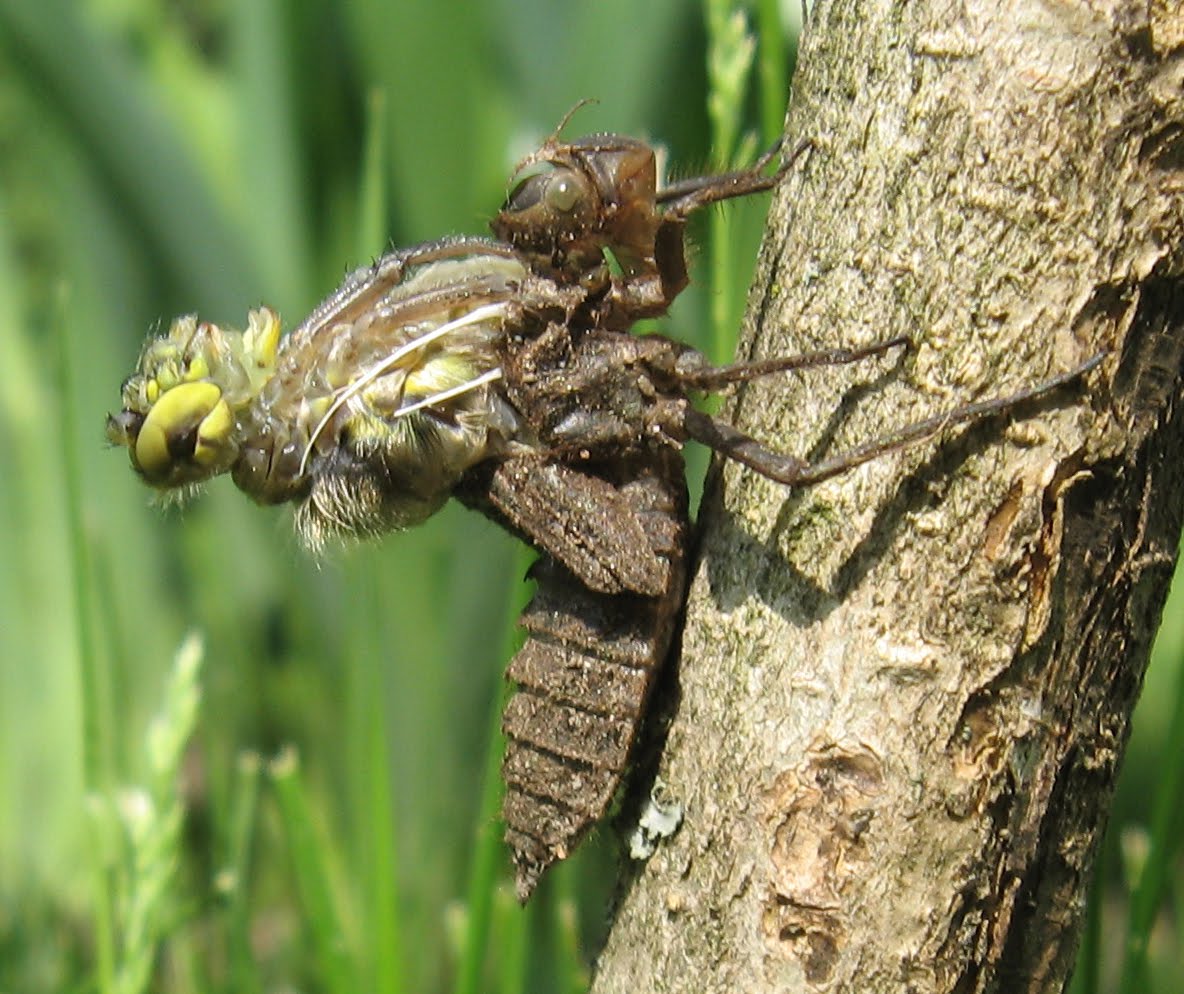
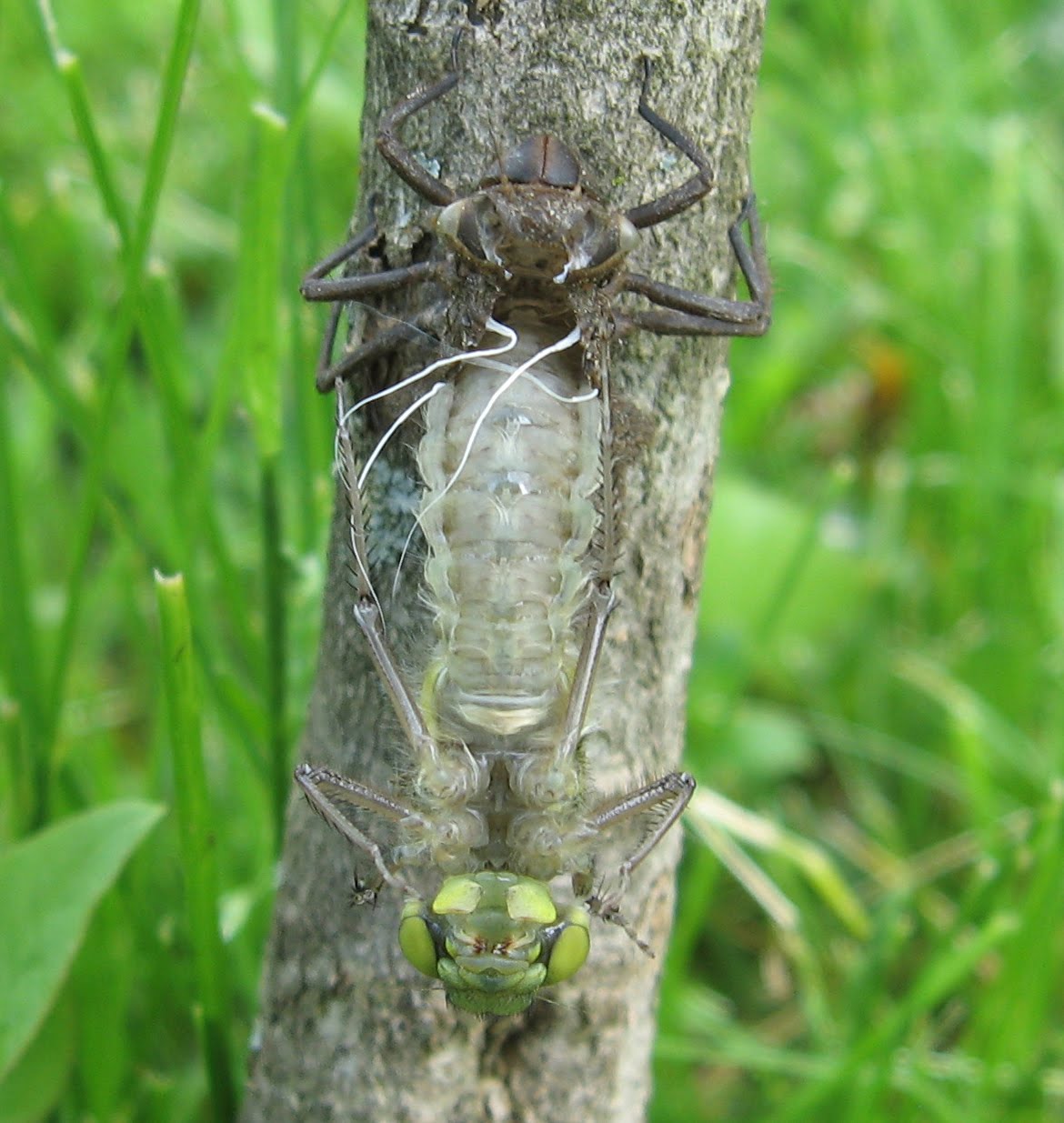
11:05 AM ... a ventral view of the dragonfly hanging head down, with only the end of its abdomen remaining inside the exoskeleton.

11:14 AM to 11:16 AM ... having been upside down to this point in time, the insect now tries to heave itself into an upright position. Imagine trying to do situps while hanging head down! Eventually it succeeds and follows suit by pulling its abdomen free of the larval skin as well. With the abdomen visible we can see that this is a female.


11:22 AM to 11:23 AM ... the wings have been expanding as haemolymph (insect circulatory fluid) flows into them, and the abdomen continues to lengthen as well.


11:26 AM ... the teneral adult climbs up the branch, leaving the cast-off larval skin (exuviae) behind.

11:27 AM ... the wings and exoskeleton are still very soft – especially the wings, which are so limp that they blow like a flags in the breeze.

11:56 AM ... the dragonfly's body is beginning to assume a more adult profile. Although the wings are still folded together over its back, they are now more rigid and almost clear and colorless, and the abdomen is much straighter.

12:15 AM ... the wing's first tentative flutters ...

... and a minute later at 12:16 AM the wings are held horizontally. Note the luster of the wings typical of teneral odonates (almost like plastic wrap). At 12:21 AM the dragonfly was capable of weak flight.

The time spanned by this sequence of images is one hour and twenty-seven minutes. In this relatively short interval the dragonfly has changed from a squat, brown, aquatic bottom crawler to a colorful winged incarnation (still predacious) capable of executing extraordinary aerial manoeuvers. The naiad was about 20 mm long, the length of the adult is about 40 mm. It's hard to believe they are one and the same entity, and except for this digital record of the transformation, all that's left is this little souvenier of our brief encounter ...