Showing posts with label White Admiral. Show all posts

Thursday, July 12, 2012

Looking like Crap

This is not necessarily a bad thing, certainly not when you are a potentially tasty meal surrounded by dozens of predatory species often much larger and faster than yourself. In the unforgiving realm of nature the demands of survival take precedence over vanity, and unlike we, the people, insects don't have the luxury of worrying about the latter, their only goal is to live at least long enough to pass on their genes to the next generation.

A Small Bird-dropping Moth (Ponometia erastrioides) ... the name says it all. The usual color scheme is a mottled mixture of white with reddish-brown and/or black, combined with a lumpy irregular profile.


Schlaeger's Fruitworm Moth (Antaeotricha schlaegeri)


A mating pair of Pearly Wood-Nymphs (Eudryas unio)


White Banded Fungus Weevil (Eurymycter fasciatus)


A winged adult insect can always take flight as a last resort if the poop ploy fails. Larvae don't have this option and many strive look even more convincingly like bird droppings, such as this Giant Swallowtail (Papilio cresphontes) caterpillar which comes complete with a glossy finish.


Should relatively small predators such as ants or spiders persist in their attentions the caterpillar has a secondary line of defense, the osmeterium, the "horns" seen in the following two photos. This gland is covered with a repellent 40:60 mixture of isobutyric acid and 2-methyl butyric acid – thus saith the various sources on the Internet, I didn't have my chemistry set with me.


Faking a piece of crap isn't solely about color, attitude and posture are also important. This White Admiral (Limenitis arthemis) larva curls its front end to imitate the appearance of a bird dropping. Hopefully this "ugly duckling" will live long enough to pupate and eventually metamorphose into an adult.


Although very different in appearance the Viceroy (Limenitis archippus) is closely related to the White Admiral. (The quite palatable Viceroy is, of course, mimicking the toxic Monarch.) Except for the brown being replaced by a grungy green the caterpillars definitely resemble one another – as well as bird droppings. Also note this caterpillar's posture – feeling threatened by my presence, it is keeping its head down while holding its convincingly head-like non-vital tail end in the air ... just in case its crappy camouflage fails ...


The larval stage of Tenthredo grandis, a species of Sawfly (order Hymenoptera) related to the bees and wasps. Is this pattern meant to fool a hungry bird, or does it serve some other purpose? It is somewhat too regular when compared to the butterfly larvae above, but who knows, maybe its good enough.


And I've always wondered about the pruinosity on a male Chalk-fronted Corporal (Ladona julia). These dragonflies prefer to perch in open sunny places on the ground. Are those chalky white markings meant to look like splats left by a passing bird?

Friday, July 29, 2011

Heads or Tails?

In spite of its psychedelic complexion and robust build this Promethea Moth (Callosamia promethea) proved difficult to spot amongst the foliage.

I've inserted my pinky finger in the picture to give an idea of the size of this insect, but it's scared and has hunched itself up somewhat, making it about ten centimeters shorter than its normal length ... about the same as my finger.

Chowing down on some yummy White Ash leaves ...

Note in the images above that the head has no bold colors or patterns, and the insect pulls it under its body when it feels threatened. Now consider these views with an emphasis on the posterior end. The terminal pro-legs or pseudopods are large, bear a black circular mark that suggests an eye, and are left in plain sight. (Pseudopod → "false foot" ... insects have only six legs, they are visible just behind the head in this photo).

Eyes can betray an animal's position to a potential predator, and many organisms sport bars or camouflage patterns to disguise them. By the same token, note how many butterflies, fish, etc., often sport fake eyespots on hindwings or tail fins. Are the eyespots targets to draw a strike to a non-vital area, or to make an otherwise innocuous species look threatening to a hungry hunter? Here's some thought-provoking reading: Why eyespots?.

And where, you say, is the "moth" in these photos? That lies in the future ... first, this caterpillar will overwinter as a pupa, and with luck this story will continue next year ...

The Orange-Humped Mapleworm Moth (Symmerista leucitys) adopts similar "false head" plan of action if it feels endangered. Although the head is a bold shade of orange the back end also bears prominently colored red and orange markings, and it holds its posterior the air with the last pair of prolegs splayed open. Everything about the caterpillar's posture suggests a head with antennae – at the non-vital backside of the insect.


The two appendages at the tail end of this Furcula Moth (not sure what species) larva also look very much like antennae.


The slow moving, soft-bodied larva of the larva of the White Admiral (Limenitis arthemis) makes a yummy morsel for a hungry bird. This caterpillar increases its chances of survival by not only being colored like ...

... but adopting the posture of, an inedible and not-so-tasty bird dropping.


Some species make themselves distasteful or toxic to minimise predation. The larva of the Monarch (Danaus plexippus) ingests the toxins found in its food plant, the Common Milkweed. The caterpillar's bold yellow, white and black stripes advertise its unpalatability.


Presumably the Milkweed Tussock Moth (Euchaetes egle) also toxic for the same reason, and hair or bristles can also be a deterrent to being captured and swallowed. But what's with the grouping? Are they mimicking a larger animal? Or is it a matter of safety in numbers like a flock of birds or a school of fish ... any single individual is less likely to be targeted?


Wednesday, June 2, 2010

What's for Lunch?

Depends on what you are. Butterflies imbibe their nutrients through a straw-like proboscis.


While they are generally thought of as insects that sip nectar from flowers, butterflies can often be observed drinking from ... in fact, having a preference for ... mud, sap, bird droppings, manure, urine, rotting fruit or well aged carcasses. This is how they obtain vital salts, minerals and amino acids.

These Eastern Tiger Swallowtails (Papilio glaucus) were feeding at freshly watered compost on the garden. The two butterflies were frequently jockeying for position to get at the same morsel.


A White Admiral (Limenitis arthemis arthemis) stopping to sip at a damp spot on the Eastern Ontario Trail. Having one for the road, so to speak?


A Baltimore Checkerspot (Euphydryas phaeton) engaging in the same behaviour a short distance further up the trail.

Ventral view of the Baltimore Checkerspot


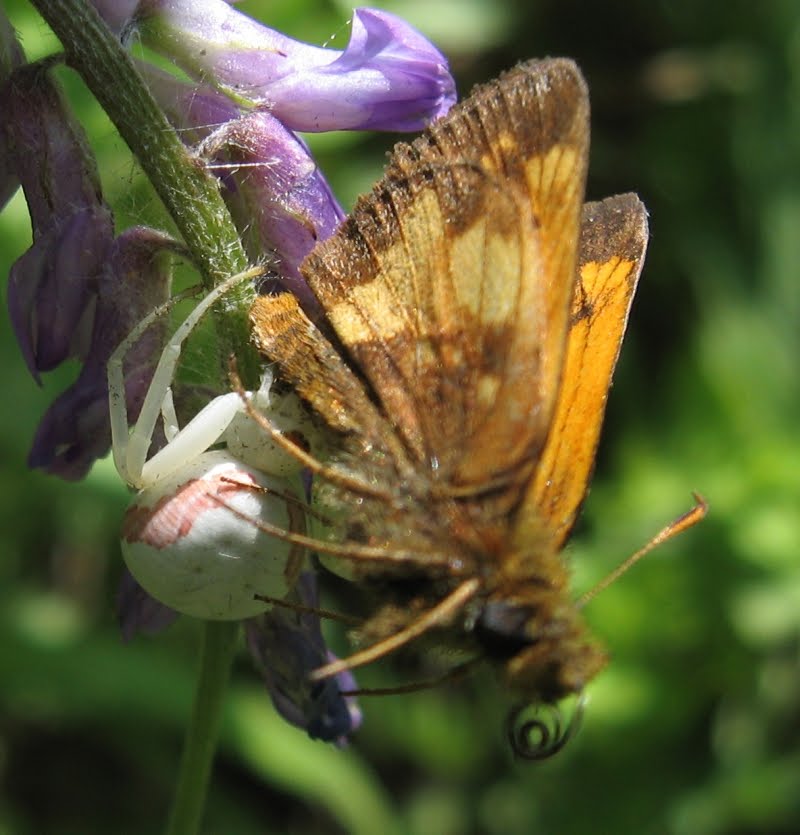
This hapless Hobomok Skipper (Poanes hobomok) stopped to nectar at a Purple Vetch, placed its proboscis where it shouldn't have, and has itself become dinner for a Flower Crab Spider (Misumena vatia). These spiders are able to change their color to yellow or white in order to blend into the background of the flower on which they are lurking.


As often happens the hunter becomes the hunted. Things were moving fast so I couldn't get good closeups of this wasp dragging a paralysed orb weaver to its burrow, where the spider will provide nourishment for the wasp's larva. As yet I haven't been able to identify the wasp, but I should be able to narrow it down in time. There are many different species of spider wasp and they don't prey indiscriminately on any spider, each has its own host species. This wasp would be adapted to instinctively avoid getting entagled in an orb weaver's web.


I found the orb weaver itself interesting, as there aren't that many green spiders around and I couldn't recall having seen one quite like this. I did some Googling and it looks like this spider is a Giant Lichen Orbweaver (Araneus bicentenarius). The spider in my photo would easily fit on the nail of my pinky finger but according to the author linked to above the adult female is the size of a golf ball.


Lunch for the larva of a Beewolf (Philanthus sp.) is the bee in the female's grasp. The Beewolf settled on a stepping stone in the garden for a few seconds to oviposit on the unfortunate host bee.


For a damselfly lunch is a smaller insect. There isn't enough left over to tell what the Stream Bluet (Enallagma exsulans) is eating ...

... but this Marsh Bluet (Enallagma ebrium) is chowing down on a seed bug. The bug wasn't captured on the wing, the bluet pounced on it while it was resting on the blade of grass seen in the photo.

This takes first prize: how to get a perfect meal and simultaneously eliminate a potential younger competitor from the gene pool. A mature female Eastern Forktail (Ischnura verticalis) consuming an immature female of her own species. You are what you eat ...