Showing posts with label Teneral Dragonfly. Show all posts

Tuesday, July 5, 2011

Dragonhunter (Hagenius brevistylus)

The largest of the clubtails, the boldly colored Dragonhunter is a specialist at preying on other dragonflies as well as moths and butterflies.

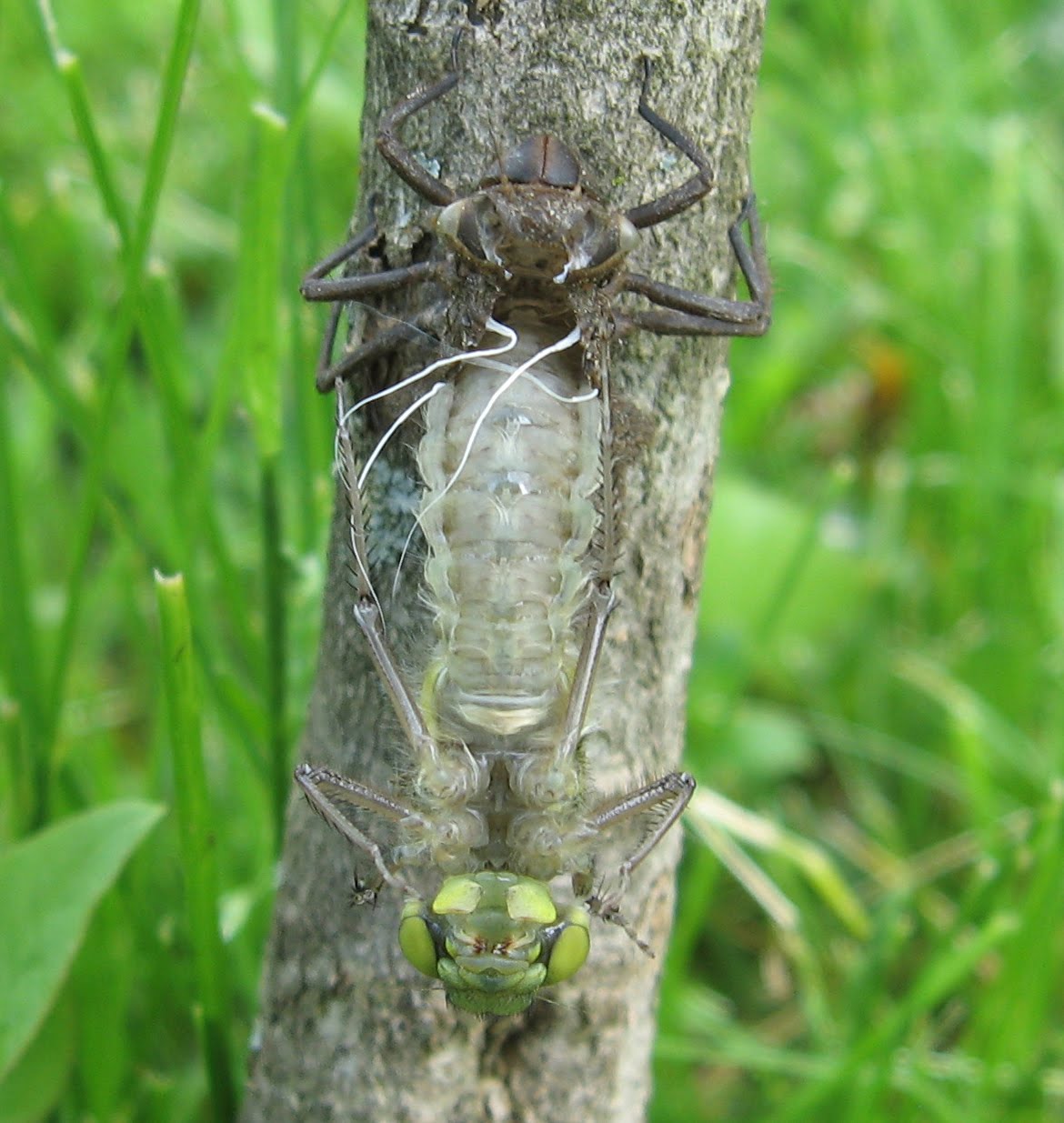
This male measured 85 mm in length. In addition to its large size, the massive thorax and long back legs make this dragonfly easy to identify in the field. The larva is also distinctive, as seen in this sequence of images of a Dragonhunter naiad undergoing its final molt and making the transformation to adulthood.

As a rule dragonflies aren't very docile and co-operative but this one was suffering from a hangover as a result of a collision with a vehicle.

A closeup of those beautiful translucent green eyes ...

... and a detail shot of the terminal abdominal segments. As their binomial name suggests, Hagenius brevistylus males have small claspers. The claspers aren't necessary to identify this dragonfly as its other physical attributes are so conspicuous that there's little chance of mistaking it for another species.

Tuesday, May 24, 2011

Changing with the Season

With the warmer weather of late spring and summer more species of dragonflies and damselflies are emerging and taking flight with each passing day. Depending on the species the larvae, called naiads, take from one to several years to mature. The flying adult most people are familiar with is the but final phase of the odonate's life; in a few weeks, before it dies, it must find a mate and start the cycle of life over again. The insects in the following images were photographed at the marsh bordering the Eastern Ontario Trail.

This small teneral dragonfly is a Whiteface. On the basis of habitat I'm tempted to say it's a Frosted Whiteface (Leucorrhinia frigida), but cannot rule out a Dot-tailed Whiteface (Leucorrhinia intacta). Both species are common in this area and I lack the experience to tell the tenerals apart.

Views of the exuviae; its length is 16 mm


Judging by the number of tenerals flying in the vegetation near our local marshes hordes of naiads are making the change every day, but actually catching them in the act of metamorphosing is difficult. The teneral insect's pale colors blend in with the low vegetation. This is a male Four-spotted Skimmer (Libellula quadrimaculata) and its exuviae.


As of late last year I had only Pauline Campbell's images to document a dragonfly undergoing the dramatic change from larva to adult. But having recently observed large numbers of tenerals along the shoreline of the marsh, this weekend seemed like a good time to go hunting for a naiad about to begin its final moult ... and it wasn't long before I got lucky.

The Four-spotted Skimmer (Libellula quadrimaculata) naiad in this next group of pictures was about fifteen feet from the water ... in fact, had already crossed the road and was heading for the marsh on the other side. Fortunately it didn't get stepped on by a hiker or run over by a four-wheeler.

Seeing opportunity knocking, I scooped the naiad into a baggie and took it to the garden where it could complete its metamorphosis in relative safety and I could take photos of the process in comfort. The dragonfly is extremely vulnerable to predators such as frogs and birds during this stage of its life. But turnabout is fair play; it's a good bet that this naiad has consumed a tadpole or two in its time ...

10:50 to 10:54 AM ... the naiad perching on a branch. The exoskeleton has been heaving and expanding as the adult dragonfly struggles to break out.

10:59 AM ... the outer integument has opened at the thorax; the eyes begin to show a few seconds later.

11:00 AM ... the eyes have emerged and more of the thorax is now free of the larval skin.

11:01 AM to 11:02 AM ... events are moving fast as the teneral adult begins to pull itself out.

11:05 AM ... a ventral view of the dragonfly hanging head down, with only the end of its abdomen remaining inside the exoskeleton.

11:14 AM to 11:16 AM ... having been upside down to this point in time, the insect now tries to heave itself into an upright position. Imagine trying to do situps while hanging head down! Eventually it succeeds and follows suit by pulling its abdomen free of the larval skin as well. With the abdomen visible we can see that this is a female.

11:22 AM to 11:23 AM ... the wings have been expanding as haemolymph (insect circulatory fluid) flows into them, and the abdomen continues to lengthen as well.

11:26 AM ... the teneral adult climbs up the branch, leaving the cast-off larval skin (exuviae) behind.

11:27 AM ... the wings and exoskeleton are still very soft – especially the wings, which are so limp that they blow like a flags in the breeze.

11:56 AM ... the dragonfly's body is beginning to assume a more adult profile. Although the wings are still folded together over its back, they are now more rigid and almost clear and colorless, and the abdomen is much straighter.

12:15 AM ... the wing's first tentative flutters ...

... and a minute later at 12:16 AM the wings are held horizontally. Note the luster of the wings typical of teneral odonates (almost like plastic wrap). At 12:21 AM the dragonfly was capable of weak flight.

The time spanned by this sequence of images is one hour and twenty-seven minutes. In this relatively short interval the dragonfly has changed from a squat, brown, aquatic bottom crawler to a colorful winged incarnation (still predacious) capable of executing extraordinary aerial manoeuvers. The naiad was about 20 mm long, the length of the adult is about 40 mm. It's hard to believe they are one and the same entity, and except for this digital record of the transformation, all that's left is this little souvenier of our brief encounter ...

Thursday, November 25, 2010

An Extraordinary Transfiguration

The emergence of an adult dragonfly from it's larval exoskeleton is one of the most remarkable events in the natural world. Within a short span of time the insect's body is transformed from a squat, cryptically colored aquatic form to a gaudy, streamlined aerial configuration. Thanks to Pauline Campbell for sharing her striking series of images documenting this metamorphosis. The photos were taken at Sand Lake, near Elgin, Ontario.

Dragonflies and damselflies go through incomplete metamorphosis, with their life cycle consisting of only three stages, the egg, the larva or nymph (or more properly, since the larva is aquatic, a naiad or water nymph), and the adult or imago. There's no dormant pupal stage between larva and adult as with butterflies, wasps, beetles and flies.

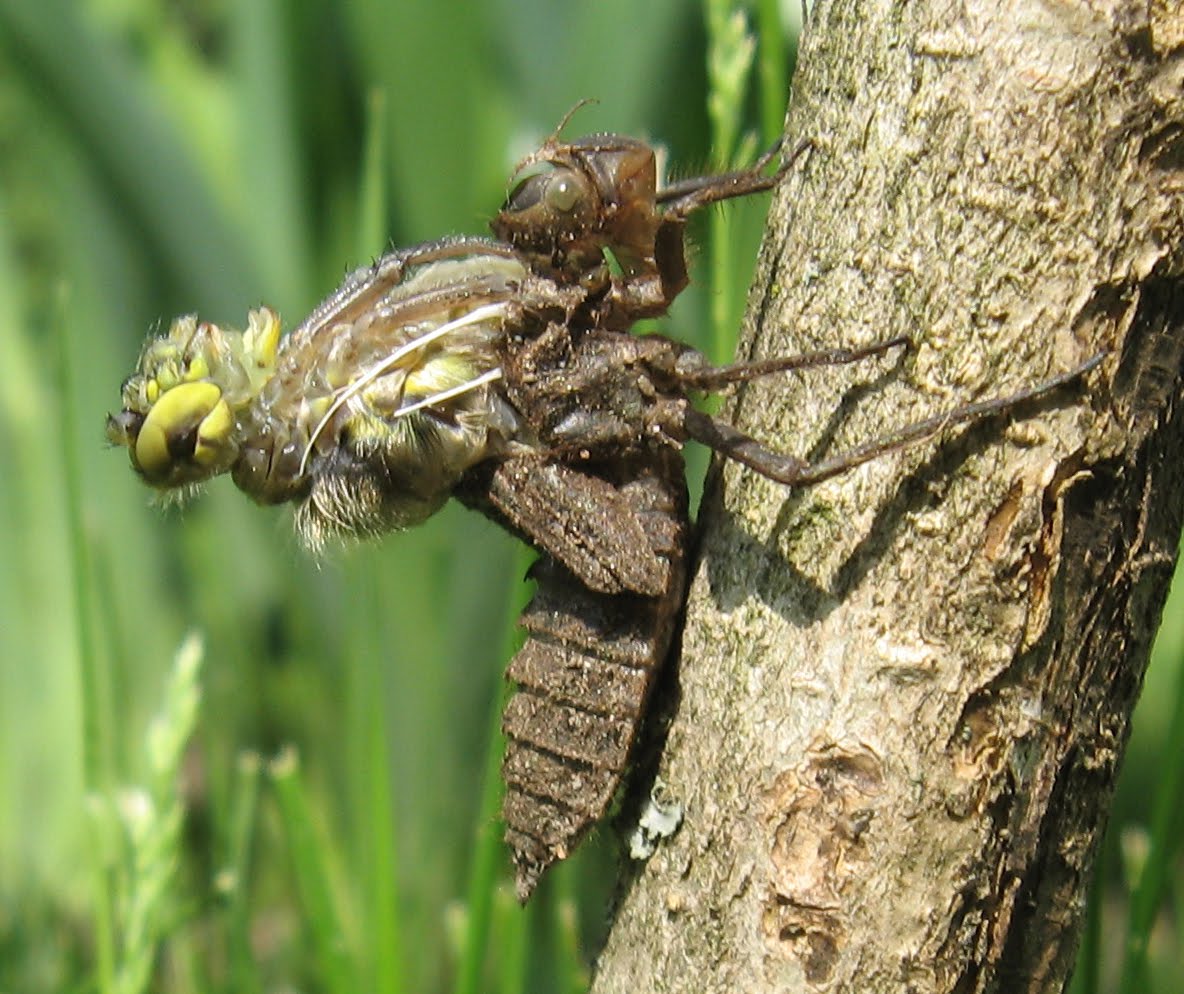
The first image should actually be last. It's the cast-off larval exoskeleton or exuviae; note the split in the thorax where the dragonfly has exited. However, this picture will serve to illustrate the dragonfly naiad. An insect's exoskeleton is rigid, and in order to be able to grow to this size the naiad has already undergone several molts. Each stage between molts is called an instar.

When it's time to undergo its final molt the naiad instinctively leaves its watery home and crawls to a nearby stone, stick or stem along the shoreline to begin the amazing transition to maturity.

Free at last! The newly emerged adult, called a teneral, pumps haemolymph (insect circulatory fluid) through its body, unfurling the crumpled, stubby wings and lengthening the abdomen. Needless to say, in this state the dragonfly is completely defenceless and vulnerable to predators.

The wings are now fully deployed. This dragonfly is a obviously clubtail, a member of the family Gomphidae, but the colors at this stage are so pallid that it's difficult to identify the species on this basis. Judging by the wide leaf-like profile of the exuviae and comparing it to this Dragonhunter naiad at Discover Life, and looking at this teneral Dragonhunter at BugGuide.Net, I'm going to hazard a guess that Pauline's dragonfly is probably a male Dragonhunter (Hagenius brevistylus).

Here's a link to more Discover Life images of Gomphid naiads.

Although the dragonfly's body and wings are still soft and delicate it's ready to take flight to the relative safety of the shoreline vegetation. In a few days the exoskeleton will harden and assume its adult coloration, and the fully mature insect will be ready to mate and reproduce, perpetuating a cycle of life that extends back 300 million years in time.

Monday, August 9, 2010

Canada Darner (Aeshna canadensis), Black-tipped Darner (Aeshna tuberculifera) and Shadow Darner (Aeshna umbrosa)

This Canada Darner (Aeshna canadensis) is an immature female, and also a bit cold, so it lacks the depth of color of a mature adult. A large dragonfly, the Canada Darner is about 70 mm long. The photo was taken at Stoco Lake.

Note the styli in this closeup of the terminal abdominal segments.

The notched thoracic stripe is visible in the following lateral views. Also note in the third image that this darner has no facial cross-stripe. The absence or presence of this feature can often be a quick means of sorting out similar darner species in the field.

The exuviae in the next series of images, discovered a few feet away on another tree, likely belongs to the darner above. This find provided an opportunity to obtain pictures of the hinged labium unique to odonate larve.

The colors are pale and the light isn't the best, but the notched thoracic stripe and lack of a facial cross-stripe can be seen in this teneral female, encountered not far from where the female above was photographed.

Darners often forage a fair distance from water and this female lost its bearings and got trapped a window. This is generally game over as the heat will quickly exhaust and kill the insect. The dragonfly was extricated and I took advantage of the chance to capture the beautiful green, turquoise and blue of a mature Canada Darner, after which it was released to continue its journey.

There is a bit of reasonable doubt in my mind as to species and it's possible that these "Canada Darners" are actually the closely related Green-striped Darners (Aeshna verticalis). I haven't had many close encounters with either kind of dragonfly and lack the experience to be proficient at distinguishing the two. Here are a couple of tail end views ... you be the judge.


This male Black-tipped Darner (Aeshna tuberculifera) was the victim of a collision with a vehicle. The thorax was too badly damaged to make out the stripes but enough of the insect's other key field marks remained intact enough to be worth imaging. Black-tipped Darners attain a length of about 70 mm. Note the the cross-stripe on the dragonfly's face.

Views of the claspers and all black terminal segment S10.

This female Black-tipped Darner was encountered along the Eastern Ontario Trail in August of 2008. The female below was photographed perching alongside the trail a few kilometers west of town; again note that S10 is completely black.


I couldn't get any images of the distinctive walking cane shaped thoracic stripes of this male Shadow Darner (Aeshna umbrosa) because it too was hit by a car. The face lacks a cross-stripe although it may show a thin brown line as in this specimen. Shadow Darners are about 75 mm long but relatively slender compared to their other large darner cousins.

The next set of images depicts lateral, dorsal and ventral views of the terminal abdominal segments. In lateral profile the cerci are spatulate with pointed tips, similar to the claspers of the Lance-tipped Darner. However, these organs appear quite different in the two species when viewed from above or below. The Shadow Darner's abdominal spots are greenish and much smaller than in other Aeshna species, giving this dragonfly a dark aspect.