Found buried in a sand-bottomed stream flowing through a wooded area, 25 mm in length, it's definitely Cordulegaster spp. – but which one?
There are three members the family Cordulegastridae in our area: the Delta-spotted Spiketail (Cordulegaster diastatops), the Twin-spotted Spiketail (Cordulegaster maculata), and the Arrowhead Spiketail (Cordulegaster obliqua). According to the Ontario Odonata Summary Atlas the Arrowhead Spiketail is by all accounts an uncommon dragonfly and it's tempting to rule it out on this basis. But by the same token the naiad was encountered in appropriate habitat within half a kilometer of where an adult female Cordulegaster obliqua was sighted and photographed in mid-June of 2011.


The next picture was taken indoors using the flash ... not much of an improvement, but a friend with a better camera has taken some cleaner, more detailed images under brighter lighting. The photos in this post have been submitted to
BugGuide.Net, and maybe someone who has experience with identifying odonate naiads can take this to the species level. (EDIT ... one of the forum members has posted a
Key to the Michigan Species of Cordulegaster, and it doesn't look like these images are going to be good enough ...)
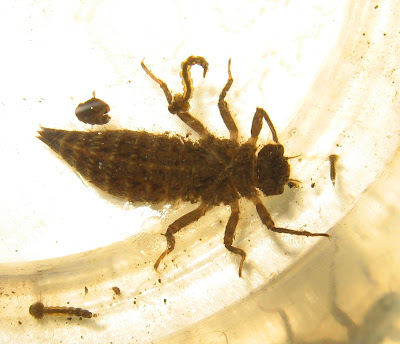
The youngster ate two mosquito larvae while in captivity, and upon being returned to the stream where it was found it quickly proceeded to bury itself in the sand and silt. Spiketail larvae hunt by concealing themselves under the sediment and leaving only their eyes exposed, lurking in ambush for an unwary passerby. Hopefully it will survive the hurdles of larval life long enough to attain maturity, and who knows, we may meet again and it can pose for more photos next summer ...
Where there's one Spiketail naiad it's reasonable to expect there might be others, so it looks like more forays to the woodland stream in the near future to acquire a larger, older instar to study.
The story continues ... upon visting a stretch of the woodland stream between the trans-Canada Trail and Lakeview Lane, a little south of the site of yesterday's find, I discovered that it's virtually crawling with Spiketail larvae! Within a distance of no more than three meters I found four naiads between 15 and 18 mm in length, one the same size as the previous day's find (25 mm), and four at 35 mm. (I should have saved all of the naiads and done a group shot.)
If they survive that long, three of these will emerge and transform into adults next year, and one, the first of today's finds, will not, as it was dead when I came upon it. Bad luck for the naiad, but this gave me an opportunity to photograph the prementum and palps on a relatively large specimen. Here are the images in the order they were acquired, and it's only fair to point out that this isn't really good science, as the characteristics we're looking at in the following images are not attributes of the same individual.
The best available macros of the outer surface of the serrated palps, the palpal setae and the premental setae. There are six palpal setae – although only five hairs are visible in the image there are six "roots" and the other palp has six as well (not visible due to the angle the photo). There appear to be ten, not more than eleven, premental setae. Unfortunately, being new to this, I neglected to acquire an image of the epaulet.
One of the smaller – 15 to 18 mm – naiads.
Another large (35 mm) – but alive – individual. Since I didn't have a ruler to determine the length of the insects I used a stick or my spare key, which were measured after I went home.
The frontal shelf (the part of the head between the antennae) is rounded in dorsal view. Another error in judgement due to inexperience ... while in the field I never thought to photograph or at least examine the frontal shelf's lateral aspect on any of the naiads.
A ventral view ... scaling the prementum as best I can on the computer screen, the palpal width is at least 2.5× the basal width.
A couple of views of the abdomen. The lateral spine of S8 does not appear to be strongly upcurved, in fact, I can't really see any lateral spines, just hair ....
The Spiketail naiad in its habitat upon being released, out of focus since it's both underwater and in motion. Being submerged brings forth a lot subtle, beautiful colors that completely disappear when the insects are removed from their natural element.
Knowing the length of a female naiad's developing ovipositor in relation to S9 would be helpful, but all of the specimens examined today, save the naiad in the next collection of images, were either too young to have developed an ovipositor or were males. This individual was also 35 mm in length and doesn't appear any different from the other naiads examined thus far ... except ... look carefully at the lateral views of the abdomen.
There's no evidence of an upcurved lateral spine on S8.
Jackpot! This one's a girl and the ovipositor is clearly a little longer than S9.
A few pictures of the larva after it was set free to go on its way, again, there's a striking difference in appearance compared to when it was perching on the palm of my hand. As with the other naiads captured, I didn't take any photos of the mouth parts and associated setae, as I didn't feel I could accomplish this without injuring the insects.


Assuming the naiads are all the same species and share all of the above characteristics (no, this definitely isn't exemplary science), and looking at that
Key to the Michigan Species of Cordulegaster, it's safe to rule out the Delta-spotted Spiketail (Cordulegaster diastatops). There do appear to be six palpal setae, or the roots thereof if not the actual setae, but I do not count more than eleven premental setae. And – the ovipositor of the female is definitely longer than S9.
So it's still a bit of an open question because of inconsistencies in the number of palpal setae, but for now the weight of the evidence points toward the Twin-spotted Spiketail (Cordulegaster maculata). Despite the numbers of larvae, and although this species does range in this area, I have never encounterd it in its adult incarnation. But next summer I will certainly be staking out this stream when the Twin-spotted Spiketails are expected to emerge and fly in early June.
August 12th ... checking out a section of the stream to the north of the trans-Canada Trail turned up half a dozen naiads. Four larvae were between 15 and 20 mm in length, and another two larger specimens measured 30 to 35 mm long. This makes for a grand total of sixteen in a fairly short stretch of water, so the Spiketails are hardly uncommon. Yet I have only encountered one adult in five years!?


