Showing posts with label Texas Bush Katydid. Show all posts

Tuesday, September 27, 2011

Autumn Insects

Autumn is harvest time, a busy time for wildlife, a time to hoard food or fatten up for the winter. Many insect species don't attain maturity until the fall, and must find a mate and breed in the limited time available to them before first hard frost.

Sad to say, time is running out for this beautiful Common Buckeye (Junonia coenia). According to my Peterson Field Guide to Eastern Butterflies this insect is a "migrant and temporary colonist north to ... s. Ontario". Although Common Buckeyes theoretically colonize this area and even a bit farther north, this is my first encounter with this butterfly and I've never seen one even in larval form or as roadkill. Nor will it be around much longer: this species cannot survive our winters, and new generations from warm southern climes will have to resettle the harsher northern limits of their range all over again next spring and summer.

An inspiring insect, and all those appealing colors and patterns on the wings call for a hand drawn sketch.


Several species of darners (Anax junius and Aeshna sp.) and meadowhawks (Sympetrum sp.) are well known late season fliers. A bit of a wanderer and thereby less often seen is the Black Saddlebags (Tramea lacerata). But it was somewhat surprising to find this female – a teneral – as late as September 26th.

Sometimes Black Saddlebags aren't around for a year or two. But there seems to have been a bumper crop this year, and I've already encountered two others: one on September 16th at the intersection of Louisa St. and the Eastern Ontario Trail, the other on September 19th near the intersection of Alexander St. and the Eastern Ontario Trail.


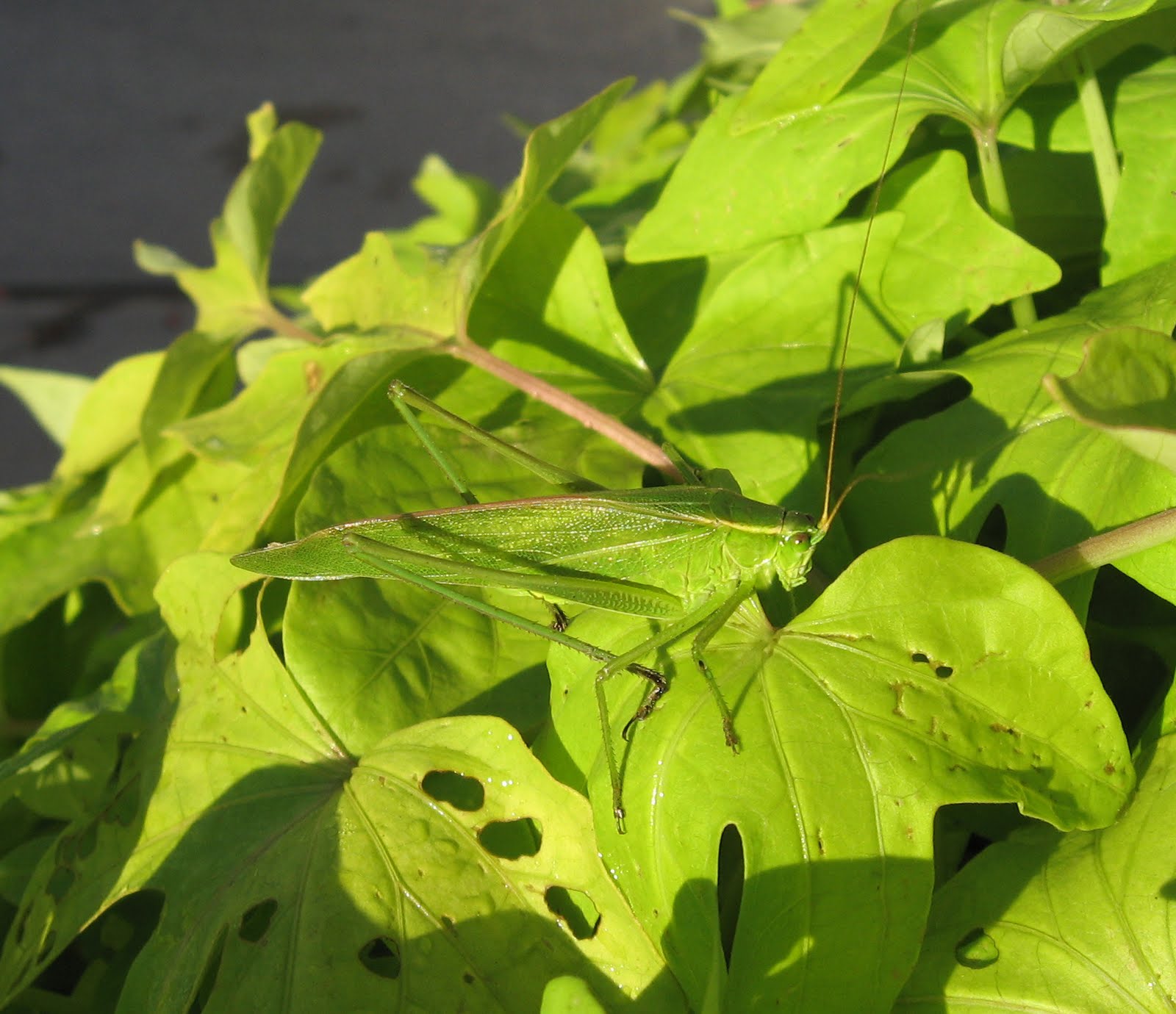
Always look twice at twigs, bird droppings and dead leaves ... or even living leaves, that green "leaf" could be a Texas Bush Katydid (Scudderia texensis).

A closeup shot of the katydid's ovipositor.

This Maple Spanworm Moth (Ennomos magnaria) is doing its best to masquerade as a dead yellow leaf ...

... while a caterpillar (as yet unidentified) imitates a dry, unpalatable twig.


When an insect advertises its presence with bold colors it's for a good reason! This odd looking "carpenter ant" was was on the run when I took its picture so the image quality is rather poor. Luckily I was unable to capture it to take a closeup shot of it sitting in my hand because it can sting – it's not a carpenter ant, it's a wasp called a Velvet Ant. Timulla sp., possibly grotei, and this one is a female; males velvet ants can fly but the females lack wings. I don't know what kind of a punch Timulla can pack, but it has relatives nicknamed "cow killers" ...

Learn more about the life cycle of Velvet Ants at Wikipedia: Mutillidae.


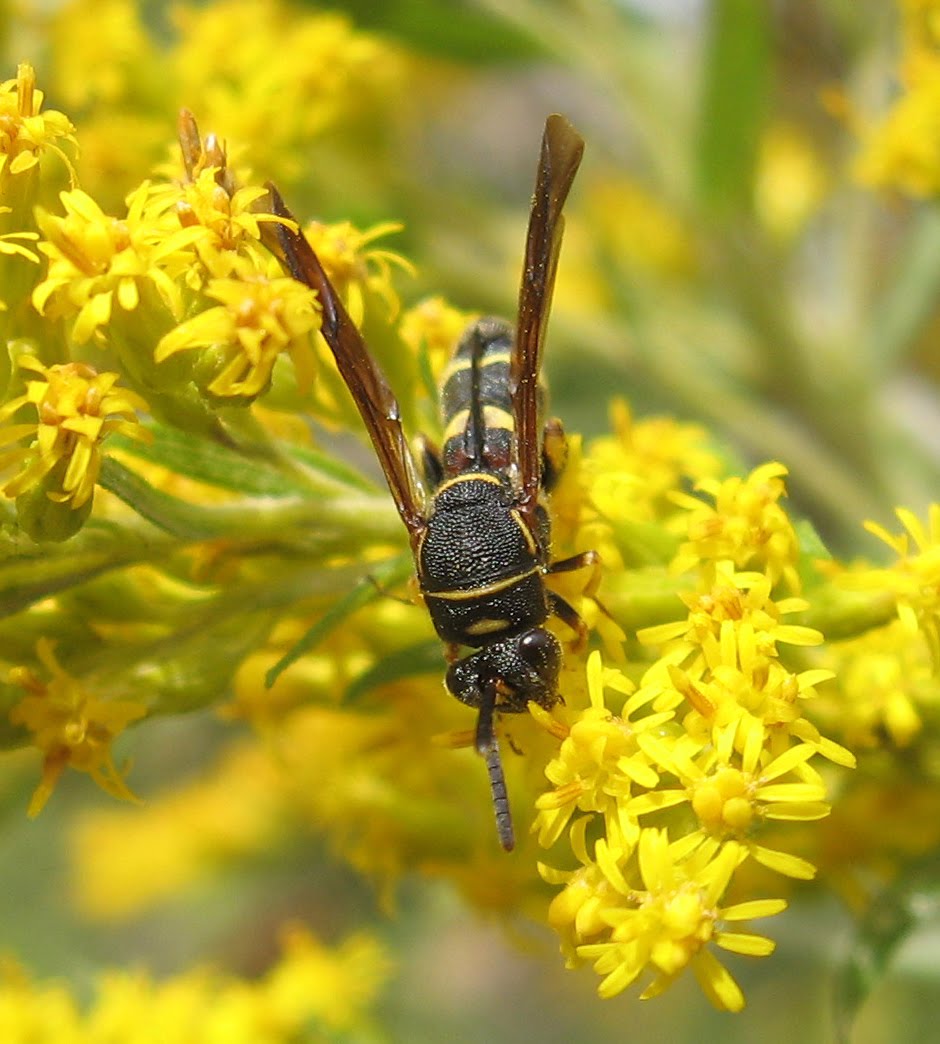
Easily mistaken for a yellowjacket, the chalcid wasp Leucospis affinis is a parasite of Megachilid bees. Note how this female carries her ovipositor over the top of her abdomen. Another distinguishing characteristic (unfortunately not very clear in the photos) are the enlarged spiny femora on the hind legs.

Friday, August 13, 2010

Bug eggs on Purple Loosestrife, and other random insect encounters

This clutch of unusual eggs and small insects (?) on a Purple Loosestrife leaf was found along the Eastern Ontario Trail. Inspection with a low power magnifying glass showed that the little red-and-black objects were indeed insects, true bug (Heteroptera) nymphs, and my first thought was that this might be a species introduced to control the unwelcome plants.

Not so. It seems the momma bug is likely a Spined Soldier Bug, or a related species, and used the leaf for convenience and not as a future food source for her offspring. Here's a link to further reading at BugGuide.Net, and searching for "spined soldier bug eggs" at Google Images will return more photos.


Always look twice ... a misplaced patch of brown on a Box Elder (a.k.a. Manitoba Maple) leaf turned out to be the eggs of a Boxelder Bug upon closer inspection. A big thank you to Laurie Campbell of Campbell's One Stop in Tweed for the use of her digital microscope which made it possible to capture the images in such detail. There are also some good photos of Box Elder Bugs ovipositing at Seabrooke Leckie's The Marvelous in Nature.


With a length of only about 5 mm and cryptically colored, this tiny treehopper, Acutalis brunnea, is easy to overlook.


Inconspicuous against the background of foliage, this female Texas Bush Katydid (Scudderia texensis) was found perching in the planters downtown. Here's a link to an instructive web page used to identify the insect (includes range maps) ... Genus Scudderia


Moving on to some flies: the next two images depict a Syrphid fly of the genus Sphaerophoria (length about 10 mm). The larvae are good friends to have in the garden as they prey on aphids. More information on these flies may be found at BugGuide.Net.


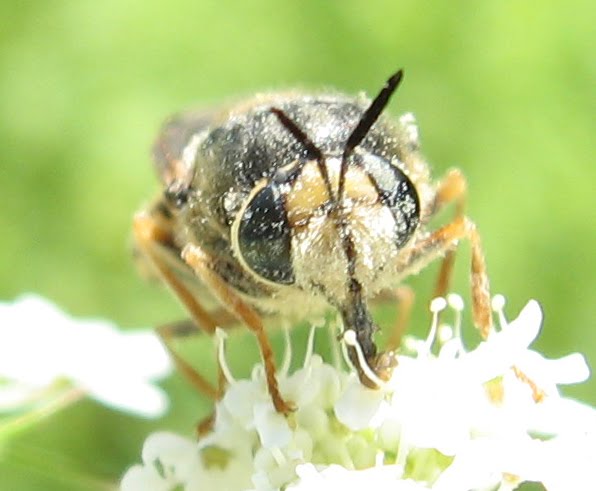
Syrphid flies, a.k.a. hover flies or flower flies, form a large family. Many are boldly striped in some variation of black and yellow, imitating bees or wasps. This is a Transverse Flower Fly (Eristalis transversa).


Parhelophilus sp., nectaring on flowers of wapato, is another member of the family Syrphidae. These photos were taken along the shore of Stoco Lake.


Tachinid flies are another interesting and diverse family. The fly with the extraordinary spines on its abdomen in the first group of four photos is Juriniopsis sp.


The tachinid fly in the next four images is Archytas sp. These flies can be wary and hard to photograph but for whatever reason (good taste, maybe?) this one was quite unafraid and landed on my hand.


Various species of soldier flies of the family Stratiomyidae. Or rather various genera ... even for experts many insects can be difficult to narrow down to the species level using only photos. This cool lime green fly is Odontomyia sp.


A more robust soldier fly, Stratiomys sp.


And this fly? I can't decide what name to assign to it ... there are images of both Stratiomys and Odontomyia that look similar.


According to BugGuide.Net there are four different species in the genus Sparnopolius, but only S. confusus occurs in the east. To compare notes have a look at the images of Systoechus from 2008. I've made a judgement as to species based on images, is it correct in one or both cases?


North shore of Stoco Lake ... a mature female Swamp Spreadwing (Lestes vigilax) consuming a male Eastern Forktail (Ischnura verticalis). The colors on older females become obscured and they will often develop some pruinosity on the terminal segments of the abdomen.

A mating pair of Swamp Spreadwings (Lestes vigilax).


Despite the abundance of Blue Dashers (Pachydiplax longipennis) my encounters with mating pairs of this species are few and far between. Male and female odonates can be very different in appearance and prior to owning field guides observing a mating pair was my only means of establishing that a given male and female are the same species.


Last but not least: I don't recall how long ago the images of this pale green Assassin Bug were taken, but I couldn't ID the insect in a reasonable time and the photos ended up being buried in my "unidentified" files. Thanks to the images submitted by Mike Mills, a contributor at BugGuide.Net, I was able to identify my mystery bug as Zelus luridus.