The Slender Bluet (Enallagma traviatum) is not a particularly rare or outstandingly patterned and colored damselfly, what makes this pair of interest is the location where they were encountered and photographed.
The insects in the following four images were not captured so I did not examine the male's cerci or paraprocts, nor the female's mesostigmal plates. The following field marks are as per Page #61, Damselflies of the Northeast by Ed Lam (2004).
– Length is about the same as a Familiar Bluet (about 30 mm) but this damselfy is much less robust
– The color is a powder blue, but a distinctly paler shade than E. civile, E. ebrium, E. carunculatum, and other local bluet species
– The male's abdomen mostly black with blue rings when viewed from above
– Very narrow (virtually non-existent) black shoulder stripes
– Large eyespots connected by an occipital bar
– Prothorax with blue markings (visible in the dorsal view of the male, somewhat visible in the lateral view of the female)
– Top of male's S10 is black
– Narrow black mark on female's dorsal S8


The photos above were taken near the swimming area on the north shore of Stoco Lake in Tweed, Hastings County, Ontario. (Screen capture courtesy of Google Maps.)

However – according to the distribution map for the Slender Bluet in Ed Lam's book, as well as the maps at the
MNR's Ontario Odonata Summary Atlas, this species does not range in southern Hastings County. There were some storms with high winds from the west a few days ago, so it's possible these damselflies were blown in from the southwest.
Although I'm fairly certain I've identified the damselflies correctly, I've emailed the images to an expert at the MNR and also uploaded them to
BugGuide.Net ... it can't hurt to have some second opinions.
Two days later, on July 25th, I revisited Stoco Lake to do a more thorough survey and see if there any more Slender Bluets present. I observed not one, but two mating pairs – four Slender Bluets – at the exact same tree where the first pair was encountered. And perched on the emergent vegetation about twenty-five meters further south were another five Slender Bluets ... two happy couples busy ensuring their genes were passed on to the next generation, and a solo male.
So it seems that Enallagma traviatum has established a foothold in Stoco Lake. (Have I been overlooking this species, and if so, for how long?) Since I wasn't risking injuring the only known breeding pair I decided to capture two of the insects in order to take some closeup shots. These aren't the greatest macros, but they are good enough to confirm the identity of this damselfly beyond any doubt.
A closeup of the male's head and thorax – note the large eyespots connected by an occipital bar, narrow shoulder stripes and extensive blue markings on the prothorax.

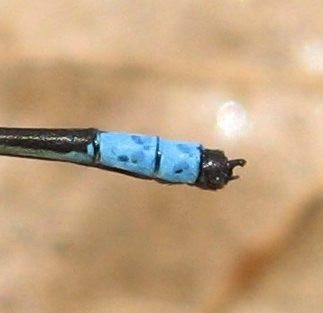
The male's terminal abdominal segments – S10 is black, and the profile of the cerci indicates this is actually sub-species Enallagma traviatum westfalli – Westfall's Slender Bluet. These relatively long appendages are visible in the field.
The female's the head and thorax are similar to the male's, with a lighter line visible along the middorsal carina.
The female's terminal abdominal segments, note the black bar on S8.
July 26th ... yes, it appears that Enallagma traviatum westfalli is here to stay and is by no means an uncommon species in Stoco Lake.
9:55 AM – two males were observed perching on the rushes growing between the culvert and the pavillion. The images of these damselflies weren't worth keeping (out of focus due to strong winds).
10:37 AM – a tandem pair photographed about ten meters to the west of the boat ramp.
10:46 AM – back near the culvert again; two mating pairs of Slender Bluets can be seen in this photo.
A portrait of one of the mating males.
The same pair of damselflies as above ... the insects were so engrossed in mating they were oblivious to external stimuli and it seemed that even a life-threatening event couldn't "bug" them. Indeed, when I captured the pair yesterday to take the closeup shots, I only picked up the male by his wings. In theory the female could have escaped, but she couldn't take flight because her mate continued holding on tight with his claspers. Now that's what I call true love ...
Later in the day I spotted another mating pair near the culvert at 2:12 PM, and a lone female at 2:15 PM. In addition Jason King encountered and photographed a mating pair at the pier, for a total count of thirteen damselflies.
July 27th ... 9:55 AM – one female Slender Bluet sighted between the pavilion and the culvert (photo below). A few minutes later at 10:05 AM I saw another female perching on the shrubbery near the pavilion. It's warm but overcast and windy so there isn't much odonate activity going on. Although the lighting could have been better at least I have an image of a female from a lateral oblique angle nicely showing all of the damselfly's identifying characteristics. Now to get a similar photo of a male.
July 28th ... overcast, windy and on the cool side, but there are plenty of dragonflies and damselflies going about their business among the rushes near the culvert. I spotted two pairs of mating Slender Bluets today around 12:00 noon. Encountering so many mating couples indicates that this species is definitely breeding in the lake.
Any species has to not only reproduce, but do so in large enough numbers to outpace attrition due to – among other life-threatening hazards – predation. One is apt to find three species of spreadings at this site, the Northern Spreadwing (Lestes disjunctus disjunctus), the Swamp Spreadwing (Lestes vigilax) and the Elegant Spreadwing (Lestes inaequalis). And it appears that Enallagma and their other small damselfy cousins are the spreadwing's favoured prey. Today I observed two instances of female Elegant Spreadwings consuming Enallagma males (not Slender Bluets in these particular cases) ...
... and in the image below a female Swamp Spreadwing is eating a teneral female Eastern Forktail.
And of course other large odes such as dragonflies aren't fussy about what they eat and will catch and dispatch whatever smaller odonate species they can overpower.
It appears that two of the Slender Bluets weren't victims of predation today, because at 2:22 PM, I encountered another mating pair perching on the rushes near the culvert. Life goes on ...
July 29th ... a mixture of sun and clouds, windy and warm. Some bad news – the town's maintenance crews have mowed the rushes near the culvert where most of the Slender Bluets have been hanging out.
No real harm done – presumably the damselflies were able to evade the mower, and this is a view of the shoreline looking southeast at emergent vegetation between the pavillion and the culvert. The flora is mostly Torrey Three-square Rush mixed with some Flowering Rush, Pickerelweed and White Water Lily.
Since I hadn't checked it out for a few days I decided to re-visit the spot marked on the map where I first encountered the mating Slender Bluets (or perhaps it would be more accurate to say that the bluets encountered me).
I wasn't disappointed ... at 10:20 AM I saw a female perching on a leaf, and not far away on another leaf was a male.
10:24 AM – a satisfactory lateral oblique view of a male Slender Bluet depicting its key identifying marks. It's possible that this might be the same damselfly that I photographed sitting on the leaf a few minutes ago. However, not long after taking this photo I spotted a different male between the "first encounter" tree and the culvert; that makes for a count of three individual Slender Bluets this morning. Note the cerci, relatively long compared to other local bluet species and quite noticable in the field.
Having obtained acceptable images of a male, female and mating pair of Westfall's Slender Bluets, as a rule it would be time to move on to another topic. However, as far as I can ascertain these damselflies aren't supposed to range within about 250 km of Stoco Lake, so I'm going to keep an eye on them for a while ...