Showing posts with label Flower Crab Spider. Show all posts

Friday, July 27, 2012

It only took about 300 million years ...

... for the forces of natural selection to produce spiders. Silk-producing arachnids go back even farther (nearly 390 million years), and chelicerates – distant cousins of spiders – were among the first animals to leave the sea and conquer dry land. Of the roughly 40,000 species of spiders in the world about 5,000 belong to the family Salticidae, the jumping spiders.

Jumpers are fun spiders to watch. Unlike the orb weavers which simply hang in the middle of a web waiting for a meal to come to them, jumping spiders actively hunt for their dinner – they almost seem to have character. The sturdy female spider in the next two pictures is a Phidippus whitmani. A photo of a male, which is a striking bright red rather than brown, would have brightened up the color scheme.


The average Phidippus clarus in my area also tends to be a rusty brown but this summer I was lucky and stumbled across several males that were a beautiful red. It's tough to get a dorsal shot of that abdomen, as jumping spiders have a habit of facing toward the camera, aiming those arresting anterior median eyes at whatever they perceive to be a threat. See what I mean about character?


Phidippus clarus is a good sized jumping spider about 10 mm long, my finger to the left in the photo gives a sense of scale.


A male Marpissa formosa basking on the rocks along the river shoreline, also about 10 mm in length but elongated and lean rather than robust.


I was at unable to identify the male spider in the following three images. Despite its length of 6 mm and the shape of the carapace being completely wrong, I nevertheless – tentatively, reluctantly, unhappily – called it a "crab spider" (male crab spiders are tiny, much smaller than 6 mm). This diagnosis was less than satisfactory so I submitted the images to the always helpful people at BugGuide.Net, and it turns out that my "crab spider" is an old friend ...


... Araneus trifolium, the Shamrock Orbweaver. (The little red hitchhiker on the spider's abdomen is a parasitic larval mite, family Erythraeidae.) As is often the case with spiders the male is much smaller than the female, the old girl in the photo below is a good 25 mm in length, and gravid, ready to lay eggs any time. Talk about sexual dimorphism ... looking at these two spiders, who would guess that they were the same species?

This is a white form female, and if the difference between the male and female aren't enough to cause confusion, female Shamrock Orbweavers, a.k.a Pumpkin Spiders, come in an awesome array of colors!


Whilst they don't come in a baffling variety of tints and hues, Flower Crab Spiders such as Misumena vatia can change their color from yellow to white in order to match the color of the flower they are lurking on. Obviously the Flower Scarab (genus Trichiotinus, itself an accomplished bee mimic) is unaware of how perilously close it is to its possible demise ...


Although many species of wasps are parasitoids of spiders, the Thread-waisted Wasp (Ammophila sp.) provisions its larvae with caterpillars and this wasp was simply stopping at these False Solomon's Seal blossoms for drink of nectar, not hunting the spider as a potential source of nourishment for its young.

But Flower Crab Spiders blend into the background so well they are virtually invisible, nature seldom forgives errors in judgement, and unlike the Flower Scarab this wasp wasn't so lucky. The Thread-waisted Wasp won't be passing on its genes to the next generation, the Flower Crab Spider might – if it survives the hazards and vicissitudes of an uncertain life – and who knows ... her descendants may still be around in another 300 million years.

Friday, June 1, 2012

Hanging by a Thread

Identifying a spider to the species level based on its colors and markings from just a photograph can be difficult or impossible, even for an expert. It's pretty safe to say this glossy female, about 15 mm long, is a Foliate Orbweaver (Larinioides cornutus). She looks like she's gravid and ready to lay eggs any time soon.


There's enough detail in the next image to see the eye pattern and determine that the spider is a Ground Crab Spider, genus Xysticus. And it looks like she's bagged another Ground Crab Spider, perhaps a different species, or maybe a younger version of her own kind.


This female is about 8 mm in length. Size and the patterning on the abdomen suggest Xysticus punctatus, but without having captured the spider and examined its anatomy in detail, its impossible to say for sure.


The best we can say for certain as to the identity of this tiny spider, only a few millimeters long, is subfamily Erigoninae (Dwarf Spiders). The webs these little spiders were weaving looked more like something an Orb Weaver would make rather than the typical sheetweb. This is strictly guesswork because there are a few look-alikes in this group – the closest match in terms of species seems to be Hypselistes florens. Finding a mating pair would go a long way toward confirming this hypothesis because the males are very distinctive ... photo of Hypselistes florens by Tom Murray at BugGuide.Net.


A mug shot of a male Long-jawed Orb Weaver, genus Tetragnatha. The name "long-jawed" sort of fits, doesn't it?


A pair of mating Long-jawed Orb Weavers – the male and female have locked those impressively toothed jaws. Presumably the purpose of this to restrain the female, as spiders are born predators and her hair-trigger killer instincts impel her to eat her prospective mate.


The same two spiders after they've separated. This is the male, and he was in a hurry to disengage after mating but having difficulty doing so. Was this due to the spider's teeth and jaws being entangled, or because the female was trying to attack the male?


The more robust female.


Sexual dimporphism in spiders can be pretty dramatic, as demonstrated by these female and male Flower Crab Spiders (Misumena vatia), the much larger female is eating a Soldier Fly. When I first encountered these two, the male was on top of the flower. When he moved underneath to avoid me, this happened ...

There might be a mating in the offing but the female sure didn't seem to like what was happening and she was trying to brush the male off of her backside with her hind legs. Considering the difference in size it's lucky for the diminutive male that his prospective mate was preoccupied with her dinner, because otherwise his life might indeed be hanging by a thread.

Friday, May 27, 2011

Some Small Spiders

Relatively small, compared to some heavyweights such as the Dark Fishing Spider.

This is an Elegant Crab Spider (Xysticus elegans). Not uncommon, but often overlooked due to their cryptic coloration, small size – this one is about 5 mm long, and their habit of staying low and living near the ground.

As often happens in nature, a predator has itself become prey. This female Elegant Crab Spider has captured a predacious Carabid beetle.


Robber flies are fearsome hunters in their own right but this one has been captured by a Jumping Spider. Despite the distinctive markings on the abdomen I haven't been able to get a better I.D. on this spider than possibly Phidippus clarus.

This unknown spider at BugGuide.Net looks the same but there's no consensus as to species. To make life a little more complicated ... Phidippus clarus can have different color forms, and it's also possible that my photos are of an immature specimen, which can look very different from an adult.

There seem to be dozens of different kinds of jumping spiders lurking on the vegetation. I don't know what this robust little female is either.


Insects aren't the only arthropods that have fatal encounters with spiders, sometimes it's other spiders. The large pale spider is about 10 mm long. It's a Slender Crab Spider (Tibellus sp.), and this time a Jumping Spider's turn to play the role of the hunted.


A Flower Crab Spider (Misumena vatia) lurks on vetch.

The spider's patience has paid off. Though larger and possessing a stinger the bumblebee never had a chance, as the venom of these crab spiders is specifically toxic to bees.


Excluding its legs this Long-jawed Orb Weaver (Tetragnatha sp.) is about 15 mm long and can easily mistaken for a grass seed when at rest.

This mug shot is about the best detail possible with a subject so small (good lighting really helps!). The appellation "long jawed" certainly fits. Note what looks like globules on the ends of stalks: this spider is a male and the balls are sperm packets on the ends of its pedipalps. (The pedipalps are the two "feelers" at the front of a spider – they are not true legs).


Most orb weavers spin a new web daily, abandoning the old one. Almost invisible, these webs often entangle unwary victims such as this Four-spotted Skimmer.


The following three images were acquired indoors under poor lighting so they can't do justice to the eye-catching color scheme of this female cobweb spider. It's about 5 mm long, and the abdomen is black with silver markings. This is (probably) a Triangulate Cobweb Spider (Steatoda triangulosa). A welcome guest in many homes, as it is known to prey on fire ants, ticks, and spiders whose bite is harmful to humans such as the Hobo Spider and the Brown Recluse. With the exception of ticks none of these other arthropods are extant in this area, so a wasp moth will do for lunch ...


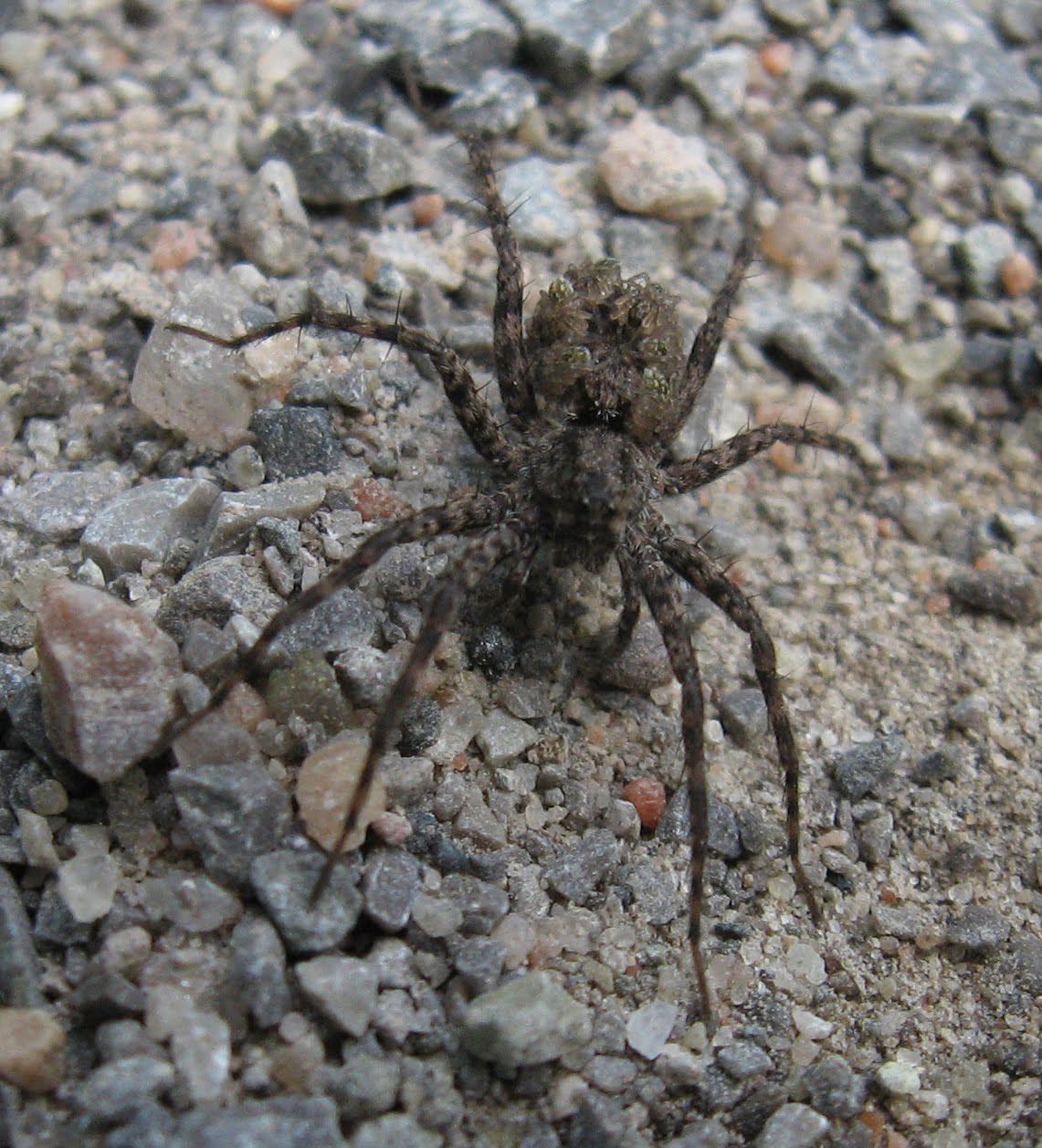
As I was taking photos of this Wolf Spider (Lycosa sp?) it seemed like something looked wrong with its abdomen. Zooming in on the image later showed what was amiss ... this is a mother spider with her young hitching a ride on her back. They will stay with her for a few weeks until they are old enough to fend for themselves. Small spiders indeed ...

Wednesday, June 2, 2010

What's for Lunch?

Depends on what you are. Butterflies imbibe their nutrients through a straw-like proboscis.


While they are generally thought of as insects that sip nectar from flowers, butterflies can often be observed drinking from ... in fact, having a preference for ... mud, sap, bird droppings, manure, urine, rotting fruit or well aged carcasses. This is how they obtain vital salts, minerals and amino acids.

These Eastern Tiger Swallowtails (Papilio glaucus) were feeding at freshly watered compost on the garden. The two butterflies were frequently jockeying for position to get at the same morsel.


A White Admiral (Limenitis arthemis arthemis) stopping to sip at a damp spot on the Eastern Ontario Trail. Having one for the road, so to speak?


A Baltimore Checkerspot (Euphydryas phaeton) engaging in the same behaviour a short distance further up the trail.

Ventral view of the Baltimore Checkerspot


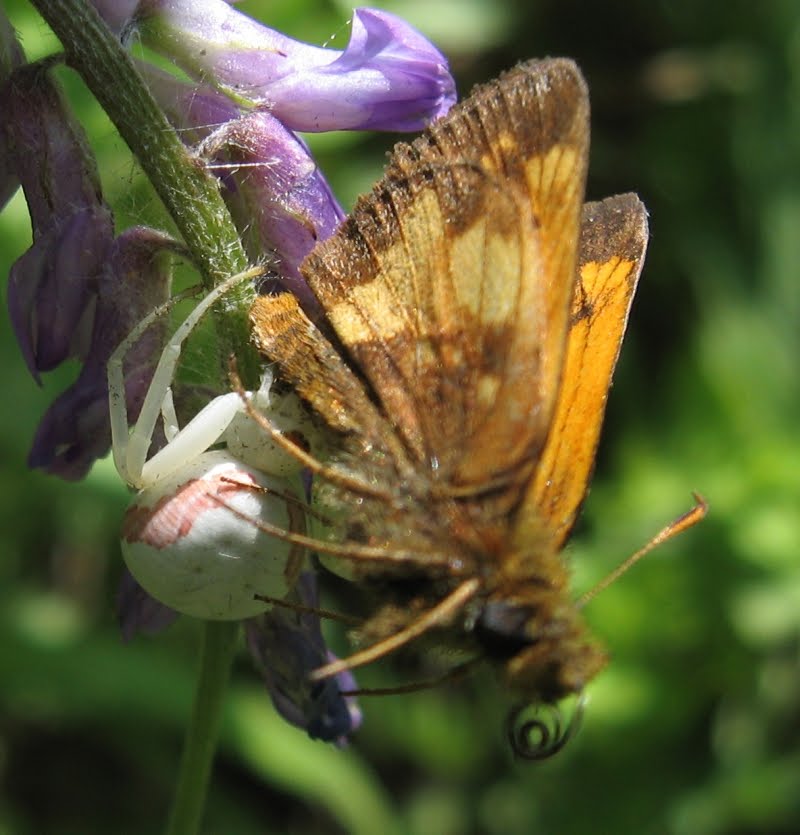
This hapless Hobomok Skipper (Poanes hobomok) stopped to nectar at a Purple Vetch, placed its proboscis where it shouldn't have, and has itself become dinner for a Flower Crab Spider (Misumena vatia). These spiders are able to change their color to yellow or white in order to blend into the background of the flower on which they are lurking.


As often happens the hunter becomes the hunted. Things were moving fast so I couldn't get good closeups of this wasp dragging a paralysed orb weaver to its burrow, where the spider will provide nourishment for the wasp's larva. As yet I haven't been able to identify the wasp, but I should be able to narrow it down in time. There are many different species of spider wasp and they don't prey indiscriminately on any spider, each has its own host species. This wasp would be adapted to instinctively avoid getting entagled in an orb weaver's web.


I found the orb weaver itself interesting, as there aren't that many green spiders around and I couldn't recall having seen one quite like this. I did some Googling and it looks like this spider is a Giant Lichen Orbweaver (Araneus bicentenarius). The spider in my photo would easily fit on the nail of my pinky finger but according to the author linked to above the adult female is the size of a golf ball.


Lunch for the larva of a Beewolf (Philanthus sp.) is the bee in the female's grasp. The Beewolf settled on a stepping stone in the garden for a few seconds to oviposit on the unfortunate host bee.


For a damselfly lunch is a smaller insect. There isn't enough left over to tell what the Stream Bluet (Enallagma exsulans) is eating ...

... but this Marsh Bluet (Enallagma ebrium) is chowing down on a seed bug. The bug wasn't captured on the wing, the bluet pounced on it while it was resting on the blade of grass seen in the photo.

This takes first prize: how to get a perfect meal and simultaneously eliminate a potential younger competitor from the gene pool. A mature female Eastern Forktail (Ischnura verticalis) consuming an immature female of her own species. You are what you eat ...