These damselflies are commonly encountered at the marsh bordering the Eastern Ontario Trail, about one kilometer west of town. The Northern Spreadwing (Lestes disjunctus disjunctus) below is an immature male, just beginning to develop pruinosity at the tip of its abdomen. The eyes will also turn blue with increasing age.
A small, slightly built spreadwing with a length of about 35 mm, males of this species may be confused with male Sweetflag Spreadwings (Lestes forcipatus). The relatively short, rounded hamule is visible in the lateral view. And although it's not the final word as to species, in this area the colors on the thoraxes of male Common Spreadwings tend to be less obscured by pruinosity than the colors of male Sweetflag Spreadwings.


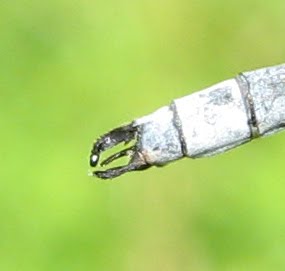
Details of the terminal abdominal segments (two different individuals than depicted above). The sharp apical hood can be seen in the first image. The space between the basal tooth and the large distal tooth is small, and the paraprocts look correct for a Northern Spreadwing (Lestes disjunctus disjunctus).

Claspers of another male; note the large sharp distal tooth

An older male Northern Spreadwing (Lestes disjunctus disjunctus). In this area Northern Spreadwing males generally have less pruinosity on the thorax than Sweetflag Spreadwings; the middorsal carina and shoulder stripes are visible. (Compare my photos to this image published by the University of Puget Sound).


Oblique view of cerci; note the prominent sharp distal tooth.

Images of a young female Northern Spreadwing (Lestes disjunctus disjunctus). Visible in the lateral view are the relatively small light-rimmed ovipositor and yellow sides of the thorax which differentiates this damselfly from the female Sweetflag Spreadwing. These criteria aren't a hundred percent reliable, difficult to see in the field, and females of other spreadwing species are also similar at first glance in any event. The best thing is to observe a mating pair.


And there we have it ... a tandem pair of Lestes disjunctus disjunctus. The male's hamule, and female's ovipositor and distinctly yellow sides, are visible in the field and confirm the species. Note the claspers gripping the female behind the head.

Found in the same habitat, its shoulder stripes clouded by pruinosity, to the unaided eye this 35 to 40 mm long damselfly looks like it might be a mature male Northern Spreadwing. But maybe we should have a closer look ...


The blunt distal tooth appears shorter than the basal tooth in the detail view of the terminal abdominal segments, and the paraprocts look correct for a Sweetflag Spreadwing (Lestes forcipatus). The apical hood appears wider than that of the Northern Spreadwing depicted above. Based on the amount of detail visible in these images the damselfly could be a Southern Spreadwing (Lestes disjunctus australis), but according to currently published range maps this species is not extant in this area.
The pruinosity seen in my photos of the Northern Spreadwing and Sweetflag Spreadwing agrees with this image published by the University of Puget Sound. But pruinosity alone isn't sufficient; save for their greater length, mature male Swamp Spreadwings with obscured colors appear the same at a glance as the damselfly above. Spreadwings can be difficult to identify and the detail and clarity possible with the camera I'm using leaves much to be desired. Tandem pairs and a lateral closeup of the hamule are needed before I'm one hundred percent certain as to the species.

Lateral view of a different male. The hamule looks relatively large; compare this photo to the image of the Northern Spreadwing.

Oblique views of the terminal abdominal segments. The distal tooth is small and blunt, the width of the apical hood is clearly visible in the first image. Also note the long span between the basal tooth and distal tooth; compare this to the space between the teeth on the cerci of a Northern Spreadwing.


Images of a female ... the ovipositor is dark along the rim but I would expect it to be longer for Lestes forcipatus; this is a female Slender Spreadwing (Lestes rectangularis).


Detail of the ovipositor

The dark rimmed ovipositor appears larger in this lateral view of another female; this looks more like Lestes forcipatus.

This is the opportunity I've been watching for ... a mating pair of damselflies. Especially note the second image, a more detailed lateral view. The female's large dark-rimmed ovipositor leaves no doubt as to the species; these insects are Sweetflag Spreadwings (Lestes forcipatus).


Another mating pair of Sweetflag Spreadwings (Lestes forcipatus) in the wheel position, again, note the female's ovipositor. The placement of the male's claspers as he grips the female's thorax is visible in this image.

An oblique detail view of the claspers holding female.


