Showing posts with label Ground Crab Spider. Show all posts

Friday, June 1, 2012

Hanging by a Thread

Identifying a spider to the species level based on its colors and markings from just a photograph can be difficult or impossible, even for an expert. It's pretty safe to say this glossy female, about 15 mm long, is a Foliate Orbweaver (Larinioides cornutus). She looks like she's gravid and ready to lay eggs any time soon.


There's enough detail in the next image to see the eye pattern and determine that the spider is a Ground Crab Spider, genus Xysticus. And it looks like she's bagged another Ground Crab Spider, perhaps a different species, or maybe a younger version of her own kind.


This female is about 8 mm in length. Size and the patterning on the abdomen suggest Xysticus punctatus, but without having captured the spider and examined its anatomy in detail, its impossible to say for sure.


The best we can say for certain as to the identity of this tiny spider, only a few millimeters long, is subfamily Erigoninae (Dwarf Spiders). The webs these little spiders were weaving looked more like something an Orb Weaver would make rather than the typical sheetweb. This is strictly guesswork because there are a few look-alikes in this group – the closest match in terms of species seems to be Hypselistes florens. Finding a mating pair would go a long way toward confirming this hypothesis because the males are very distinctive ... photo of Hypselistes florens by Tom Murray at BugGuide.Net.


A mug shot of a male Long-jawed Orb Weaver, genus Tetragnatha. The name "long-jawed" sort of fits, doesn't it?


A pair of mating Long-jawed Orb Weavers – the male and female have locked those impressively toothed jaws. Presumably the purpose of this to restrain the female, as spiders are born predators and her hair-trigger killer instincts impel her to eat her prospective mate.


The same two spiders after they've separated. This is the male, and he was in a hurry to disengage after mating but having difficulty doing so. Was this due to the spider's teeth and jaws being entangled, or because the female was trying to attack the male?


The more robust female.


Sexual dimporphism in spiders can be pretty dramatic, as demonstrated by these female and male Flower Crab Spiders (Misumena vatia), the much larger female is eating a Soldier Fly. When I first encountered these two, the male was on top of the flower. When he moved underneath to avoid me, this happened ...

There might be a mating in the offing but the female sure didn't seem to like what was happening and she was trying to brush the male off of her backside with her hind legs. Considering the difference in size it's lucky for the diminutive male that his prospective mate was preoccupied with her dinner, because otherwise his life might indeed be hanging by a thread.

Friday, May 25, 2012

Tmarus angulatus and Xysticus alboniger

This is definitely one of the funkiest spiders I've ever chanced upon – it's a Crab Spider, genus Tmarus, and according to the distribution given for this species at BugGuide.Net, it's probably Tmarus angulatus.


A dorsal view of the spider – this is a female, and she's about 8 mm long.


Nice camouflage ... the spider's size, shape, color and posture all conspire to make it resemble a sedge flowerhead.


A shot of the spider's abdomen and spinnerets.


Ventral views of Tmarus angulatus.


It's been a good couple of days for finding "new" species of spiders, but I was lucky indeed to spot this lttle male Ground Crab Spider – Xysticus alboniger – as he's only about 3 mm in length.

Friday, May 27, 2011

Some Small Spiders

Relatively small, compared to some heavyweights such as the Dark Fishing Spider.

This is an Elegant Crab Spider (Xysticus elegans). Not uncommon, but often overlooked due to their cryptic coloration, small size – this one is about 5 mm long, and their habit of staying low and living near the ground.

As often happens in nature, a predator has itself become prey. This female Elegant Crab Spider has captured a predacious Carabid beetle.


Robber flies are fearsome hunters in their own right but this one has been captured by a Jumping Spider. Despite the distinctive markings on the abdomen I haven't been able to get a better I.D. on this spider than possibly Phidippus clarus.

This unknown spider at BugGuide.Net looks the same but there's no consensus as to species. To make life a little more complicated ... Phidippus clarus can have different color forms, and it's also possible that my photos are of an immature specimen, which can look very different from an adult.

There seem to be dozens of different kinds of jumping spiders lurking on the vegetation. I don't know what this robust little female is either.


Insects aren't the only arthropods that have fatal encounters with spiders, sometimes it's other spiders. The large pale spider is about 10 mm long. It's a Slender Crab Spider (Tibellus sp.), and this time a Jumping Spider's turn to play the role of the hunted.


A Flower Crab Spider (Misumena vatia) lurks on vetch.

The spider's patience has paid off. Though larger and possessing a stinger the bumblebee never had a chance, as the venom of these crab spiders is specifically toxic to bees.


Excluding its legs this Long-jawed Orb Weaver (Tetragnatha sp.) is about 15 mm long and can easily mistaken for a grass seed when at rest.

This mug shot is about the best detail possible with a subject so small (good lighting really helps!). The appellation "long jawed" certainly fits. Note what looks like globules on the ends of stalks: this spider is a male and the balls are sperm packets on the ends of its pedipalps. (The pedipalps are the two "feelers" at the front of a spider – they are not true legs).


Most orb weavers spin a new web daily, abandoning the old one. Almost invisible, these webs often entangle unwary victims such as this Four-spotted Skimmer.


The following three images were acquired indoors under poor lighting so they can't do justice to the eye-catching color scheme of this female cobweb spider. It's about 5 mm long, and the abdomen is black with silver markings. This is (probably) a Triangulate Cobweb Spider (Steatoda triangulosa). A welcome guest in many homes, as it is known to prey on fire ants, ticks, and spiders whose bite is harmful to humans such as the Hobo Spider and the Brown Recluse. With the exception of ticks none of these other arthropods are extant in this area, so a wasp moth will do for lunch ...


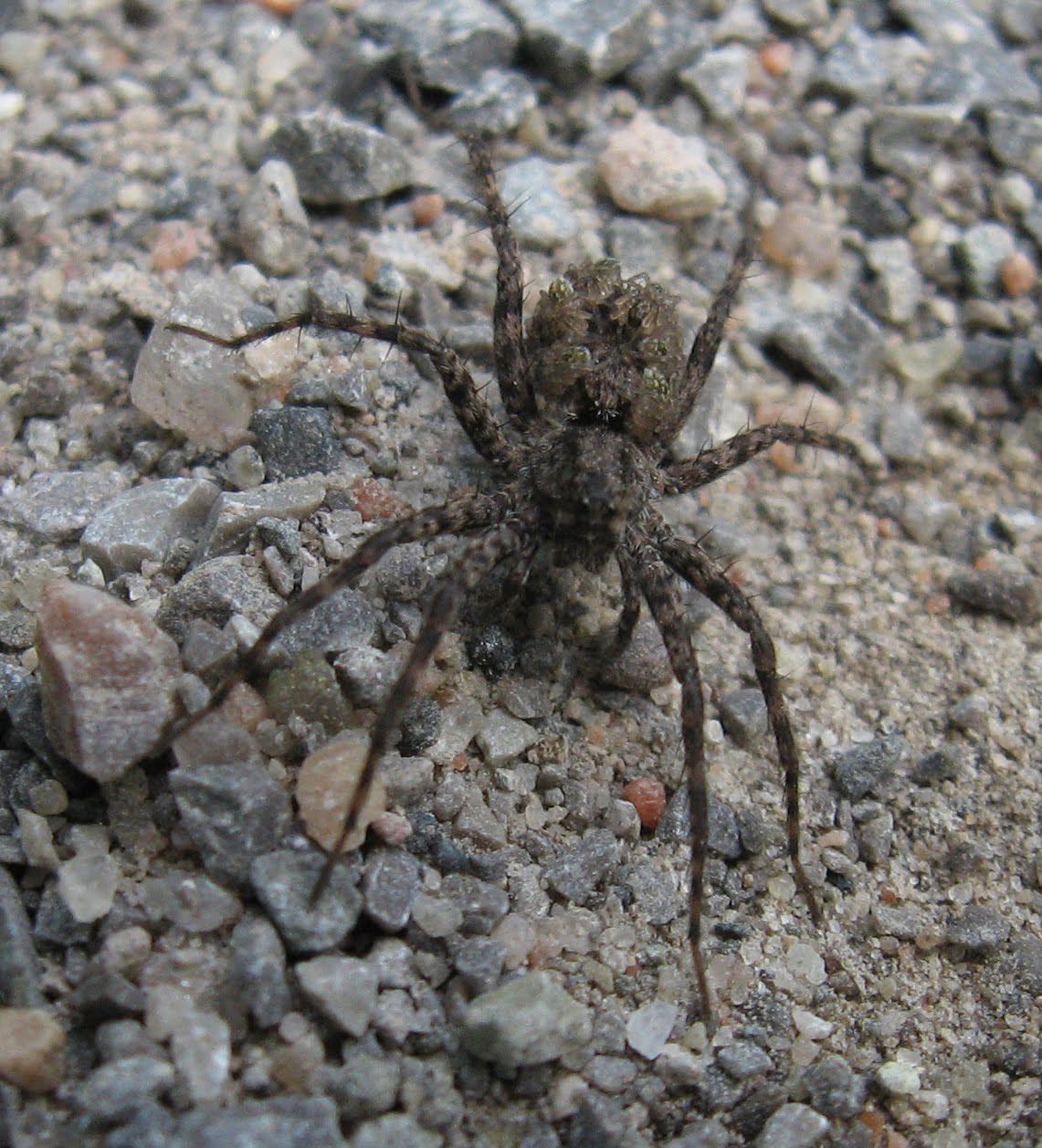
As I was taking photos of this Wolf Spider (Lycosa sp?) it seemed like something looked wrong with its abdomen. Zooming in on the image later showed what was amiss ... this is a mother spider with her young hitching a ride on her back. They will stay with her for a few weeks until they are old enough to fend for themselves. Small spiders indeed ...

Saturday, August 21, 2010

Spider Snapshots

Several species of jumping spiders (family Salticidae) are extant in our area. The spider in the following four images is a female Bold Jumper (Phidippus audax), about 15 to 20 mm long. The three white (less frequently red, or orange as in this specimen) spots on the abdomen and iridescent blue-green chelicerae are typical field marks. Juveniles often sport orange spots.

Bold Jumpers come by their name honestly as they have been known to leap at photographers who have approached too closely. This spider was obviously feeling threatened by my presence.


There isn't enough detail in the next two images to determine if this is Eris flava or Eris militaris. For anyone interested here's a link to more information at BugGuide.Net. (EDIT: one year later, and lot more research ... I now believe this jumper is more likely genus Pelegrina).

I'm not sure as to the identity of the less vividly marked jumping spider in the next two images.


No collection of jumping spider images would be complete without the including photos of the ubiquitous Zebra Jumper (Salticus scenicus).


Sparking up the color scheme a bit: a female Black and Yellow Garden Spider (Argiope aurantiae) that has nabbed a paper wasp.

The following image is out of focus because the spider is shaking its web, and by no small amount, the spider was displaced by about two inches. I've observed this reaction in other orb weavers if they are approached too closely for their comfort. Is the purpose of this to make the spider a more difficult target for a potential predator?


Six-spotted Fishing Spiders (Dolomedes triton) are common along the north shore of Stoco Lake. The female in the image below is about 20 mm long. In the complex tangled web of life even large predators are not invulnerable; a smaller immature spider of this species has been captured by the Blue Black Spider Wasp (Anoplius sp.) in Life's a Beach.

As a rule Fishing Spiders are found on the shoreline or floating water plants. This is the first time I've seen one was making a web in the vegetation a few feet off the ground. The spider assumed this posture whenever I brought the camera up close.


Many species of Hymenoptera are parasites of spiders, but when I turned over a stepping stone in the garden I chanced across a scene where the tables were turned and found a Wolf Spider (Lycosa sp.) with an unlucky ant in its grasp.


Gardens host a variety of spider species; the spiders are attracted to the insects nectaring on the flowers. A Ground Crab Spider, probably Xysticus sp., assumes its characteristic ambush pose on an iris leaf.