Showing posts with label Stream Bluet. Show all posts

Tuesday, August 13, 2013

An Instance of Mistaken Identity

Stream Bluet (Enallagma exsulans), female – this specimen was so aberrantly marked and colored compared to the norm for this area that I mistook it for a female Double-striped Bluet. The postocular spots are very small, the paler stripes within the middorsal carina and humeral stripe are quite pronounced, and the "W" on S9 is relatively elongated.


The lines on the middorsal carina and humeral stripes of local female Stream Bluets I've encountered in the past few years are barely visible. And the "W"-shaped spots on their ninth abdominal segments generally look exactly like a "W"; the next two images illustrate a couple of variations.


However, were this a Double-striped Bluet it would be hundreds of kilometers from home. Not impossible, as I recently found a group of Slender Bluets breeding in Stoco Lake. But the habitat is also be wrong – I found this damselfly along the Moira River where the water runs fast and the bottom is rocky, ideal Stream Bluet territory. Double-striped Bluets prefer ponds and lakes, or the slower portions of streams and rivers. And having researched images of other female Stream Bluets on the Internet and obtained some second opinions (at BugGuide.Net) the conclusion is – yes, this is indeed a Stream Bluet.

Alhough it would have been exciting to have stumbled upon another odonate species outside of its historical range, I would never in any event accept this as a Double-striped Bluet sighting without checking the mesostigmal plates or seeing and/or photographing a male or a mating pair.

Wednesday, June 2, 2010

What's for Lunch?

Depends on what you are. Butterflies imbibe their nutrients through a straw-like proboscis.


While they are generally thought of as insects that sip nectar from flowers, butterflies can often be observed drinking from ... in fact, having a preference for ... mud, sap, bird droppings, manure, urine, rotting fruit or well aged carcasses. This is how they obtain vital salts, minerals and amino acids.

These Eastern Tiger Swallowtails (Papilio glaucus) were feeding at freshly watered compost on the garden. The two butterflies were frequently jockeying for position to get at the same morsel.


A White Admiral (Limenitis arthemis arthemis) stopping to sip at a damp spot on the Eastern Ontario Trail. Having one for the road, so to speak?


A Baltimore Checkerspot (Euphydryas phaeton) engaging in the same behaviour a short distance further up the trail.

Ventral view of the Baltimore Checkerspot


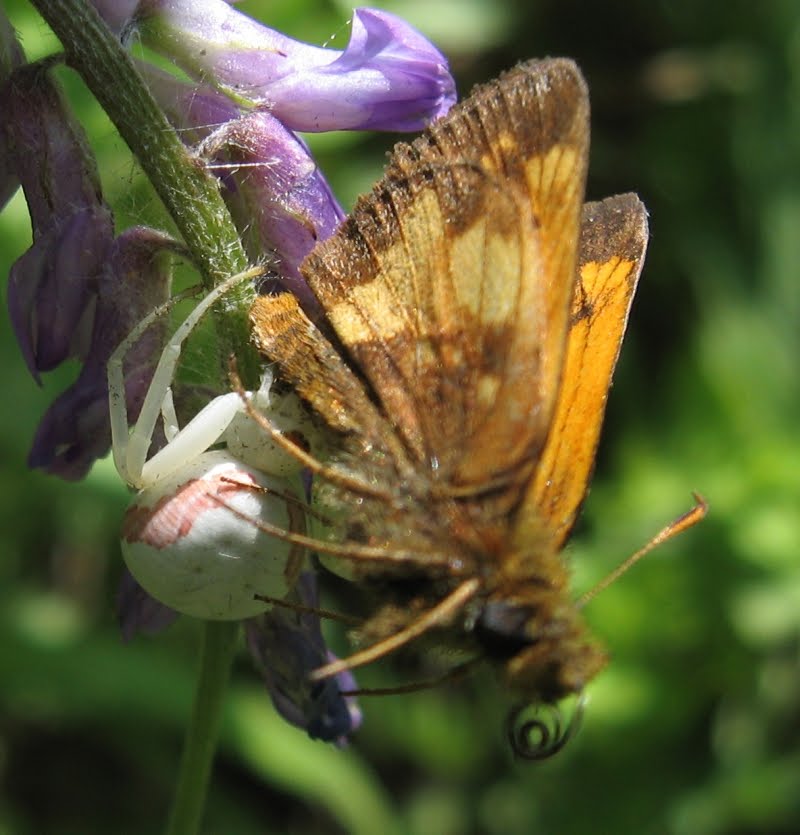
This hapless Hobomok Skipper (Poanes hobomok) stopped to nectar at a Purple Vetch, placed its proboscis where it shouldn't have, and has itself become dinner for a Flower Crab Spider (Misumena vatia). These spiders are able to change their color to yellow or white in order to blend into the background of the flower on which they are lurking.


As often happens the hunter becomes the hunted. Things were moving fast so I couldn't get good closeups of this wasp dragging a paralysed orb weaver to its burrow, where the spider will provide nourishment for the wasp's larva. As yet I haven't been able to identify the wasp, but I should be able to narrow it down in time. There are many different species of spider wasp and they don't prey indiscriminately on any spider, each has its own host species. This wasp would be adapted to instinctively avoid getting entagled in an orb weaver's web.


I found the orb weaver itself interesting, as there aren't that many green spiders around and I couldn't recall having seen one quite like this. I did some Googling and it looks like this spider is a Giant Lichen Orbweaver (Araneus bicentenarius). The spider in my photo would easily fit on the nail of my pinky finger but according to the author linked to above the adult female is the size of a golf ball.


Lunch for the larva of a Beewolf (Philanthus sp.) is the bee in the female's grasp. The Beewolf settled on a stepping stone in the garden for a few seconds to oviposit on the unfortunate host bee.


For a damselfly lunch is a smaller insect. There isn't enough left over to tell what the Stream Bluet (Enallagma exsulans) is eating ...

... but this Marsh Bluet (Enallagma ebrium) is chowing down on a seed bug. The bug wasn't captured on the wing, the bluet pounced on it while it was resting on the blade of grass seen in the photo.

This takes first prize: how to get a perfect meal and simultaneously eliminate a potential younger competitor from the gene pool. A mature female Eastern Forktail (Ischnura verticalis) consuming an immature female of her own species. You are what you eat ...

Friday, July 31, 2009

A Few Photos of some Common Damselflies

Most of the damselflies and dragonflies in this blog were identified with the help of the Field Guide to The Dragonflies and Damselflies of Algonquin Provincial Park and the Surrounding Area. This book is a must have reference for the serious naturalist. It covers the Odonata apt to be found in southern Ontario and the illustrations and species accounts are excellent.

The first group of pictures are Pond Damselflies, family (Coenagrionidae).

Violet Dancer (Argia fumipennis violacea), males and female. It's impossible to mistake the males for any other local species.


Powdered Dancer (Argia moesta), male


Stream Bluet (Enallagma exsulans), male, and a mating pair


Skimming Bluet (Enallagma geminatum), males and females


A couple of shots of a male Tule Bluet (Enallagma carunculatum) ...


... and a female Tule Bluet


Tule Bluets mating, in the second photo the pair are just disengaging from the "wheel" or "heart" position.


... and a male Familiar Bluet (Enallagma civile)


The ubiquitous Eastern Forktail (Ischnura verticalis) ... male, immature female, mature female and a mating pair


Fragile Forktail (Ischnura posita), male


A male Slender Spreadwing (Lestes rectangularis); the long, thin abdomen and lack of pruinosity on the last segments are diagnostic. This damselfly is a member of the family Lestidae, the Spread-wing damselflies, which typically hold their wings at about 45° to their body rather than folded together in the manner of pond damsels.


Without a clear photo or study of the male's claspers I stuck my neck out and originally misidentified the following specimen as a Northern Spreadwing (Lestes disjunctus).


The male above is an older specimen with a considerable amount of pruinosity hiding any identifying marks. Moreover, the final arbiter of damselfly species are the male's claspers or female's mesostigmal plates and/or the structure of the ovipositor. It seemed like a good idea to go back and take a closer look. The photo below is another male spreadwing (yes, I'm assuming the same species as above on the basis of appearance but I think it's reasonable to do so). Closeups of this damselfly's claspers are depicted in the succeeding two images. Note how the bottom claspers are very thin; this suggests a Swamp Spreadwing (Lestes vigilax), as per the Field Guide to The Dragonflies and Damselflies of Algonquin Provincial Park and the Surrounding Area. And if I zoom in on the upper claspers, the teeth match the drawings shown in the book for this species.


It seemed like an even better idea to follow correct scientific procedure, capture a specimen, and examine the claspers in more detail in the field. I think the damselfly below is young Swamp Spreadwing male: the colors on the thorax and abdomen are visible and match those in the color drawing in the field guide. More importantly, note the claspers ... I took closeups from several different angles. The upper and lower claspers are the same as on the spreadwings in the images above and as depicted in the book. So despite the fact that the two damselflies look quite different, I can only conclude they are the same species.


The next three photos depict a female (note the ovipositor) Spotted Spreadwing (Lestes congener). This time it's safer to go by general appearances, this is the only spreadwing species with two spots on the side of the thorax.


Three views of a male Spotted Spreadwing (Lestes congener). This damselfly had a few preferred perches on the shoreline grasses and despite its relatively small size (about 35 mm) it was surprisingly aggressive with regard to defending its turf. It took on all comers, not only damselflies of other species larger than itself but even intercepting and chasing a White-faced Meadowhawk that had the temerity to approach too closely.

Dorsal and ventral views of the Spotted Spreadwing's claspers.