Showing posts with label Teneral Damselfly. Show all posts

Saturday, May 21, 2011

Aurora Damsel (Chromagrion conditum)

Early season odonates are becoming a more frequent sight with each passing day. Teneral Four-spotted Skimmers and Whitefaces (probably Frosted Whitefaces) are abundant at the wetlands bordering the Eastern Ontario Trail.

Today I got a surprise: this teneral damselfly was looking for a safe place to rest and decided to perch on my hand. The camera was on "Auto" and I couldn't change the settings with only one hand so the image is a bit out of focus.

Although the colors and markings are still pale this is clearly a female Aurora Damsel (Chromagrion conditum) – the yellow area on the side of the thorax is diagnostic. At roughly 35 mm this damselfly is longer than the more commonly seen Enallagma bluets.

The wavy dark patch on the dorsal surface of the thorax is also characteristic of this species, as is the absence of shoulder stripes and postocular spots.


This male was encountered about a month later at a marsh on the Marlbank Road, just east of VanderWey Ct. Although members of the pond damselfly family, Aurora Damsels have a habit of holding their wings open at an angle in the manner of spreadwings when resting.

Friday, August 13, 2010

Bug eggs on Purple Loosestrife, and other random insect encounters

This clutch of unusual eggs and small insects (?) on a Purple Loosestrife leaf was found along the Eastern Ontario Trail. Inspection with a low power magnifying glass showed that the little red-and-black objects were indeed insects, true bug (Heteroptera) nymphs, and my first thought was that this might be a species introduced to control the unwelcome plants.

Not so. It seems the momma bug is likely a Spined Soldier Bug, or a related species, and used the leaf for convenience and not as a future food source for her offspring. Here's a link to further reading at BugGuide.Net, and searching for "spined soldier bug eggs" at Google Images will return more photos.


Always look twice ... a misplaced patch of brown on a Box Elder (a.k.a. Manitoba Maple) leaf turned out to be the eggs of a Boxelder Bug upon closer inspection. A big thank you to Laurie Campbell of Campbell's One Stop in Tweed for the use of her digital microscope which made it possible to capture the images in such detail. There are also some good photos of Box Elder Bugs ovipositing at Seabrooke Leckie's The Marvelous in Nature.


With a length of only about 5 mm and cryptically colored, this tiny treehopper, Acutalis brunnea, is easy to overlook.


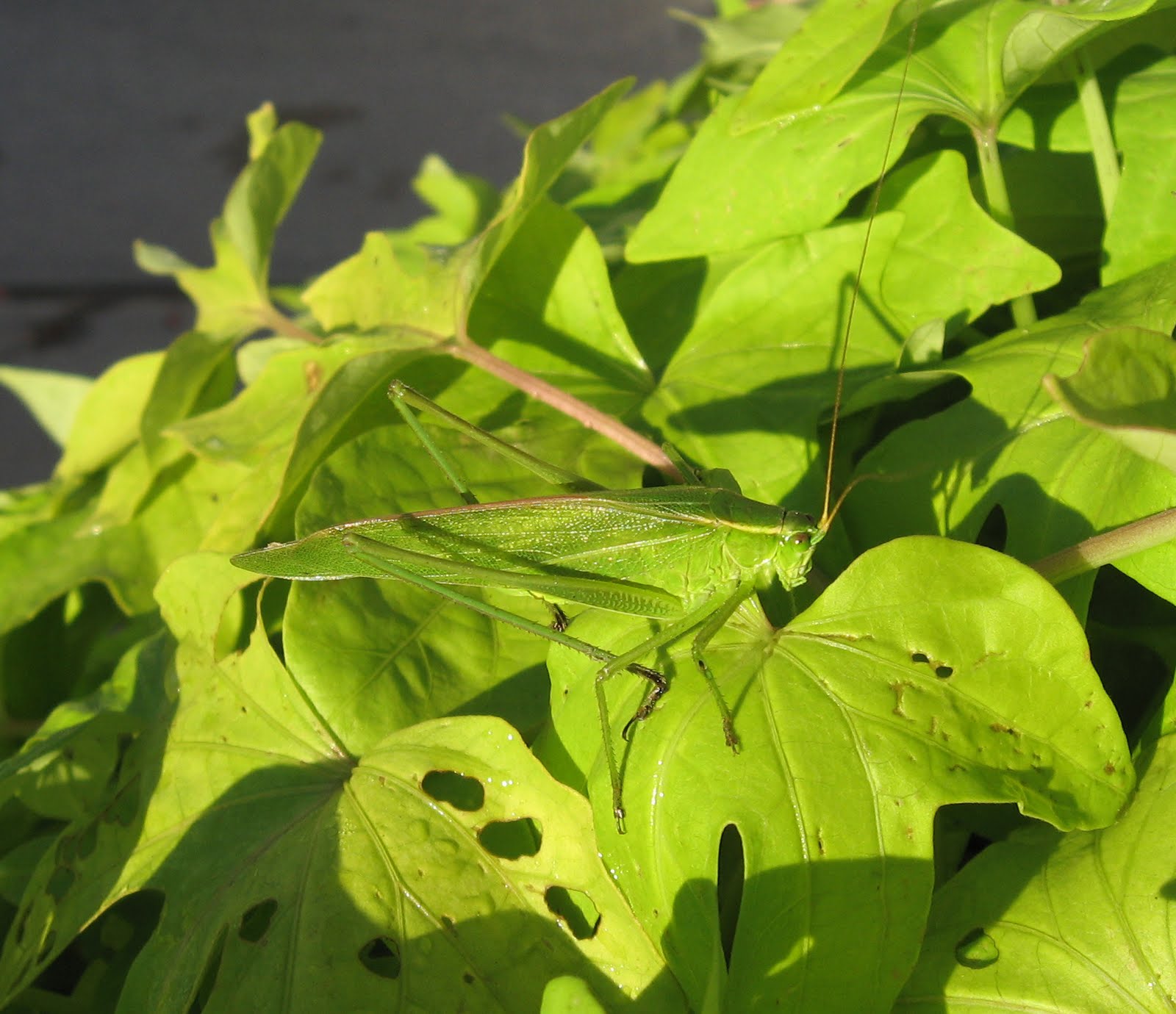
Inconspicuous against the background of foliage, this female Texas Bush Katydid (Scudderia texensis) was found perching in the planters downtown. Here's a link to an instructive web page used to identify the insect (includes range maps) ... Genus Scudderia


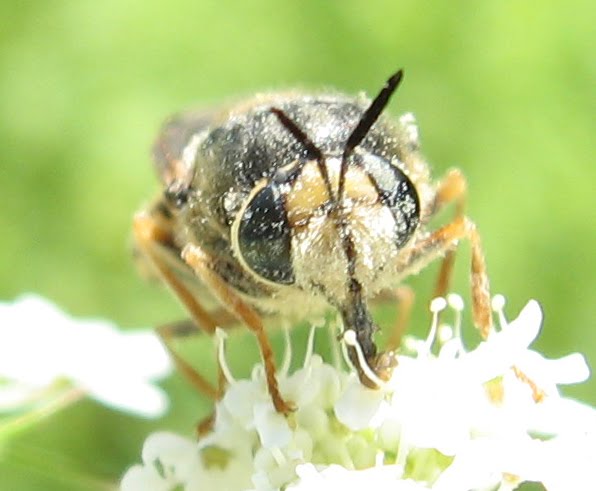
Moving on to some flies: the next two images depict a Syrphid fly of the genus Sphaerophoria (length about 10 mm). The larvae are good friends to have in the garden as they prey on aphids. More information on these flies may be found at BugGuide.Net.


Syrphid flies, a.k.a. hover flies or flower flies, form a large family. Many are boldly striped in some variation of black and yellow, imitating bees or wasps. This is a Transverse Flower Fly (Eristalis transversa).


Parhelophilus sp., nectaring on flowers of wapato, is another member of the family Syrphidae. These photos were taken along the shore of Stoco Lake.


Tachinid flies are another interesting and diverse family. The fly with the extraordinary spines on its abdomen in the first group of four photos is Juriniopsis sp.


The tachinid fly in the next four images is Archytas sp. These flies can be wary and hard to photograph but for whatever reason (good taste, maybe?) this one was quite unafraid and landed on my hand.


Various species of soldier flies of the family Stratiomyidae. Or rather various genera ... even for experts many insects can be difficult to narrow down to the species level using only photos. This cool lime green fly is Odontomyia sp.


A more robust soldier fly, Stratiomys sp.


And this fly? I can't decide what name to assign to it ... there are images of both Stratiomys and Odontomyia that look similar.


According to BugGuide.Net there are four different species in the genus Sparnopolius, but only S. confusus occurs in the east. To compare notes have a look at the images of Systoechus from 2008. I've made a judgement as to species based on images, is it correct in one or both cases?


North shore of Stoco Lake ... a mature female Swamp Spreadwing (Lestes vigilax) consuming a male Eastern Forktail (Ischnura verticalis). The colors on older females become obscured and they will often develop some pruinosity on the terminal segments of the abdomen.

A mating pair of Swamp Spreadwings (Lestes vigilax).


Despite the abundance of Blue Dashers (Pachydiplax longipennis) my encounters with mating pairs of this species are few and far between. Male and female odonates can be very different in appearance and prior to owning field guides observing a mating pair was my only means of establishing that a given male and female are the same species.


Last but not least: I don't recall how long ago the images of this pale green Assassin Bug were taken, but I couldn't ID the insect in a reasonable time and the photos ended up being buried in my "unidentified" files. Thanks to the images submitted by Mike Mills, a contributor at BugGuide.Net, I was able to identify my mystery bug as Zelus luridus.

Friday, July 2, 2010

Northern Spreadwing (Lestes disjunctus disjunctus) and Sweetflag Spreadwing (Lestes forcipatus)

These damselflies are commonly encountered at the marsh bordering the Eastern Ontario Trail, about one kilometer west of town. The Northern Spreadwing (Lestes disjunctus disjunctus) below is an immature male, just beginning to develop pruinosity at the tip of its abdomen. The eyes will also turn blue with increasing age.

A small, slightly built spreadwing with a length of about 35 mm, males of this species may be confused with male Sweetflag Spreadwings (Lestes forcipatus). The relatively short, rounded hamule is visible in the lateral view. And although it's not the final word as to species, in this area the colors on the thoraxes of male Common Spreadwings tend to be less obscured by pruinosity than the colors of male Sweetflag Spreadwings.

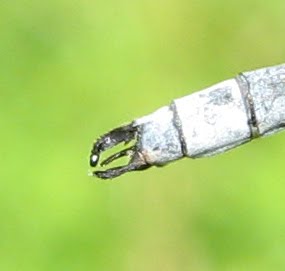
Details of the terminal abdominal segments (two different individuals than depicted above). The sharp apical hood can be seen in the first image. The space between the basal tooth and the large distal tooth is small, and the paraprocts look correct for a Northern Spreadwing (Lestes disjunctus disjunctus).

Claspers of another male; note the large sharp distal tooth


An older male Northern Spreadwing (Lestes disjunctus disjunctus). In this area Northern Spreadwing males generally have less pruinosity on the thorax than Sweetflag Spreadwings; the middorsal carina and shoulder stripes are visible. (Compare my photos to this image published by the University of Puget Sound).

Oblique view of cerci; note the prominent sharp distal tooth.

Images of a young female Northern Spreadwing (Lestes disjunctus disjunctus). Visible in the lateral view are the relatively small light-rimmed ovipositor and yellow sides of the thorax which differentiates this damselfly from the female Sweetflag Spreadwing. These criteria aren't a hundred percent reliable, difficult to see in the field, and females of other spreadwing species are also similar at first glance in any event. The best thing is to observe a mating pair.


And there we have it ... a tandem pair of Lestes disjunctus disjunctus. The male's hamule, and female's ovipositor and distinctly yellow sides, are visible in the field and confirm the species. Note the claspers gripping the female behind the head.


Found in the same habitat, its shoulder stripes clouded by pruinosity, to the unaided eye this 35 to 40 mm long damselfly looks like it might be a mature male Northern Spreadwing. But maybe we should have a closer look ...

The blunt distal tooth appears shorter than the basal tooth in the detail view of the terminal abdominal segments, and the paraprocts look correct for a Sweetflag Spreadwing (Lestes forcipatus). The apical hood appears wider than that of the Northern Spreadwing depicted above. Based on the amount of detail visible in these images the damselfly could be a Southern Spreadwing (Lestes disjunctus australis), but according to currently published range maps this species is not extant in this area.

The pruinosity seen in my photos of the Northern Spreadwing and Sweetflag Spreadwing agrees with this image published by the University of Puget Sound. But pruinosity alone isn't sufficient; save for their greater length, mature male Swamp Spreadwings with obscured colors appear the same at a glance as the damselfly above. Spreadwings can be difficult to identify and the detail and clarity possible with the camera I'm using leaves much to be desired. Tandem pairs and a lateral closeup of the hamule are needed before I'm one hundred percent certain as to the species.

Lateral view of a different male. The hamule looks relatively large; compare this photo to the image of the Northern Spreadwing.


Oblique views of the terminal abdominal segments. The distal tooth is small and blunt, the width of the apical hood is clearly visible in the first image. Also note the long span between the basal tooth and distal tooth; compare this to the space between the teeth on the cerci of a Northern Spreadwing.

Images of a female ... the ovipositor is dark along the rim but I would expect it to be longer for Lestes forcipatus; this is a female Slender Spreadwing (Lestes rectangularis).

Detail of the ovipositor

The dark rimmed ovipositor appears larger in this lateral view of another female; this looks more like Lestes forcipatus.

This is the opportunity I've been watching for ... a mating pair of damselflies. Especially note the second image, a more detailed lateral view. The female's large dark-rimmed ovipositor leaves no doubt as to the species; these insects are Sweetflag Spreadwings (Lestes forcipatus).

Another mating pair of Sweetflag Spreadwings (Lestes forcipatus) in the wheel position, again, note the female's ovipositor. The placement of the male's claspers as he grips the female's thorax is visible in this image.

An oblique detail view of the claspers holding female.