Showing posts with label Crab Spider. Show all posts

Friday, June 1, 2012

Hanging by a Thread

Identifying a spider to the species level based on its colors and markings from just a photograph can be difficult or impossible, even for an expert. It's pretty safe to say this glossy female, about 15 mm long, is a Foliate Orbweaver (Larinioides cornutus). She looks like she's gravid and ready to lay eggs any time soon.


There's enough detail in the next image to see the eye pattern and determine that the spider is a Ground Crab Spider, genus Xysticus. And it looks like she's bagged another Ground Crab Spider, perhaps a different species, or maybe a younger version of her own kind.


This female is about 8 mm in length. Size and the patterning on the abdomen suggest Xysticus punctatus, but without having captured the spider and examined its anatomy in detail, its impossible to say for sure.


The best we can say for certain as to the identity of this tiny spider, only a few millimeters long, is subfamily Erigoninae (Dwarf Spiders). The webs these little spiders were weaving looked more like something an Orb Weaver would make rather than the typical sheetweb. This is strictly guesswork because there are a few look-alikes in this group – the closest match in terms of species seems to be Hypselistes florens. Finding a mating pair would go a long way toward confirming this hypothesis because the males are very distinctive ... photo of Hypselistes florens by Tom Murray at BugGuide.Net.


A mug shot of a male Long-jawed Orb Weaver, genus Tetragnatha. The name "long-jawed" sort of fits, doesn't it?


A pair of mating Long-jawed Orb Weavers – the male and female have locked those impressively toothed jaws. Presumably the purpose of this to restrain the female, as spiders are born predators and her hair-trigger killer instincts impel her to eat her prospective mate.


The same two spiders after they've separated. This is the male, and he was in a hurry to disengage after mating but having difficulty doing so. Was this due to the spider's teeth and jaws being entangled, or because the female was trying to attack the male?


The more robust female.


Sexual dimporphism in spiders can be pretty dramatic, as demonstrated by these female and male Flower Crab Spiders (Misumena vatia), the much larger female is eating a Soldier Fly. When I first encountered these two, the male was on top of the flower. When he moved underneath to avoid me, this happened ...

There might be a mating in the offing but the female sure didn't seem to like what was happening and she was trying to brush the male off of her backside with her hind legs. Considering the difference in size it's lucky for the diminutive male that his prospective mate was preoccupied with her dinner, because otherwise his life might indeed be hanging by a thread.

Friday, May 25, 2012

Tmarus angulatus and Xysticus alboniger

This is definitely one of the funkiest spiders I've ever chanced upon – it's a Crab Spider, genus Tmarus, and according to the distribution given for this species at BugGuide.Net, it's probably Tmarus angulatus.


A dorsal view of the spider – this is a female, and she's about 8 mm long.


Nice camouflage ... the spider's size, shape, color and posture all conspire to make it resemble a sedge flowerhead.


A shot of the spider's abdomen and spinnerets.


Ventral views of Tmarus angulatus.


It's been a good couple of days for finding "new" species of spiders, but I was lucky indeed to spot this lttle male Ground Crab Spider – Xysticus alboniger – as he's only about 3 mm in length.

Tuesday, April 10, 2012

Along came a Running Crab Spider ...

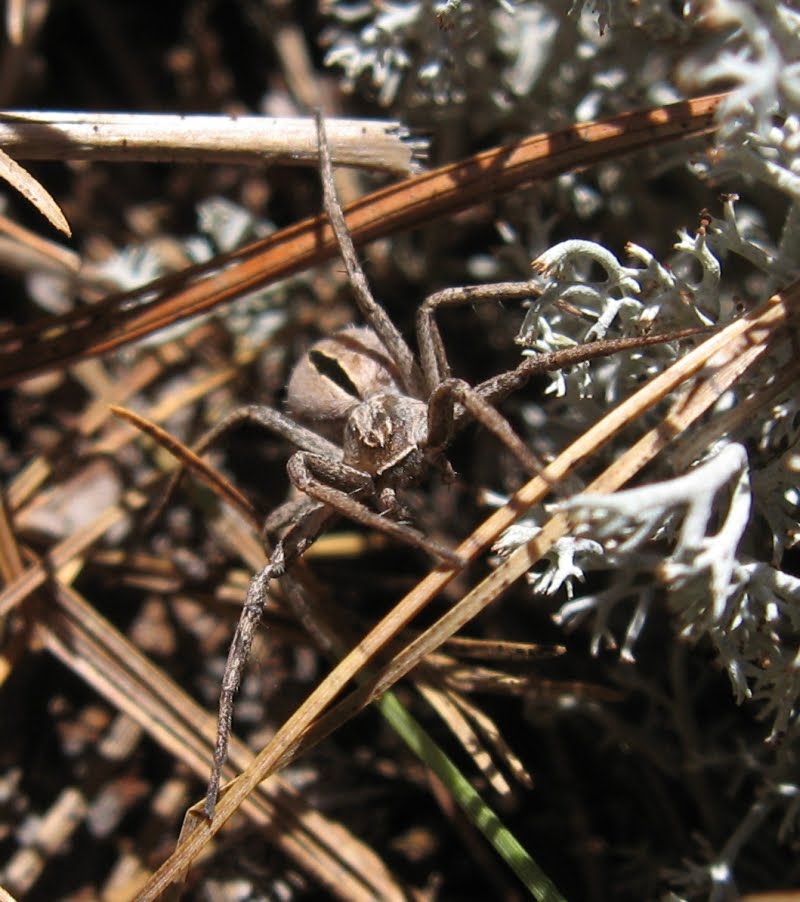
Always look twice! At first glance I mistook this arachnid for a Wolf Spider, but it is not. This spider is a female Thanatus sp., a Running Crab Spider of the family Philodromidae. Here's a link to an image of Thanatus sp. at BugGuide.Net.

The photo was taken near the same location I encountered the Red Efts, east of Highway #37, about one kilometer south of Actinolite – not far from Buttermilk Falls where I stumbled across the Striped Fishing Spider (Dolomedes scriptus) last autumn.

A mug shot is desirable when identifying spiders as their eye patterns are characteristic for a given family.


I found this Running Crab Spider lurking on the trees near Stoco Lake; I think it's genus Philodromus. Had the spider not moved, I never would have spotted it – its resemblance to the lichens and bark in the background is uncanny.

A tiny male crab spider, about 3 mm to 4 mm long ... I'm going to call this Mecaphesa sp. pending a response to an ID request at BugGuide.Net. However, I might be out of luck on getting an ID, my camera was unable to take a picture of the eyes.


At about 6 mm in length this female Ground Spider is also on the small side, that's my pinky finger she's sitting on. Definitely family Gnaphosidae, probably genus Zelotes. Normally a beautiful glossy black, it took a bit of a dusting when captured it for a closeup shot.


A female Nursey Web Spider (Pisaurina mira) striking a rather dramatic pose on a dead leaf.

No problem getting a good image of the eye pattern of this large spider, its body was close to 25 mm long.


Ouch!!! This is my number one photo from the trip to Presqu'ile Provincial Park back in mid-March ... a tick. I think this is a male Deer Tick a.k.a. Black-legged Tick (Ixodes scapularis), a potential vector of Lyme's Disease – I gave my little friend a nice swim in isopropyl alcohol and kept the specimen just in case.

Images of some tick species

This is not intended to frighten people or discourage them from visiting our parks and conservation areas. The parks I've visited thus far have warning signs posted, and no doubt there are ticks in the Tweed area as well. In all my wanderings through the years in woods and fields, this is the first time I've been bitten by one of these (no pun intended) little suckers. But having said that – be aware.

This is my little hitchhiker with a penny and a toothpick to impart a sense of scale. I didn't get bitten until after I got home, and the bite didn't appear to penetrate my skin. Needless to say I showered with lots of soap and water, washed all the clothing I had been wearing, went over my body with a fine-toothed comb (figuratively speaking, that is), and checked everything else I had taken to the park with me that may have come into contact with ticks.