Showing posts with label Nursery Web Spider. Show all posts

Tuesday, April 10, 2012

Along came a Running Crab Spider ...

Always look twice! At first glance I mistook this arachnid for a Wolf Spider, but it is not. This spider is a female Thanatus sp., a Running Crab Spider of the family Philodromidae. Here's a link to an image of Thanatus sp. at BugGuide.Net.

The photo was taken near the same location I encountered the Red Efts, east of Highway #37, about one kilometer south of Actinolite – not far from Buttermilk Falls where I stumbled across the Striped Fishing Spider (Dolomedes scriptus) last autumn.

A mug shot is desirable when identifying spiders as their eye patterns are characteristic for a given family.
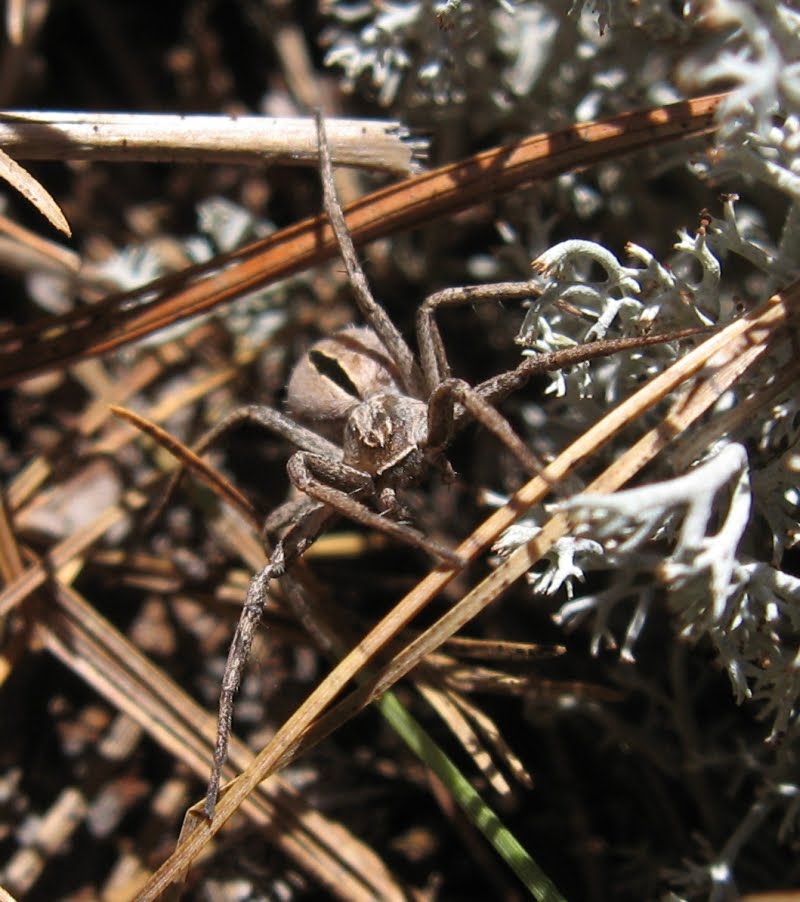

I found this Running Crab Spider lurking on the trees near Stoco Lake; I think it's genus Philodromus. Had the spider not moved, I never would have spotted it – its resemblance to the lichens and bark in the background is uncanny.

A tiny male crab spider, about 3 mm to 4 mm long ... I'm going to call this Mecaphesa sp. pending a response to an ID request at BugGuide.Net. However, I might be out of luck on getting an ID, my camera was unable to take a picture of the eyes.


At about 6 mm in length this female Ground Spider is also on the small side, that's my pinky finger she's sitting on. Definitely family Gnaphosidae, probably genus Zelotes. Normally a beautiful glossy black, it took a bit of a dusting when captured it for a closeup shot.


A female Nursey Web Spider (Pisaurina mira) striking a rather dramatic pose on a dead leaf.

No problem getting a good image of the eye pattern of this large spider, its body was close to 25 mm long.


Ouch!!! This is my number one photo from the trip to Presqu'ile Provincial Park back in mid-March ... a tick. I think this is a male Deer Tick a.k.a. Black-legged Tick (Ixodes scapularis), a potential vector of Lyme's Disease – I gave my little friend a nice swim in isopropyl alcohol and kept the specimen just in case.

Images of some tick species

This is not intended to frighten people or discourage them from visiting our parks and conservation areas. The parks I've visited thus far have warning signs posted, and no doubt there are ticks in the Tweed area as well. In all my wanderings through the years in woods and fields, this is the first time I've been bitten by one of these (no pun intended) little suckers. But having said that – be aware.

This is my little hitchhiker with a penny and a toothpick to impart a sense of scale. I didn't get bitten until after I got home, and the bite didn't appear to penetrate my skin. Needless to say I showered with lots of soap and water, washed all the clothing I had been wearing, went over my body with a fine-toothed comb (figuratively speaking, that is), and checked everything else I had taken to the park with me that may have come into contact with ticks.

Saturday, August 23, 2008

Tangled Webs

Actually, not so tangled, and not all spiders spin webs. A spider is guided by instinct in building a web characteristic of its species. The webs are marvels of geometry ... it seems that no matter where we look, mathematics is "hardwired" into the universe.

The orb weaver snacking on the hapless hoverfly in the first three photos looks like a Shamrock Spider (Araneus trifolium). The coloration of this spider is highly variable and some individuals are nearly white. This female had a nest above its web made of rolled up leaves held together with silk. A line connected the redoubt and the web, transmitting vibrations to alert the spider to the presence of prey snared in its net.


Mangora gibberosa ... same spider as in an earlier post.


The same Long Jawed Orb Weaver (Tetragnatha sp.) as in the last post. Despite its limited vision the spider was very well aware of my presence ...


An immature Flower Spider (Misumena sp.), this specimen is approximately one third the size of an adult.


A different species of Crab Spider. It was windy, making it difficult to capture details (especially the eyes), my best guess based on this sole out of focus image is Xysticus sp.


An immature Cross Spider (Araneus diadematus).


The following picture is the ventral view of an adult female Cross Spider. It's hard to judge the scale from a photo ... this spider is actually twice the size of the spider in the two pictures above.


A dorsal view of the adult female Cross Spider seen above.


The next three photos show an adult male Cross Spider. Male spiders deliver their sperm with their pedipalps and the customized organs can clearly be seen in the lateral and dorsal views of the spider.


Female Funnel Weaver Spider, Agelenopsis sp.

This is the smaller Agelenopsis sp. male


A female Nursery Web Spider, Pisaurina mira. Judging by the pale color this one looks like it has molted recently.


Since I caught it in the act of making its web, it's probably safe to say the spider in the next two pictures is an orb weaver. The photos were taken at night against a green background so the quality of the images leaves something to be desired (some of the green was removed and the images sharpened after being downloaded to the hard drive). Some of the orb weavers can be hard to identify even from a good image, based on the information at hand I'm going to go with Larinioides sp. , most likely Larinioides sclopetarius.


The spider in the next picture is a male Larinioides sp., note the large modified pedipalps (he also seems to have misplaced a leg). Male and female spiders appear so different from one another that sometimes it's hard to believe they are the same species.