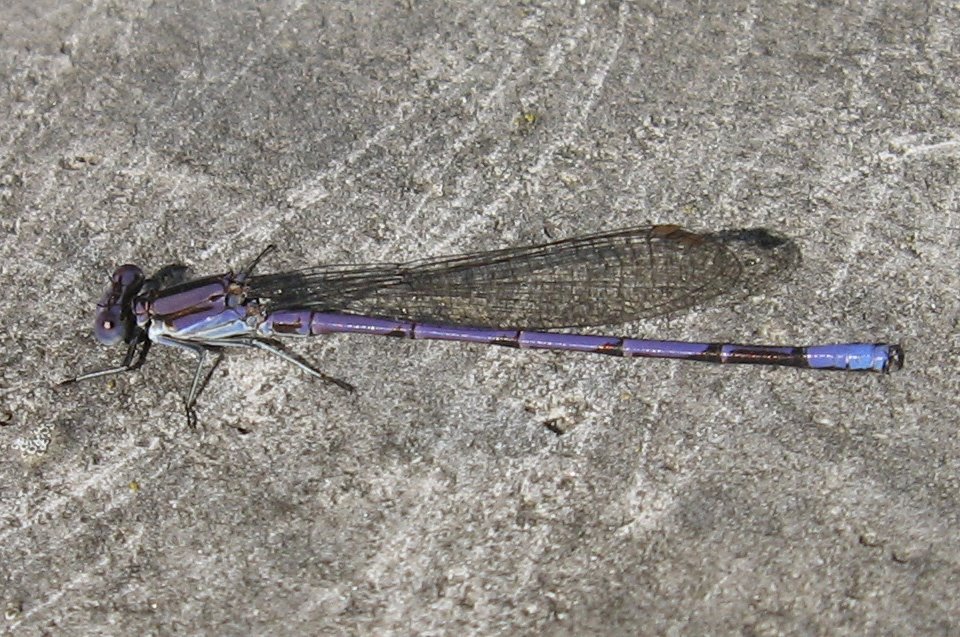
Not a complete checklist by any means, just a record of my seventy-nine up close and personal encounters with our local odonates in the past five years. How long would a "complete" list of local species be anyway ... would it break one hundred?
Beneath the insect's name I've included the date of my first sighting to give a rough idea of the adult's flight season, followed by a brief description of the location and co-ordinates – as per Google Earth – where they're most commonly encountered. In a few cases I've also noted the rank or status, as per the downloadable Excel spreadsheet at Wild Species 2010 – The General Status of Species in Canada.
Here's a link to list of the dragonfly and damselfly habitats near Tweed and the surrounding area.
June 25, 2009
Moira River – the Point
44.47694 ... -77.30194
(2) River Jewelwing (Calopteryx aequabilis)
June 26, 2010
Moira River – the Point
44.47694 ... -77.30194
(3) Spotted Spreadwing (Lestes congener)
August 10, 2009
Moira River – Walking Bridge and the Dam
44.48000 ... -77.31278
(4) Slender Spreadwing (Lestes rectangularis)
July 31, 2009
Marsh .7 km west of Tweed
44.46889 ... -77.31528
(5) Swamp Spreadwing (Lestes vigilax)
August 05, 2009
North shore of Stoco Lake
44.47389 ... -77.30722
(6) Emerald Spreadwing (Lestes dryas)
June 02, 2010
Marsh .7 km west of Tweed
44.46889 ... -77.31528
(7) Elegant Spreadwing (Lestes inaequalis)
June 04, 2010
North shore of Stoco Lake
44.47389 ... -77.30722
(8) Northern Spreadwing (Lestes disjunctus disjunctus)
July 01, 2010
Marsh .7 km west of Tweed
44.46889 ... -77.31528
(9) Sweetflag Spreadwing (Lestes forcipatus)
July 07, 2010
Marsh .7 km west of Tweed
44.46889 ... -77.31528
(10) Amber-winged Spreadwing (Lestes eurinus)
Sensitive (3)
July 10, 2012
Marsh .7 km west of Tweed
44.46889 ... -77.31528
(11) Aurora Damsel (Chromagrion conditum)
May 21, 2011
Marsh .7 km west of Tweed
44.46889 ... -77.31528
(12) Taiga Bluet (Coenagrion resolutum)
June 02, 2010
Marsh .7 km west of Tweed
44.46889 ... -77.31528
(13) Violet Dancer (Argia fumipennis violacea)
July 16, 2009
Moira River – the Point
44.47694 ... -77.30194
(14) Powdered Dancer (Argia moesta)
July 18, 2009
Moira River – Walking Bridge and the Dam
44.48000 ... -77.31278
(15) Rainbow Bluet (Enallagma antennatum)
June 13, 2010
Moira River – Walking Bridge and the Dam
44.48000 ... -77.31278
(16) Boreal Bluet (Enallagma boreale)
June 13, 2010
Marsh .7 km west of Tweed
44.46889 ... -77.31528
(17) Marsh Bluet (Enallagma ebrium)
June 11, 2010
Moira River – Walking Bridge and the Dam
44.48000 ... -77.31278
(18) Hagen's Bluet (Enallagma hageni)
June 15, 2010
North shore of Stoco Lake
44.47389 ... -77.30722
(19) Tule Bluet (Enallagma carunculatum)
August 01, 2009
Moira River – Walking Bridge and the Dam
44.48000 ... -77.31278
(20) Familiar Bluet (Enallagma civile)
August 03, 2009
Moira River – Walking Bridge and the Dam
44.48000 ... -77.31278
(21) Stream Bluet (Enallagma exsulans)
July 18, 2009
Moira River – Walking Bridge and the Dam
44.48000 ... -77.31278
(22) Azure Bluet (Enallagma aspersum)
Sensitive (3)
August 30, 2011
Trans-Canada Trail, about 1 km east of Tweed
44.47972 ... -77.30139
(23) Skimming Bluet (Enallagma geminatum)
August 03, 2009
North shore of Stoco Lake
44.47389 ... -77.30722
(24) Orange Bluet (Enallagma signatum)
June 07, 2010
North shore of Stoco Lake
44.47389 ... -77.30722
(25) Vesper Bluet (Enallagma vesperum)
June 08, 2010
North shore of Stoco Lake
44.47389 ... -77.30722
(26) Slender Bluet (Enallagma traviatum westfalli)
May be at risk (2)
July 23, 2013
North shore of Stoco Lake
44.47389 ... -77.30722
(27) Fragile Forktail (Ischnura posita)
August 03, 2009
Moira River – Walking Bridge and the Dam
44.48000 ... -77.31278
(28) Eastern Forktail (Ischnura verticalis)
August 12, 2008
North shore of Stoco Lake
44.47389 ... -77.30722
(29) Sedge Sprite (Nehalennia irene)
June 01, 2010
Marsh .7 km west of Tweed
44.46889 ... -77.31528
(30) Canada Darner (Aeshna canadensis)
August 01, 2009
North shore of Stoco Lake
44.47389 ... -77.30722
(31) Mottled Darner (Aeshna clepsydra)
Sensitive (3)
September 24, 2009
Tweed – garden at 417 Metcalf St.
44.79261 ... -77.31582
(32) Lance-tipped Darner (Aeshna constricta)
September 01, 2009
Marsh .7 km west of Tweed
44.46889 ... -77.31528
(33) Black-tipped Darner (Aeshna tuberculifera)
August 30, 2008
Marsh .7 km west of Tweed
44.46889 ... -77.31528
(34) Shadow Darner (Aeshna umbrosa)
September 24, 2010
Marsh .7 km west of Tweed
44.46889 ... -77.31528
(35) Fawn Darner (Boyeria vinosa)
August 31, 2008
Moira River – Walking Bridge and the Dam
44.48000 ... -77.31278
(36) Springtime Darner (Basiaeschna janata)
June 01, 2010
Trans-Canada Trail, about 1 km east of Tweed
44.47972 ... -77.30139
(37) Common Green Darner (Anax junius)
August 07, 2010
Marsh .7 km west of Tweed
44.46889 ... -77.31528
(38) Black-shouldered Spinyleg (Dromogomphus spinosus)
August 04, 2009
Moira River – Walking Bridge and the Dam
44.48000 ... -77.31278
(39) Dragonhunter (Hagenius brevistylus)
July 04, 2011
Moira River – the Point
44.47694 ... -77.30194
(40) Lilypad Clubtail (Arigomphus furcifer)
Sensitive (3)
June 04, 2010
North shore of Stoco Lake
44.47389 ... -77.30722
(41) Lancet Clubtail (Gomphus exilis)
June 15, 2010
Moira River – the Point
44.47694 ... -77.30194
(42) Dusky Clubtail (Gomphus spicatus)
May 15, 2012
Tweed
44.47472 ... -77.31028
(43) Mustached Clubtail (Gomphus adelphus)
May 24, 2011
Trans-Canada Trail, about 1 km east of Tweed
44.47972 ... -77.30139
(44) Arrowhead Spiketail (Cordulegaster obliqua)
May be at risk (2)
June 11, 2011
Tweed – intersection of Alexander St. and the trans-Canada Trail
44.48000 ... -77.30389
(45) Stream Cruiser (Didymops transversa)
May 24, 2011
Trans-Canada Trail, about 1 km east of Tweed
44.47972 ... -77.30139
(46) Swift River Cruiser (Macromia illinoiensis illinoiensis)
June 14. 2011
Tweed – intersection of Alexander St. and the trans-Canada Trail
44.48000 ... -77.30389
(47) Racket-tailed Emerald (Dorocordulia libera)
June 23, 2009
North shore of Stoco Lake
44.47389 ... -77.30722
(48) American Emerald (Cordulia shurtleffi)
June 07, 2010
North shore of Stoco Lake
44.47389 ... -77.30722
(49) Brush-tipped Emerald (Somatochlora walshii)
May 29, 2011
Marsh .7 km west of Tweed
44.46889 ... -77.31528
(50) Williamson's Emerald (Somatochlora williamsoni)
July 13, 2012
Tweed
44.47472 ... -77.31028
(51) Common Baskettail (Epitheca cynosura)
May 25, 2011
Trans-Canada Trail, about 1 km east of Tweed
44.47972 ... -77.30139
(52) Beaverpond Baskettail (Epitheca canis)
May 25, 2011
Trans-Canada Trail, about 1 km east of Tweed
44.47972 ... -77.30139
(53) Spiny Baskettail (Epitheca spinigera)
May 25, 2011
Trans-Canada Trail, about 1 km east of Tweed
44.47972 ... -77.30139
(54) Prince Baskettail (Epitheca princeps)
June 06, 2011
Trans-Canada Trail, about 3 km east of Tweed
44.49139 ... -77.28556
(55) Eastern Pondhawk (Erythemis simplicicollis)
August 10, 2008
North shore of Stoco Lake
44.47389 ... -77.30722
(56) Blue Dasher (Pachydiplax longipennis)
September 01, 2008
North shore of Stoco Lake
44.47389 ... -77.30722
(57) Wandering Glider (Pantala flavescens)
August 13, 2009
North shore of Stoco Lake
44.47389 ... -77.30722
(58) Elfin Skimmer (Nannothemis bella)
June 04, 2011
Marsh south of Bridgewater Road, about 1 km east of Actinolite
44.54083 ... -77.31333
(59) Black Saddlebags (Tramea lacerata)
August 28, 2008
North shore of Stoco Lake
44.47389 ... -77.30722
(60) Halloween Pennant (Celithemis eponina)
August 10, 2008
North shore of Stoco Lake
44.47389 ... -77.30722
(61) Calico Pennant (Celithemis elisa)
July 17, 2010
Marsh .7 km west of Tweed
44.46889 ... -77.31528
(62) Eastern Amberwing (Perithemis tenera)
August 05, 2009
North shore of Stoco Lake
44.47389 ... -77.30722
(63) Dot-tailed Whiteface (Leucorrhinia intacta)
June 06, 2009
North shore of Stoco Lake
44.47389 ... -77.30722
(64) Frosted Whiteface (Leucorrhinia frigida)
June 08, 2010
Marsh .7 km west of Tweed
44.46889 ... -77.31528
(65) Belted Whiteface (Leucorrhinia proxima)
July 01, 2012
Marsh .7 km west of Tweed
44.46889 ... -77.31528
(66) Hudsonian Whiteface (Leucorrhinia hudsonica)
May 17, 2013
Tweed – intersection of Alexander St. and the trans-Canada Trail
44.48000 ... -77.30389
(67) Cherry-faced Meadowhawk (Sympetrum internum)
September 08, 2009
Moira River – Walking Bridge and the Dam
44.48000 ... -77.31278
(68) Ruby Meadowhawk (Sympetrum rubicundulum)
September 07, 2009
Moira River – Walking Bridge and the Dam
44.48000 ... -77.31278
(69) Saffron-winged Meadowhawk (Sympetrum costiferum)
August 11, 2009
North shore of Stoco Lake
44.47389 ... -77.30722
(70) White-faced Meadowhawk (Sympetrum obtrusum)
August 13, 2008
Moira River – Walking Bridge and the Dam
44.48000 ... -77.31278
(71) Band-winged Meadowhawk (Sympetrum semicinctum)
August 01, 2009
Moira River – Walking Bridge and the Dam
44.48000 ... -77.31278
(72) Autumn Meadowhawk (Sympetrum vicinum)
August 27, 2008
Marsh .7 km west of Tweed
44.46889 ... -77.31528
(73) Chalk-fronted Corporal (Ladona julia)
June 04, 2009
North shore of Stoco Lake
44.47389 ... -77.30722
(74) Common Whitetail (Plathemis lydia)
June 13, 2010
Marsh .7 km west of Tweed
44.46889 ... -77.31528
(75) Slaty Skimmer (Libellula incesta)
June 18, 2010
North shore of Stoco Lake
44.47389 ... -77.30722
(76) Widow Skimmer (Libellula luctuosa)
August 10, 2008
North shore of Stoco Lake
44.47389 ... -77.30722
(77) Twelve-spotted Skimmer (Libellula pulchella)
August 20, 2008
Marsh .7 km west of Tweed
44.46889 ... -77.31528
(78a) Four-spotted Skimmer (Libellula quadrimaculata)
June 01, 2010
Marsh .7 km west of Tweed
44.46889 ... -77.31528
(78b) Four-spotted Skimmer (Libellula quadrimaculata praenubila)
Early June, 2011
Tweed – intersection of Alexander St. and the trans-Canada Trail
44.48000 ... -77.30389
(79) Painted Skimmer (Libellula semifasciata)
May be at risk (2)
June 03, 2013 (photo by Jason King)
Trans-Canada Trail, about 1.5 km west of Tweed
44.46333 ... -77.32890
More odonate related posts, including a images of exuviae, naiads, tenerals and comparisons of similar looking species ...
A Few Notes on Water Nymphs
Spiketail Naiads
Changing with the Season
An Extraordinary Transfiguration
An anomalous male Eastern Forktail, and how to distinguish a disorderly disarray of damselflies
Northern Spreadwing (Lestes disjunctus disjunctus) and Sweetflag Spreadwing (Lestes forcipatus)
Trying to make sense of Teneral Spreadwings
Not all Bluets are blue: Orange Bluet (Enallagma signatum) and Vesper Bluet (Enallagma vesperum)
Which one is it? An Emerald Spreadwing (Lestes dryas), or an Elegant Spreadwing (Lestes inaequalis)?
Spring Damselflies
A Few Photos of some Common Damselflies
A Fetch of Dragonflies
The Stoco Fen
A look at the bigger picture – the Atlas of Ontario Odonata administered by the NHIC is down for the time being. However, iNaturalist.org maintains a photographic guide to the Odonata of Ontario, and distribution maps of Ontario's dragonfly and damselfly species may be perused at Odonata Central.
In order to create a more comprehensive checklist of the possible odonate species of Hastings County, I studied the following checklists (PDFs) for neighboring Ontario counties:
Damselflies and Dragonflies of Kingston Checklist (2008)
A List of the Odonates of Northumberland County (2010)
Odonates of Renfrew County (2010)
I've also read the species accounts in the Field Guide to The Dragonflies and Damselflies of Algonquin Provincial Park and the Surrounding Area (2008), and inspected the distribution maps in Damselflies of the Northeast (2004). Based on the foregoing five resources it appears that there are potentially another fifty-two odes in the county, however, it's only fair to say that some of these species are apt to be rarely – if ever – encountered, and a few are best considered vagrants. Any errors, omissions, typos or other boo-oos in the following summary are mine ...
American Rubyspot (Hetaerina americana)
Northumberland County – possible
Kingston – possible, considered provincially/regionally rare
Hastings County – possible, Damselflies of the Northeast
Southern Spreadwing (Lestes disjunctus australis)
Northumberland County – possible
Kingston – possible, considered provincially/regionally rare
Hastings County – possible, Damselflies of the Northeast
Lyre-tipped Spreadwing (Lestes unguiculatus)
Northumberland County – recorded
Kingston – recorded, considered provincially/regionally rare
Hastings County – recorded, Damselflies of the Northeast
Algonquin Park – rare, more common further south
Renfrew County – recorded
Eastern Red Damsel (Amphiagrion saucium)
Northumberland County – recorded
Kingston – probable, considered provincially/regionally rare
Hastings County – recorded, Damselflies of the Northeast
Algonquin Park – rare and local
Renfrew County – recorded
Subarctic Bluet (Coenagrion interrogatum)
Hastings County – possible, Damselflies of the Northeast
Algonquin Park – uncommon and local
Blue-fronted Dancer (Argia apicalis)
Hastings County – possible, Damselflies of the Northeast
Blue-tipped Dancer (Argia tibialis)
Hastings County – possible, Damselflies of the Northeast
Double-striped Bluet (Enallagma basidens)
Hastings County – possible, Damselflies of the Northeast
River Bluet (Enallagma anna)
Northumberland County – possible
Kingston – possible, considered provincially/regionally rare
Hastings County – possible, Damselflies of the Northeast
Alkali Bluet (Enallagma clausum)
Kingston – possible, considered provincially/regionally rare
Frontenac County – recorded
Hastings County – possible, Damselflies of the Northeast
Northern Bluet (Enallagma annexum)
Northumberland County – recorded
Kingston – recorded, considered provincially/regionally rare
Hastings County – probable, Damselflies of the Northeast
Algonquin Park – recorded
Renfrew County – recorded
Vernal Bluet (Enallagma vernale)
Northumberland County – recorded
Kingston – recorded, considered provincially/regionally rare
Hastings County – recorded, Damselflies of the Northeast
Algonquin Park – recorded
Renfrew County – recorded
Citrine Forktail (Ischnura hastata)
Northumberland County – recorded
Kingston – possible, considered provincially/regionally rare
Hastings County – possible, Damselflies of the Northeast
Sphagnum Sprite (Nehalennia gracilis)
Northumberland County – possible
Kingston – recorded, considered provincially/regionally rare
Hastings County – probable, Damselflies of the Northeast
Algonquin Park – recorded
Renfrew County – recorded
Lake Darner (Aeshna eremita)
Northumberland County – recorded
Kingston – recorded, considered provincially/regionally rare
Algonquin Park – common and widespread, less common further south
Renfrew County – recorded
Variable Darner (Aeshna interrupta interrupta)
Northumberland County – expected
Kingston – probable, considered provincially/regionally rare
Algonquin Park – common and widespread, less common further south
Renfrew County – recorded
Green-striped Darner (Aeshna verticalis)
Northumberland County – recorded
Kingston – recorded, considered provincially/regionally rare
Algonquin Park – rare and local
Ocellated Darner (Boyeria grafiana)
Northumberland County – possible
Kingston – possible, considered provincially/regionally rare
Algonquin Park – local but widespread, less common further south
Renfrew County – recorded
Swamp Darner (Epiaeschna heros)
Northumberland County – recorded
Kingston – recorded, considered provincially/regionally rare
Algonquin Park – one record, more common further south
Renfrew County – recorded
Harlequin Darner (Gomphaeschna furcillata)
Northumberland County – possible
Kingston – recorded, considered provincially/regionally rare
Algonquin Park – rare and local
Renfrew County – recorded
Cyrano Darner (Nasiaeschna pentacantha)
Northumberland County – possible
Kingston – recorded, considered provincially/regionally rare
Algonquin Park – uncommon, recorded from lakes adjacent to the park
Renfrew County – recorded
Horned Clubtail (Arigomphus cornutus)
Northumberland County – possible
Kingston – recorded, considered provincially/regionally rare
Algonquin Park – not recorded, uncommon along Canadian Sheild
Renfrew County – recorded
Unicorn Clubtail (Arigomphus villosipes)
Northumberland County – possible
Algonquin Park – not recorded, rare throughout southern Ontario
Beaverpond Clubtail (Gomphus borealis)
Algonquin Park – uncommon, not likely encountered further south
Renfrew County – recorded
Harpoon Clubtail (Gomphus descriptus)
Northumberland County – recorded
Kingston – possible, considered provincially/regionally rare
Algonquin Park – recorded, rare elsewhere
Renfrew County – recorded
Midland Clubtail (Gomphus fraternus)
Northumberland County – possible
Algonquin Park – not recorded from the park, expected in calcerous areas south of the Canadian Sheild
Renfrew County – recorded
Pronghorn Clubtail (Gomphus graslinellus)
Northumberland County – expected
Algonquin Park – not recorded, expected along Canadian Sheild
Ashy Clubtail (Gomphus lividus)
Northumberland County – expected
Kingston – recorded, considered provincially/regionally rare
Algonquin Park – population varies from common to uncommon
Renfrew County – recorded
Rapids Clubtail (Gomphus quadricolor)
Northumberland County – possible
Algonquin Park – not recorded, rare in Ontario
Rusty Snaketail (Ophiogomphus rupinsulensis)
Northumberland County – expected
Kingston – recorded, considered provincially/regionally rare
Algonquin Park – recorded, uncommon in remainder of Ontario
Renfrew County – recorded
Common Sanddragon (Progomphus obscurus)
Northumberland County – possible
Peterborough County – known from a few sites
Eastern Least Clubtail (Stylogomphus albistylus)
Northumberland County – recorded
Kingston – recorded, considered provincially/regionally rare
Algonquin Park – uncommon to local
Renfrew County – recorded
Elusive Clubtail (Stylurus notatus)
Northumberland County – possible
Kingston – recorded, considered provincially/regionally rare
Renfrew County – recorded
Zebra Clubtail (Stylurus scudderi)
Northumberland County – recorded
Kingston – probable, considered provincially/regionally rare
Algonquin Park – uncommon to local
Renfrew County – recorded
Arrow Clubtail (Stylurus spiniceps)
Northumberland County – possible
Algonquin Park – rare and local
Renfrew County – recorded
Delta-spotted Spiketail (Cordulegaster diastatops)
Northumberland County – expected
Kingston – recorded, considered provincially/regionally rare
Algonquin Park – uncommon and local
Renfrew County – recorded
Twin-spotted Spiketail (Cordulegaster maculata)
Northumberland County – recorded
Kingston – recorded, considered provincially/regionally rare
Algonquin Park – uncommon and local
Renfrew County – recorded
Uhler’s Sundragon (Helocordulia uhleri)
Northumberland County – possible
Kingston – recorded, considered provincially/regionally rare
Algonquin Park – uncommon, rare south of Canadian Shield
Renfrew County – recorded
Stygian Shadowdragon (Neurocordulia yamaskanensis)
Northumberland County – expected
Kingston – recorded, considered provincially/regionally rare
Algonquin Park – widespread but local, crepuscular and overlooked?
Renfrew County – recorded
Broad-tailed Shadowdragon (Neurocordulia michaeli)
Algonquin Park – recorded, crepuscular and possibly overlooked at other suitable habitats?
Renfrew County – recorded
Forcipate Emerald (Somatochlora forcipata)
Northumberland County – possible
Algonquin Park – uncommon to rare and local
Delicate Emerald (Somatochlora franklini)
Algonquin Park – rare and local
Renfrew County – recorded
Ocellated Emerald (Somatochlora minor)
Northumberland County – expected
Algonquin Park – uncommon and local
Renfrew County – recorded
Clamp-tipped Emerald (Somatochlora tenebrosa)
Northumberland County – recorded
Algonquin Park – rarely encountered throughout its Ontario range
Renfrew County – recorded
Kennedy’s Emerald (Somatochlora kennedyi)
Northumberland County – possible
Kingston – recorded, considered provincially/regionally rare
Algonquin Park – uncommon to rare but widespread
Renfrew County – recorded
Ebony Boghaunter (Williamsonia fletcheri)
Northumberland County – possible
Kingston – possible, considered provincially/regionally rare
Algonquin Park – few records, uncommon to rare and local
Renfrew County – recorded
Crimson-ringed Whiteface (Leucorrhinia glacialis)
Northumberland County – possible
Kingston – recorded, considered provincially/regionally rare
Algonquin Park – common, less common and local to the south
Renfrew County – recorded
Spot-winged Glider (Pantala hymenea)
Northumberland County – recorded
Kingston – recorded, considered provincially/regionally rare
Algonquin Park – irregular migrant
Variegated Meadowhawk (Sympetrum corruptum)
Northumberland County – possible
Kingston – possible, considered provincially/regionally rare
Algonquin Park – not recorded, considered a vagrant
Black Meadowhawk (Sympetrum danae)
Northumberland County – possible
Algonquin Park – rare, but sometimes encountered south of its range
Renfrew County – recorded
Carolina Saddlebags (Tramea carolina)
Northumberland County – recorded
Kingston – possible, considered provincially/regionally rare
Red-mantled Saddlebags (Tramea onusta)
Northumberland County – possible
Kingston – probable, considered provincially/regionally rare
Damselflies and Dragonflies of Kingston Checklist (2008)
A List of the Odonates of Northumberland County (2010)
Odonates of Renfrew County (2010)
I've also read the species accounts in the Field Guide to The Dragonflies and Damselflies of Algonquin Provincial Park and the Surrounding Area (2008), and inspected the distribution maps in Damselflies of the Northeast (2004). Based on the foregoing five resources it appears that there are potentially another fifty-two odes in the county, however, it's only fair to say that some of these species are apt to be rarely – if ever – encountered, and a few are best considered vagrants. Any errors, omissions, typos or other boo-oos in the following summary are mine ...
American Rubyspot (Hetaerina americana)
Northumberland County – possible
Kingston – possible, considered provincially/regionally rare
Hastings County – possible, Damselflies of the Northeast
Southern Spreadwing (Lestes disjunctus australis)
Northumberland County – possible
Kingston – possible, considered provincially/regionally rare
Hastings County – possible, Damselflies of the Northeast
Lyre-tipped Spreadwing (Lestes unguiculatus)
Northumberland County – recorded
Kingston – recorded, considered provincially/regionally rare
Hastings County – recorded, Damselflies of the Northeast
Algonquin Park – rare, more common further south
Renfrew County – recorded
Eastern Red Damsel (Amphiagrion saucium)
Northumberland County – recorded
Kingston – probable, considered provincially/regionally rare
Hastings County – recorded, Damselflies of the Northeast
Algonquin Park – rare and local
Renfrew County – recorded
Subarctic Bluet (Coenagrion interrogatum)
Hastings County – possible, Damselflies of the Northeast
Algonquin Park – uncommon and local
Blue-fronted Dancer (Argia apicalis)
Hastings County – possible, Damselflies of the Northeast
Blue-tipped Dancer (Argia tibialis)
Hastings County – possible, Damselflies of the Northeast
Double-striped Bluet (Enallagma basidens)
Hastings County – possible, Damselflies of the Northeast
River Bluet (Enallagma anna)
Northumberland County – possible
Kingston – possible, considered provincially/regionally rare
Hastings County – possible, Damselflies of the Northeast
Alkali Bluet (Enallagma clausum)
Kingston – possible, considered provincially/regionally rare
Frontenac County – recorded
Hastings County – possible, Damselflies of the Northeast
Northern Bluet (Enallagma annexum)
Northumberland County – recorded
Kingston – recorded, considered provincially/regionally rare
Hastings County – probable, Damselflies of the Northeast
Algonquin Park – recorded
Renfrew County – recorded
Vernal Bluet (Enallagma vernale)
Northumberland County – recorded
Kingston – recorded, considered provincially/regionally rare
Hastings County – recorded, Damselflies of the Northeast
Algonquin Park – recorded
Renfrew County – recorded
Citrine Forktail (Ischnura hastata)
Northumberland County – recorded
Kingston – possible, considered provincially/regionally rare
Hastings County – possible, Damselflies of the Northeast
Sphagnum Sprite (Nehalennia gracilis)
Northumberland County – possible
Kingston – recorded, considered provincially/regionally rare
Hastings County – probable, Damselflies of the Northeast
Algonquin Park – recorded
Renfrew County – recorded
Lake Darner (Aeshna eremita)
Northumberland County – recorded
Kingston – recorded, considered provincially/regionally rare
Algonquin Park – common and widespread, less common further south
Renfrew County – recorded
Variable Darner (Aeshna interrupta interrupta)
Northumberland County – expected
Kingston – probable, considered provincially/regionally rare
Algonquin Park – common and widespread, less common further south
Renfrew County – recorded
Green-striped Darner (Aeshna verticalis)
Northumberland County – recorded
Kingston – recorded, considered provincially/regionally rare
Algonquin Park – rare and local
Ocellated Darner (Boyeria grafiana)
Northumberland County – possible
Kingston – possible, considered provincially/regionally rare
Algonquin Park – local but widespread, less common further south
Renfrew County – recorded
Swamp Darner (Epiaeschna heros)
Northumberland County – recorded
Kingston – recorded, considered provincially/regionally rare
Algonquin Park – one record, more common further south
Renfrew County – recorded
Harlequin Darner (Gomphaeschna furcillata)
Northumberland County – possible
Kingston – recorded, considered provincially/regionally rare
Algonquin Park – rare and local
Renfrew County – recorded
Cyrano Darner (Nasiaeschna pentacantha)
Northumberland County – possible
Kingston – recorded, considered provincially/regionally rare
Algonquin Park – uncommon, recorded from lakes adjacent to the park
Renfrew County – recorded
Horned Clubtail (Arigomphus cornutus)
Northumberland County – possible
Kingston – recorded, considered provincially/regionally rare
Algonquin Park – not recorded, uncommon along Canadian Sheild
Renfrew County – recorded
Unicorn Clubtail (Arigomphus villosipes)
Northumberland County – possible
Algonquin Park – not recorded, rare throughout southern Ontario
Beaverpond Clubtail (Gomphus borealis)
Algonquin Park – uncommon, not likely encountered further south
Renfrew County – recorded
Harpoon Clubtail (Gomphus descriptus)
Northumberland County – recorded
Kingston – possible, considered provincially/regionally rare
Algonquin Park – recorded, rare elsewhere
Renfrew County – recorded
Midland Clubtail (Gomphus fraternus)
Northumberland County – possible
Algonquin Park – not recorded from the park, expected in calcerous areas south of the Canadian Sheild
Renfrew County – recorded
Pronghorn Clubtail (Gomphus graslinellus)
Northumberland County – expected
Algonquin Park – not recorded, expected along Canadian Sheild
Ashy Clubtail (Gomphus lividus)
Northumberland County – expected
Kingston – recorded, considered provincially/regionally rare
Algonquin Park – population varies from common to uncommon
Renfrew County – recorded
Rapids Clubtail (Gomphus quadricolor)
Northumberland County – possible
Algonquin Park – not recorded, rare in Ontario
Rusty Snaketail (Ophiogomphus rupinsulensis)
Northumberland County – expected
Kingston – recorded, considered provincially/regionally rare
Algonquin Park – recorded, uncommon in remainder of Ontario
Renfrew County – recorded
Common Sanddragon (Progomphus obscurus)
Northumberland County – possible
Peterborough County – known from a few sites
Eastern Least Clubtail (Stylogomphus albistylus)
Northumberland County – recorded
Kingston – recorded, considered provincially/regionally rare
Algonquin Park – uncommon to local
Renfrew County – recorded
Elusive Clubtail (Stylurus notatus)
Northumberland County – possible
Kingston – recorded, considered provincially/regionally rare
Renfrew County – recorded
Zebra Clubtail (Stylurus scudderi)
Northumberland County – recorded
Kingston – probable, considered provincially/regionally rare
Algonquin Park – uncommon to local
Renfrew County – recorded
Arrow Clubtail (Stylurus spiniceps)
Northumberland County – possible
Algonquin Park – rare and local
Renfrew County – recorded
Delta-spotted Spiketail (Cordulegaster diastatops)
Northumberland County – expected
Kingston – recorded, considered provincially/regionally rare
Algonquin Park – uncommon and local
Renfrew County – recorded
Twin-spotted Spiketail (Cordulegaster maculata)
Northumberland County – recorded
Kingston – recorded, considered provincially/regionally rare
Algonquin Park – uncommon and local
Renfrew County – recorded
Uhler’s Sundragon (Helocordulia uhleri)
Northumberland County – possible
Kingston – recorded, considered provincially/regionally rare
Algonquin Park – uncommon, rare south of Canadian Shield
Renfrew County – recorded
Stygian Shadowdragon (Neurocordulia yamaskanensis)
Northumberland County – expected
Kingston – recorded, considered provincially/regionally rare
Algonquin Park – widespread but local, crepuscular and overlooked?
Renfrew County – recorded
Broad-tailed Shadowdragon (Neurocordulia michaeli)
Algonquin Park – recorded, crepuscular and possibly overlooked at other suitable habitats?
Renfrew County – recorded
Forcipate Emerald (Somatochlora forcipata)
Northumberland County – possible
Algonquin Park – uncommon to rare and local
Delicate Emerald (Somatochlora franklini)
Algonquin Park – rare and local
Renfrew County – recorded
Ocellated Emerald (Somatochlora minor)
Northumberland County – expected
Algonquin Park – uncommon and local
Renfrew County – recorded
Clamp-tipped Emerald (Somatochlora tenebrosa)
Northumberland County – recorded
Algonquin Park – rarely encountered throughout its Ontario range
Renfrew County – recorded
Kennedy’s Emerald (Somatochlora kennedyi)
Northumberland County – possible
Kingston – recorded, considered provincially/regionally rare
Algonquin Park – uncommon to rare but widespread
Renfrew County – recorded
Ebony Boghaunter (Williamsonia fletcheri)
Northumberland County – possible
Kingston – possible, considered provincially/regionally rare
Algonquin Park – few records, uncommon to rare and local
Renfrew County – recorded
Crimson-ringed Whiteface (Leucorrhinia glacialis)
Northumberland County – possible
Kingston – recorded, considered provincially/regionally rare
Algonquin Park – common, less common and local to the south
Renfrew County – recorded
Spot-winged Glider (Pantala hymenea)
Northumberland County – recorded
Kingston – recorded, considered provincially/regionally rare
Algonquin Park – irregular migrant
Variegated Meadowhawk (Sympetrum corruptum)
Northumberland County – possible
Kingston – possible, considered provincially/regionally rare
Algonquin Park – not recorded, considered a vagrant
Black Meadowhawk (Sympetrum danae)
Northumberland County – possible
Algonquin Park – rare, but sometimes encountered south of its range
Renfrew County – recorded
Carolina Saddlebags (Tramea carolina)
Northumberland County – recorded
Kingston – possible, considered provincially/regionally rare
Red-mantled Saddlebags (Tramea onusta)
Northumberland County – possible
Kingston – probable, considered provincially/regionally rare