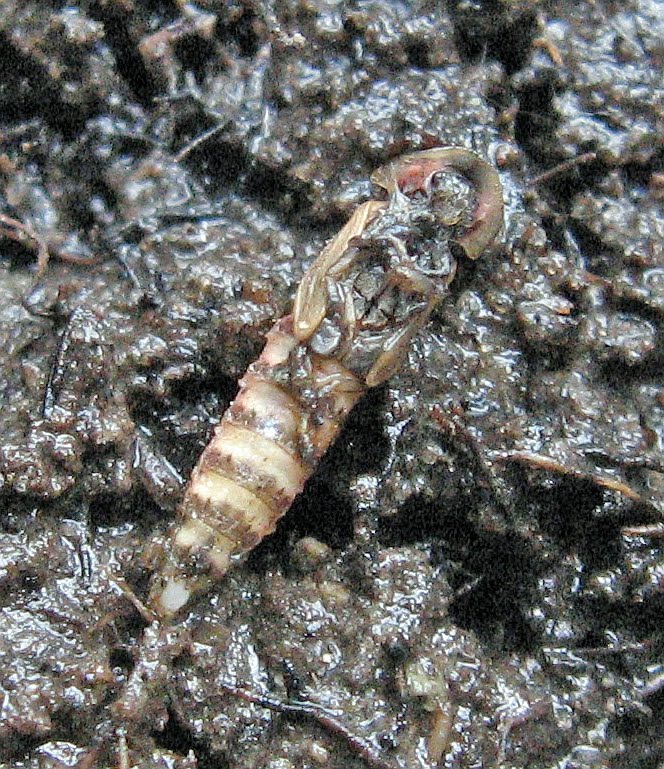
The change of form among insects that undergo complete metamorphosis is astounding, and it's difficult to believe that the egg, larva, pupa and adult are really one and the same insect.
Pupae are often thought of as a dormant and inactive but these little guys, found in moist soil under a rock along a riverbank, were quite lively when disturbed. Given the habitat, a species of diving beetle seemed to be a reasonable guess but I really had no idea as to family, let alone genus or species, so I submitted the images to BugGuide.Net for an ID.


Only so much information can be gleaned from a digital image. My camera is limited when it comes to macro shots and I don't know what the criteria are for identifying pupae in any event (in other words, which features are best to photograph?). So it seemed like a good move to take a couple of specimens home and see what kind of a beetle would emerge ... and hoping that whatever species this proved to be didn't overwinter in the pupal stage. I wasn't disappointed; the next day there was an adult Water Scavenger Beetle in the container, and not long after I posted the photos to BugGuide.Net one of the experts narrowed the ID down even more.
It seems that the keel on the ventral side is significant and my mystery pupae belong to the
genus Tropisternus.
Pretty in pink – whilst grubbing (pun intended) around under the riverside rocks and logs I found another beetle pupa and invited it to stay at my home for a time as well. I'm guessing that this is a Firefly, family Lampyridae ... time will tell. The larvae and pupae of some species are bioluminescent; I experimented in a dark room and found this one is not.
Four days later the adult beetle can been seen through the pupal case. The pupa is quite lively if disturbed and it's probably not much longer until eclosion (emergence) of the adult ...
Five days and counting ...
Development proceeded normally the following day but two days later it was obvious that the pupa had perished; there appeared to be something like a fungal growth on the exoskeleton. So what kind of beetle this – other than family Lampyridae, probably
genus Photinus – will remain a mystery.
Looking like an alien from a sci-fi movie but nothing like the adult form it will eventually assume, this Predacious Diving Beetle larva (Dytiscus sp.) was sharing a beaver pond with the
Eastern Newts photographed in the spring. With its needle-like jaws and easily 50 mm in length, the "Water Tiger" is beyond a doubt the top insect predator in its corner of the world and a newt's – not to mention a lot of other aquatic denizen's – worst nightmare.
An adult female Predacious Diving Beetle, note the grooved elytra. A rather striking change in appearance! Who would guess, without studying their life cycle and observing the changes, that the insects in these two sets of images were the same species?
The smell of carrion somewhere nearby gave a clue to the possible identity of these millipede-like larvae.
The radically different colors and profile of the adult American Carrion Beetle (Necrophila americana), one of nature's clean-up corps.
Ladybird Larvae offers a few more examples of the dramatic dissimilarities throughout the stages of a beetle's life.
The parallel striations running transverse to the length of the elytra help separate genus Colymbetes from other similar species of Dytiscid beetles. The smooth streamlined profiles of diving beetles never cease to amaze me ... so smooth that the males of some species have suction cups on their first pair of legs to hold onto the females during mating.
Rather than take pictures on the ground under poor light conditions, I let this beautiful, iridescent Carabid beetle – a Vivid Metallic Ground Beetle, genus Chlaenius – climb about on my hand until it was docile so I could turn to an angle to best display its colors. It's a good idea to handle Carabid beetles with caution; their colors may be aesthetically appealing but the foul smelling, noxious chemicals produced by many species to deter predators are definitely not, so it's best not to alarm the insect ...
Metamorphosis, mimicry and camouflage, chemical defenses, evolution, natural selection and how the myriad forms of life on our planet adapt to their ever changing circumstances, there's always something new to discover in the world of nature ... to quote one of my favorite science-fiction characters it's ... "Fascinating" ...