Tuesday, May 8, 2012

Spring Bouquet

The rush of spring bloom is in full swing, and no matter how many times I walk the same paths it seems like there's always something new that I've overlooked in past years. But it's impossible to patrol all of the habitats all the time, and, since the leaves develop after flowering, it looks like I missed out on seeing Round-lobed Hepatica (Anemone americana) in bloom this spring. Oh well, maybe next year ...


Although it's hard to see any similarity by a casual glance at its tiny flowers, Early Meadrowrue (Thalictrum dioicum) belongs to the same family – Ranunculaceae – as the familiar Meadow Buttercup.


A closeup of the flowers.


Red Baneberry, another member of the Buttercup family.


An unusual pale-flowered version of the well-known Red Trillium (Trillium erectum) stands out among the other deep red trilliums on the woodland floor.


Members of the Saxifrage family, Foamflowers (Tiarella cordifolia) are just coming into bloom.


Closeups of the blossoms ...


... and the leaves.


Growing along the river shore at the Price Conservation Area, a group of Sessile-leaved Bellwort (Uvularia sessilifolia) were so well hidden by rocks and a fallen tree that I almost passed them by.


Garlic Mustard (Alliaria petiolata) is a biennial, producing flowers and seeds in its second year of growth. Introduced from the Old World, it is considered to be a noxious weed.


The flowers of Hairy Bittercress (Cardamine hirsuta) are very similar to those of its much larger cousin, the Garlic Mustard, and bear the four petals typical of the mustards, family Brassicaceae or Cruciferae.


In addition to the difference in size, the leaves are quite different. This is the basal rosette ...


... a closeup of a basal leaf ...


... and a stem leaf.


It's not fully open yet, but I think this flower is White Avens (Geum canadense) – the leaves look correct for this species.


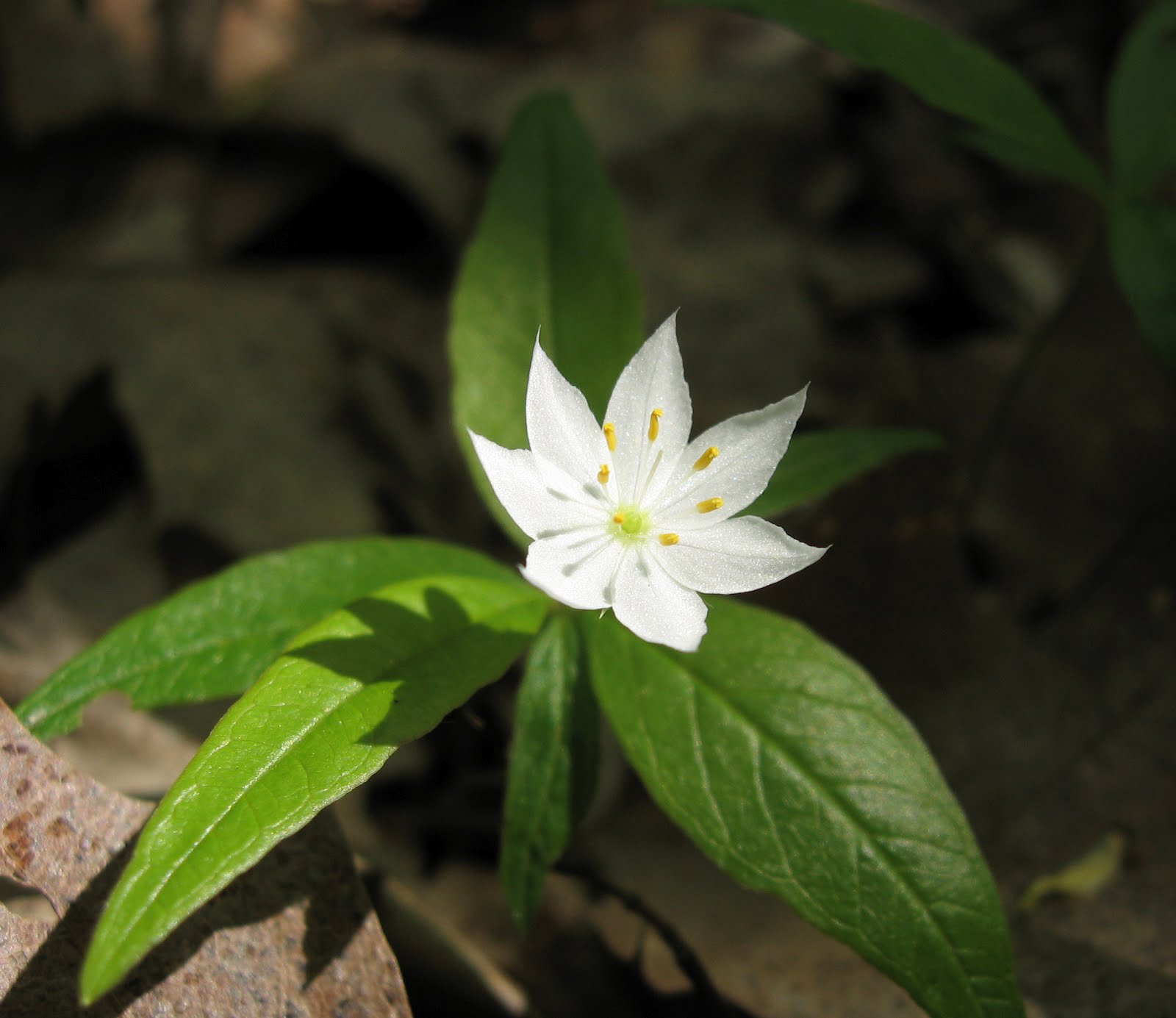
What a show! The next four species of flowers were growing within a few paces of one another. Scattered among the litter of the woodland floor were hundreds of these delicate, and aptly named, Starflowers (Trientalis borealis).

Judging by their numbers, Bluebead Lily or Yellow Clintonia (Clintonia borealis) are hardly inconspicuous or uncommon. Yet, until I literally walked into this group, I was unaware that these small lilies existed.


And another "new" flower ... Fringed Polygala or Gaywings (Polygala paucifolia).


The Bunchberry (Cornus canadensis) is a member of the Dogwood family, Cornaceae. This one is still immature, the four greenish bracts surrounding the flowers in the center will turn white in time.


Last but not least – Twining Honeysuckle (Lonicera dioica) – a botanical burst of floral fireworks to let us know that spring is really here.

American Emerald (Cordulia shurtleffii)

Another dragonfly to add to the list of species that can be seen at the Stoco Fen ... the American Emerald (Cordulia shurtleffi). The key field marks of this species are the whitish ring between S2 and S3, and the cross-vein in the forewing triangle.


The eyes of this immature female will turn a deep green with increasing age.


A male American Emerald, encountered two years ago at Stoco Lake; this dragonfly can also be found patrolling sunlit clearings along the trail.


A lateral view of another male's terminal abdominal segements – note the forked lower clasper.


In the realm of odonate identification, the male's claspers are the final word as to species. The following images depict the claspers of a male dragonfly that at first glance appeared to be a Lancet Clubtail (Gomphus exilis). But it's difficult to separate this species from the closely related Dusky Clubtail (Gomphus spicatus) and Ashy Clubtail (Gomphus lividus) solely on the basis of body coloration and patterning. So let's have a close look at the claspers ...

When viewed in lateral profile, the upper claspers of this dragonfly bear a distinct ventral spine.


And looking at the upper claspers from above, a prominent lateral spine is visible. So our specimen isn't a Lancet Clubtail after all, these features are characteristic of the Dusky Clubtail (Gomphus spicatus). Case closed.


Three of our local Baskettails are also easily confused (there's information on how to sort them out at A Fetch of Dragonflies). But the distinctively downward bent claspers of this male are clearly visible from this angle – this is a Beaverpond Baskettail (Epitheca canis). The eyes are taking on a bluish tint with increasing age.

A Flutter of Butterflies

Taking a picture of a Red Admiral (Vanessa atalanta) is not a problem this spring, as every step through a field of dandelions scares up about twenty butterflies. Other than statements such as "the right number of variables came together", there doesn't seem to be a simple explantion for the dramatic increase in numbers (it has not been attributed to global warming). But the butterflies passing through now are laying egss ... are we going to be inundated by another wave this summmer?


Closely related to both the Red Admiral and the Painted Lady (the caterpillars of which I'm trying to raise to adulthood), the American Lady (Vanessa virginiensis), sometimes called the Hunter's Butterfly, also seems to be more common than usual this year. The markings on both Lady's upper wing surfaces can be variable, making the two species difficult to distinguish. The best feature is the light orange roughly triangular spot on the leading edge of the forewing – this area is distinctly white in the Painted Lady.


The butterflies are easy to tell apart if you can get a look at the undersides of the hindwings .... the American Lady has two large eyespots, whereas the Painted Lady sports a row of four smaller spots.


This is my fifth year of photography; it took that much time and patience to luck out and get just a glimpse of the irridescent blue upper surfaces of this butterfly's wings. I've learned to have a lot of respect and appreciation for the effort the real pros have to put forth to get their shots, these people are true artists.


Apparently this small blue butterfly with the anomalous dark patch on the hindwing is a variant of the Spring Azure (Celastrina argiolus). I can only find one other picture of a similarly marked Spring Azure ... it's too bad the person who posted this didn't mention her resource, as I would like to research this further.


Fresh tree sap always makes a great butterfly magnet. Initially there was another Mourning Cloak and a couple more Red Admirals but they took flight upon my approaching too closely.

Foreground (Bottom) – Mourning Cloak (Nymphalis antiopa)
Foreground (Top) – Question Mark (Polygonia interrogationis)
Background (Center) – Red Admiral (Vanessa atalanta)


The species and numbers were constantly changing as butterflies competed for the best places to nectar.


A mere photograph cannot portray the intensity of the blue and violet spots bordering a Mourning Cloak's wings.


An Eastern Comma (Polygonia comma) perching not far from the butterfly festooned tree, and no doubt visiting it from time to time for a sip.


Moths are often drab when compared to butterflies, but not always. My first attempts at taking pictures of a brightly colored Grapevine Epimenis (Psychomorpha epimenis) were a near failure because it wouldn't sit still for two seconds. The next day I stumbled across another individual and had a little more luck. The moth became so absorbed in sipping on a particularly tasty spot of mud that I was able to pick it up and turn it to take photos from whatever angles were advantageous.


Now this looks more like a moth should – a Forage Looper (Caenurgina erechtea) neatly camouflaged against a background of dust and gravel.


The mottled wings of a Splendid Palpita (Palpita magniferalis) blend into the bark its resting on.

Saturday, May 5, 2012

The Great Painted Lady Project

One of our common but elusive local butterflies I haven't acquired a photo of to date is the Painted Lady (Vanessa cardui). An elementary school teacher I know happened to have some extra butterfly kits left over from his class, so I decided to adopt three of the caterpillars and try to raise them to adulthood. The larvae go through five stages of growth or instars, shedding their skins between each stage. I guessed (correctly, as it turned out) that the caterpillars in the following photo are third instar.


A closeup of one of the third instar caterpillars.


One week and two molts later, the caterpillars have climbed as high as they can and have attached themselves to the top of the container upside-down. The two on the left are preparing to shed their larval exoskeletons, the third on the right has made the change to a chrysalis.


A closeup of the chrysalis. The profiles of the butterfly's head with eyes and antennae, the thorax and wings, and the abdomen are clearly visible on the surface of the pupal integument. The cast-off larval skin is visible to the upper left of the chrysalis. The adult or imago should emerge in seven to ten days.


And that's where things stand as of today. One of the caterpillars died during its final molt, but with a little luck and vigilance, I'll be able to capture a sequence of images of a butterfly emerging from one of the remaining two pupae.

.................................

Maybe it was all the good nutrition, or tender loving care ... the first Painted Lady came into the world early after spending only five days as a pupa, and as a result I missed a chance to take photos of its emergence. I noticed the colors of the butterfly's wings could be seen inside the chrysalis early in the morning, when I came home four hours later, I found this ...


The wings had already hardened enough that the insect was capable of weak flight, here it is, still indoors, perching on my hand.


After having its picture taken outdoors in the sunlight the Painted Lady was released to fly free and fend for itself.


One chrysalis remaining – this is how it appeared at five days ...


... six days ...


... and seven days. The chrysalis was moved outdoors at six days, and recalling my lost opportunity to take photos of the other butterfly, I kept a close watch on the pupa all day. But – no luck, nature has its own schedules and timetables, and for whatever reason, the Painted Lady didn't emerge.


After four hours of close observation the following morning I decided to take a quick break and grab a bite to eat. When I went back outside to check on the chrysalis fifteen minutes later ... you guessed it ... too late! The Painted Lady had broken out in that short span of time, and although the wings were still like rags, weak and floppy, they had already expanded to their full size.


Now here's something that can't be observed in an adult butterfly – the slender, hollow proboscis actually consists of two sections which join at a seam along their length.


An underside view ... the split in the proboscis can be seen if the image is enlarged.


It would be virtually impossible to capture a view of the undersides of the wings when fully opened in a wild butterfly. The red fluid being expelled from the abdomen is called meconium – it's metabolic waste left over from the process of pupation.


Although the wings and body were still soft and tender, within about an hour the Painted Lady was ready to fly short distances. Like its sibling, it was photographed and left to its own devices. I didn't get the photos I wanted, but I did get pictures of this beautiful insect in mint condition, something one seldom stumbles across in the world of nature ... it's a hard, hard struggle for survival out there ...