Thursday, June 2, 2011

Lady's Slippers, a Slippery Slope and a Stray Swallowtail

A rather odd find along the trail, to the east side of the bridge across the Moira River – a Blue Columbine. Aquilegia caerulea, the state flower of Colorado? Likely a refugee from someone's flower garden.


The Stoco Fen is a rare and unique habitat that sustains uncommon species not apt to be found elsewhere. Standing or slowly moving water in the ditches alongside the road supports Cottongrass (not sure what species this one is, possibly Eriopgorum viridi-carinatum a.k.a. Green Cottongrass) ...

.. and Water Arum (Calla palustris).


Most of the Yellow Lady's Slippers (Cypripedium parviflorum) are at the end of their peak blooming period for this season and every day more of them are wilting. Luckily these two were still in good enough shape (and not powdered with dust) to be photographed.


The Small White Lady's Slipper (Cypripedium candidum), while not uncommon within the fen, has exclusive requirements, growing in very few places in Ontario, and is considered an endangered species.


One of the carnivores of the plant world and a species often characteristic of fens. Pitcher Plants (Sarracenia purpurea) grow in nutrient-poor conditions and must make up for the minerals lacking in their environment.

Abandon hope all ye who enter here ... should a hapless insect be lured into the specially modified leaf, the only direction is further down a slippery slope lined with downward pointing hairs to an enzyme filled pool ...


The return of the Giant Swallowtails! Or perhaps Papilio cresphontes has been around all along and I haven't been very observant. Not native to this area, this striking butterfly has been extending its range northward in recent years. I spotted several three years ago but haven't seen any since ... until now.


Decades ago tracts of land along the Potter's Settlement Road were planted with Red Pine. Few herbs seem to tolerate the pine needle littered forest floor and shaded understory, but Lily-of-the-Valley (Maianthemum canadense) seems to not just survive under these conditions but prosper.


The Pink Lady's Slipper (Cypripedium acaule) also thrives in this man-made habitat. There were hundreds of these floral jewels growing within a relatively small area of the forest floor.

This flower includes a mosquito, and they, too, are doing quite well and won't likely be on the endangered species list and time soon.


The road is bordered by several marshes, providing favourable growing conditions for another member of the Arum family, the Jack-in-the-Pulpit (Arisaema triphyllum).


The Stoco Fen revisted about a month later: the Small White Lady's Slipper and Yellow Lady's Slipper have had their day in the sun, they are now supplanted by the Showy Lady's Slipper (Cypripedium reginae). A one-of-a-kind habitat, and an extraordinary show of color in a brief span of time. I wonder what other orchid species grow here ...

Friday, May 27, 2011

Some Small Spiders

Relatively small, compared to some heavyweights such as the Dark Fishing Spider.

This is an Elegant Crab Spider (Xysticus elegans). Not uncommon, but often overlooked due to their cryptic coloration, small size – this one is about 5 mm long, and their habit of staying low and living near the ground.

As often happens in nature, a predator has itself become prey. This female Elegant Crab Spider has captured a predacious Carabid beetle.


Robber flies are fearsome hunters in their own right but this one has been captured by a Jumping Spider. Despite the distinctive markings on the abdomen I haven't been able to get a better I.D. on this spider than possibly Phidippus clarus.

This unknown spider at BugGuide.Net looks the same but there's no consensus as to species. To make life a little more complicated ... Phidippus clarus can have different color forms, and it's also possible that my photos are of an immature specimen, which can look very different from an adult.

There seem to be dozens of different kinds of jumping spiders lurking on the vegetation. I don't know what this robust little female is either.


Insects aren't the only arthropods that have fatal encounters with spiders, sometimes it's other spiders. The large pale spider is about 10 mm long. It's a Slender Crab Spider (Tibellus sp.), and this time a Jumping Spider's turn to play the role of the hunted.


A Flower Crab Spider (Misumena vatia) lurks on vetch.

The spider's patience has paid off. Though larger and possessing a stinger the bumblebee never had a chance, as the venom of these crab spiders is specifically toxic to bees.


Excluding its legs this Long-jawed Orb Weaver (Tetragnatha sp.) is about 15 mm long and can easily mistaken for a grass seed when at rest.

This mug shot is about the best detail possible with a subject so small (good lighting really helps!). The appellation "long jawed" certainly fits. Note what looks like globules on the ends of stalks: this spider is a male and the balls are sperm packets on the ends of its pedipalps. (The pedipalps are the two "feelers" at the front of a spider – they are not true legs).


Most orb weavers spin a new web daily, abandoning the old one. Almost invisible, these webs often entangle unwary victims such as this Four-spotted Skimmer.


The following three images were acquired indoors under poor lighting so they can't do justice to the eye-catching color scheme of this female cobweb spider. It's about 5 mm long, and the abdomen is black with silver markings. This is (probably) a Triangulate Cobweb Spider (Steatoda triangulosa). A welcome guest in many homes, as it is known to prey on fire ants, ticks, and spiders whose bite is harmful to humans such as the Hobo Spider and the Brown Recluse. With the exception of ticks none of these other arthropods are extant in this area, so a wasp moth will do for lunch ...


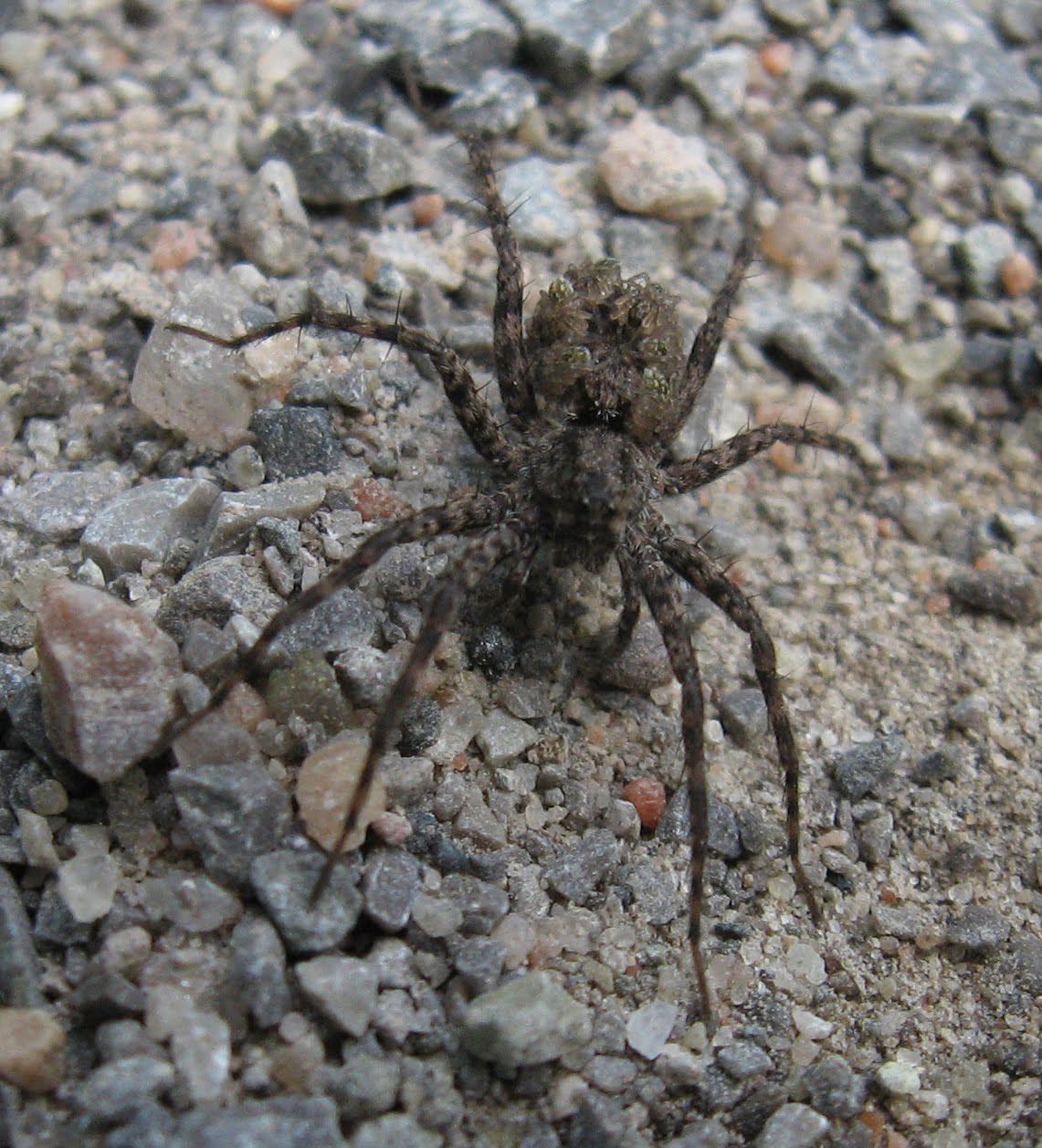
As I was taking photos of this Wolf Spider (Lycosa sp?) it seemed like something looked wrong with its abdomen. Zooming in on the image later showed what was amiss ... this is a mother spider with her young hitching a ride on her back. They will stay with her for a few weeks until they are old enough to fend for themselves. Small spiders indeed ...

Goldenrod Gall Fly (Eurosta solidaginis)

During the summer months round galls are a common sight on goldenrod. One cause of galls is insect larvae, which produce chemicals to induce the abnormal growth. The hard exterior of the gall provides a safe haven and the inside becomes a source of food.

Many kinds of insects (as well as mites and fungi) cause galls, often unique to each species on preferred host plants (more on this subject at BugGuide). Here's the culprit responsible for the round goldenrod galls: a member of the Fruit Fly family, the Goldenrod Gall Fly (Eurosta solidaginis). There's no sign of an ovipositor on this insect, which tells us that it's a male.

This fly is roughly 8 mm long (the measurement is by "rule of thumb", metaphorically speaking).

Adult flies are emerging in greater numbers every day so it was just a matter of time before I stumbled across a female (note the ovipositor) ...

... and a mating pair.

Images of females ovipositing, starting the cycle anew.

Until I took photos of this fly a few days ago and researched its life cycle on the Internet I had no idea as to the cause of the goldenrod galls. And I had always assumed that winter and early spring (when no self-respecting insect would be active) galls with holes in them were the result of predation by Downy Woodpeckers. Perhaps not: it seems that the fly larva prepares its emergence tunnel in the autumn before pupating for the winter. You learn something new every day ...


About eighteen months after posting the photographs above I've learned that there's more to the life story of the Goldenrod Gall Fly. It appears that my original surmise about the opening in the gall seen in the image above was probably correct and the cause is predation. The larva prepares an exit passage in the autumn – but – it does not chew all the way through the gall, it leaves the outer integument (epithelium) intact to provide some protection from the elements.

There were actually two larvae ensconced within the gall in the following photo. When I opened it I fortuitously split one of the exit tunnels (circled and labelled in red) right down its length. I don't have a picture of the other larva that was living in the center of the gall (its passage, which goes into the gall at a right angle to the plane of the cut surface, is annotated in blue) – it wasn't so lucky and fell victim to my jackknife.


Closer views of the larva and its exit passage.


This is the larva (about 5 mm long) in my hand, I'm not sure which end is the head. According to the Eurosta solidaginis page at BugGuide.Net pupation occurs in early spring, so I'll have to re-visit the goldenrods in a few months and check out the pupae. In the meantime, there's some fascinating information about this insect's winter survival strategies at: Which Way Out – A Study of the Exit Tunnels made by the Goldenrod Gall Fly, Eurosta solidaginis.


The conclusion of a story that began two years ago – these final three photos of the pupa of the Goldenrod Gall Fly were taken and uploaded in early May 2013. I haven't determined the earliest that pupation takes place, but I have found some in mid-April.