Tuesday, August 23, 2011

Corals, Jellies and Brackets

Despite their significant role as recyclers and symbionts ... some estimates place the amount of biomass in a forest as consisting of 90% fungi ... fungi generally go unnoticed. The mushroom a person sees on a stroll through the woods is just the spore producing structure, most of the fungus, the mycelium, consisting of microscopic thread-like hyphae, is hidden in the soil or wood. But little things add up, and depending on one's definition of an organism it's possible that a fungus, Armillaria solidipes, is one of the world's largest life forms.

On a more modest scale, individuals such as this Golden Coral Fungus (Ramaria sp.) are often overlooked because they are nearly buried in the woodland litter. There are several species in genus Ramaria, some can only be distinguished with a microscope.


White Spindles, Worm Coral Fungus or Fairy Fingers (Clavaria vermicularis) is easy to recognize ...


... as is the Yellow Spindle Coral Fungus (Clavulinopsis fusiformis).


Many species of jelly fungi superficially resemble coral fungi. The term "jelly" might seem to imply soft and weak, but jelly fungi are tough and resilient, whereas coral fungi generally brittle, breaking and bruising easily. These Yellow Fingers (Calocera cornea) were a millimeter wide at most, yet they were quite difficult to break.


This jelly fungus goes by the confusing name of White Coral Jelly (Tremella reticulata).


With its warm mahogany color and glossy surface the Lacquered Polypore (Ganoderma lucidum) is a beautiful fungus. This specimen was about 10 cm across, yet I almost missed it because it was completely hidden in the dense brush surrounding the base of the tree.


Even more striking is the Chicken of the Woods (Laetiporus sulphureus). There's no way one can overlook this polypore, it stands out like a beacon in the shade of the forest. That's a size 12 shoe in the first picture.

Getting a photo of the perfect specimen is often a matter of being in the right place at the right time. This is the same fungus as above ... nine days later.

Wednesday, August 17, 2011

The Great Fungus Hunt continues at the Vanderwater Conservation Area

The woodlands bordering the paths of the Vanderwater Conservation Area are another excellent place to hunt for mushrooms. From a photography perspective the lighting is less than optimal and it's often necessary to use the flash, resulting in distorted colors or glare. Although photographed in a shaded area this Gemmed Amanita (Amanita gemmata) didn't turn out too bad.


Using the flash on a pale white or yellow subject usually produces results like this. If possible it's best to use natural lighting reflected with aluminum foil. Despite the poor image enough of the mushroom's markings are visible to say this is a Stinking Parasol (Lepiota cristata).


By far one of the most common mushrooms found on the forest floor is Paxillus atrotomentosus ... "atrotomentosus", meaning black hair, refers to the dark, wooly stem of this species.


This Indigo Lactarius or Blue Milk Mushroom (Lactarius indigo) stood out among the drab debris littering the ground. The caps of these young specimens will assume a very different profile when the fungi matures.


Another appealingly colored mushroom, a Conic Waxcap (Hygrocybe conica). The pure, vibrant colors of waxcaps make them good subjects.


As a rule most species of fungi can't be reliably identified on a strictly visual basis; spore prints and a microscopic examination are necessary. Based on the photo and the species account in my field guide I first thought this striking orange-yellow mushroom was Pholiota malicola. Having done some research on the Internet I'm now leaning toward Pholiota limonella.

Speaking of spore prints: it isn't always necessary to remove the cap from a specimen and take it home. Look for fallen spores on a mushroom's annulus or ring if it has one (for example, the amanita above), on the lower growing mushrooms in a group, or even on dead leaves underneath.


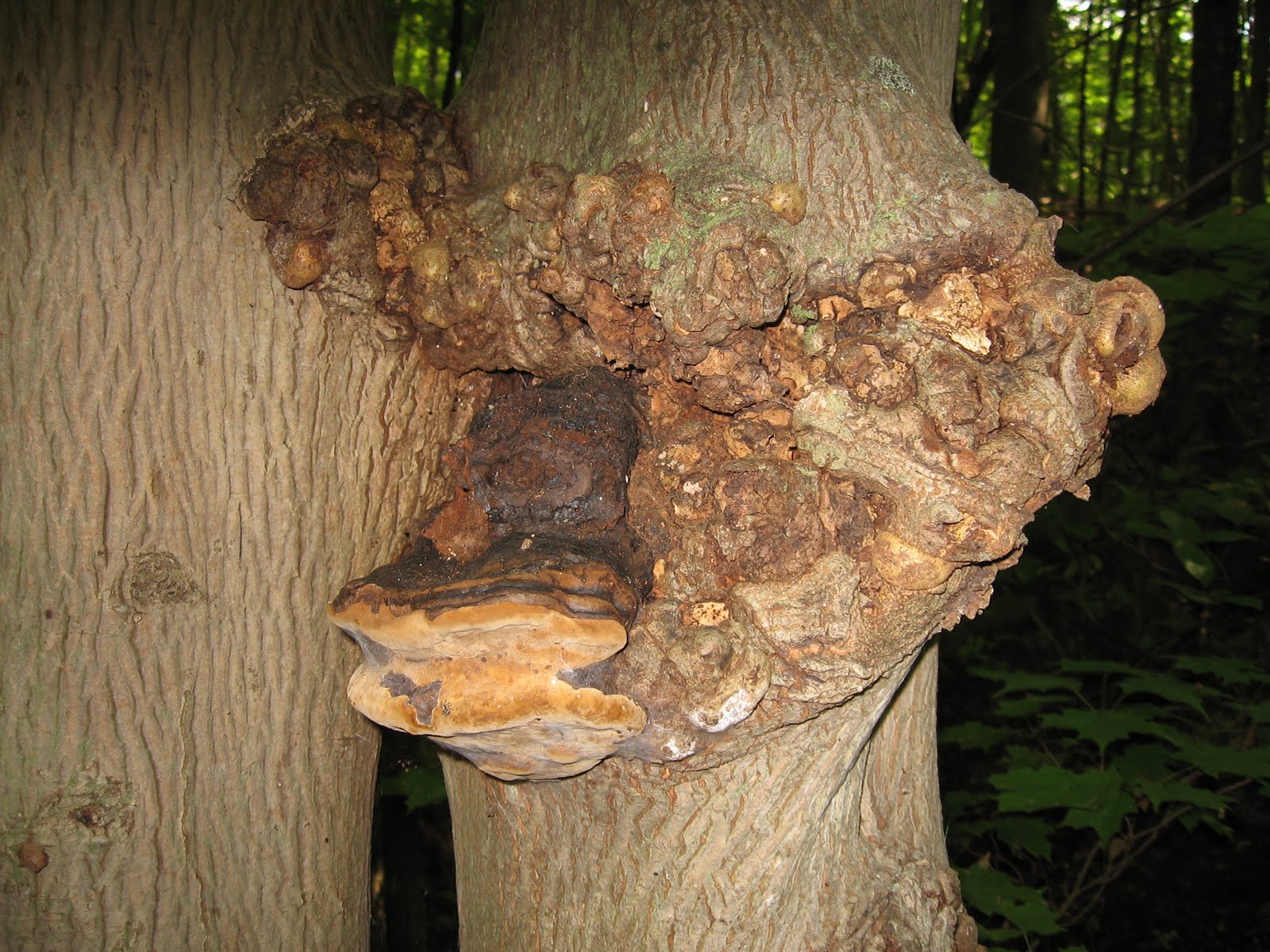
This tree was so badly infested with canker that it stood out like a sore thumb. A closer inspection revealed that the cankers were some kind of polypore, or, perhaps the bracket fungus is a secondary infection. I haven't been able to identify the species as yet.


An entire copse of birches was similarly host to the hoof-like Tinder Polypore (Fomes fomentarius). I couldn't stand back far enough to take a picture of the entire tree(s) but they were covered from top to bottom.


Polypores are often thought of as bracket fungi, shelving fungi broadly attached to their hosts without the benefit of a stipe or stem. While often true this isn't always the case, as the Polyporus varius below illustrates, and the bottom view also explains the reason this group of fungi are named "polypores" (many pores).


Coltricia perennis is another example of a stemmed polypore. This is an older specimen and the center of the cap is a little worse for wear.


The Mossy Maze Polypore (Cerrena unicolor) is a more typical bracket fungus. The upper surface often turns green from algae and the pores are tooth-like. Apparently this polypore has an interesting connection to the Pigeon Horntail and the Giant Ichneumon Wasp (Megarhyssa sp.). A tangled web indeed ...


Easily identified by their distinctive varnished caps, gaudy Red-banded Polypore (Fomitopsis pinicola) were common on decaying logs.


With its rough cap and stem the Old Man of the Woods (Strobilomyces strobilaceus) can't be mistaken for another species. An inspection of the underside of the cap reveals that this mushroom is a bolete.


As always there are always things out there that are a mystery. I don't know if this is a group of Stinkhorn "eggs", or immature Dead Man's Fingers.

It's hard to tell from the rough, woody exterior, but Dead Man's Fingers (Xylaria polymorpha) is actually an ascomycete, a distant relative of the more familiar edible morel. Living things are classified on the basis of how they survive and reproduce and fungi are no exception. When viewed under a microscope the spore producing organs of this species are the same as those of sac fungi, hence it's grouped with them.