Showing posts with label Tiger Swallowtail. Show all posts

Tuesday, May 22, 2012

Ah yes ... Oneness, Identity and Unity with Mother Nature ... Singularity, Sameness and Solidarity with the Swallowtails ...

Maybe it's the relatively warm winter and spring weather we've had, or perhaps it's due to other factors, but there's a real bumper crop of butterflies this year. In addition to the recent population explosion of Red Admirals there's also an abundance of other species ... Question Marks, Mourning Cloaks, Baltimores, and – relative newcomers to our area – Giant Swallowtails (Papilio cresphontes).

Butterflies can often be seen sipping at mud puddles, bird droppings, rotten fruit or carrion, looking for minerals and amino acids.


They can become so absorbed in their business that they barely notice what's happening around them, and this Giant Swallowtail didn't take flight when I held up it's wing to take a photo of the underside.


The insect shows no fear of me whatsoever as I move my hand closer ...


... and closer ...


I was able to pick this normally skittish and difficult to approach insect up off the sand, and it continued to contentedly imbibe the moisture and perspiration from my fingers.


Butterflies are often attracted to perspiration, and in the past few years I have had many of our local lepidoptera taste test me on warm, sunny days, like the Compton Tortoiseshell back in mid-March. But some butterflies aren't so easily tempted, and I was able to make close contact with this Black Swallowtail (Papilio polyxenes) not because it fell for my charming personality or sweet scent, but because it was stunned due to a misadventure with a passing car.


There were over a dozen Tiger Swallowtails (Papilio glaucus) sharing the beach with the Giant Swallowtails. It seems that their instincts for survival are better honed than those of their larger cousins, because, alas, I was unable to "tame" any of these butterflies ...


A digital capture of the essence of late spring and the beauty of the world around us – a Giant Swallowtail nectaring at Viburnum triloba, more commonly known as Highbush Cranberry.

Wednesday, June 2, 2010

What's for Lunch?

Depends on what you are. Butterflies imbibe their nutrients through a straw-like proboscis.


While they are generally thought of as insects that sip nectar from flowers, butterflies can often be observed drinking from ... in fact, having a preference for ... mud, sap, bird droppings, manure, urine, rotting fruit or well aged carcasses. This is how they obtain vital salts, minerals and amino acids.

These Eastern Tiger Swallowtails (Papilio glaucus) were feeding at freshly watered compost on the garden. The two butterflies were frequently jockeying for position to get at the same morsel.


A White Admiral (Limenitis arthemis arthemis) stopping to sip at a damp spot on the Eastern Ontario Trail. Having one for the road, so to speak?


A Baltimore Checkerspot (Euphydryas phaeton) engaging in the same behaviour a short distance further up the trail.

Ventral view of the Baltimore Checkerspot


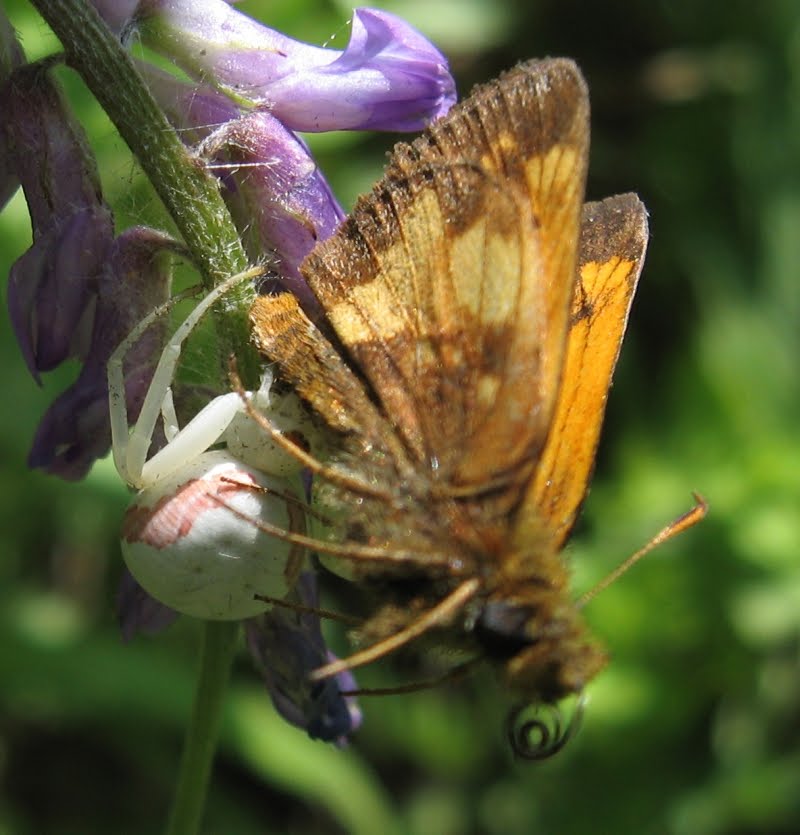
This hapless Hobomok Skipper (Poanes hobomok) stopped to nectar at a Purple Vetch, placed its proboscis where it shouldn't have, and has itself become dinner for a Flower Crab Spider (Misumena vatia). These spiders are able to change their color to yellow or white in order to blend into the background of the flower on which they are lurking.


As often happens the hunter becomes the hunted. Things were moving fast so I couldn't get good closeups of this wasp dragging a paralysed orb weaver to its burrow, where the spider will provide nourishment for the wasp's larva. As yet I haven't been able to identify the wasp, but I should be able to narrow it down in time. There are many different species of spider wasp and they don't prey indiscriminately on any spider, each has its own host species. This wasp would be adapted to instinctively avoid getting entagled in an orb weaver's web.


I found the orb weaver itself interesting, as there aren't that many green spiders around and I couldn't recall having seen one quite like this. I did some Googling and it looks like this spider is a Giant Lichen Orbweaver (Araneus bicentenarius). The spider in my photo would easily fit on the nail of my pinky finger but according to the author linked to above the adult female is the size of a golf ball.


Lunch for the larva of a Beewolf (Philanthus sp.) is the bee in the female's grasp. The Beewolf settled on a stepping stone in the garden for a few seconds to oviposit on the unfortunate host bee.


For a damselfly lunch is a smaller insect. There isn't enough left over to tell what the Stream Bluet (Enallagma exsulans) is eating ...

... but this Marsh Bluet (Enallagma ebrium) is chowing down on a seed bug. The bug wasn't captured on the wing, the bluet pounced on it while it was resting on the blade of grass seen in the photo.

This takes first prize: how to get a perfect meal and simultaneously eliminate a potential younger competitor from the gene pool. A mature female Eastern Forktail (Ischnura verticalis) consuming an immature female of her own species. You are what you eat ...