Showing posts with label Orbweaver. Show all posts

Thursday, September 25, 2014

Striking Spiders

Striking – arresting the attention and producing a vivid impression on the sight or the mind, attracting attention by reason of being unusual, extreme, or prominent, conspicuously attractive or impressive.

A dazzling Dark Fishing Spider, arresting the attention of an observer by virtue of her size, from the cephalothorax to the tip of the abdomen she is a mere 20 mm in length. Dolomedes tenebrosus can attain a body size of up to 26 mm with the legs spanning 90 mm but this one is deflated after laying her eggs. Like most Pisauridae (a.k.a. Nursery Web Spiders) she stands guard over her brood until they a bit older and better able to fend for themselves.


The spiderlings have already been through one molt and the pale exuviae can be seen littering the nursery.


A couple of closeups of the female, with one of her offspring clinging to her abdomen in the second photo.


A friend brought this wondrous Wolf Spider to me for identification, but unfortunately for the spider it was DOA when it arrived. The body length of this particular female Tigrosa aspersa was 23 mm and the legs measured 70 mm across, however, these "wolfies" can reach a respectable 30 mm.

The spider did indeed produce a vivid impression on the sight and the mind – the person who killed it woke up in the night and found the spider crawling on them; I wasn't informed what part of their anatomy. They immediately dispatched it (this was not the intent or one of the definitions of "striking" in the title), but under the circumstances it's pretty hard to fault a person for being startled ...


The arrangements spider's eyes are unique to each family, and this one's eye pattern is typical of the family Lycosidae.


A marvelous Marbled Orbweaver, in my opinion this is by far the most beautifully colored and patterned spider I have ever encountered. Araneus marmoreus is small compared to the foregoing two spiders, the body measures about 20 mm and the legs are relatively short, but it makes up visually what it lacks in sheer bulk – conspicuously attractive or impressive indeed!


The Marbled Orbweaver featured above is a female, and she's gravid and ready to lay her eggs any day to start the life cycle of her kind anew. On the other hand the female Longjawed Orbweaver (Tetragnatha spp) in the following photo won't likely get her chance to pass her genes on to the next generation, that opportunity now belongs to the small wasp, only about 3 mm in length, that's clinging to the underside of the spider.

The image was acquired under poor lighting conditions and is a bit out of focus but the wasp's ovipositor, ready to deliver its egg (or eggs?), is clearly visible in the photo. It's interesting to note that the wasp is in a "safe zone" and the hapless spider cannot reach it with its jaws.

The picture has been uploaded to BugGuide.Net where hopefully someone can identify the wasp. As of now I have no idea as to the wasp's species (Ichneumon, perhaps?) or life cycle – does it lay one egg per spider, or more? Will the spider be paralyzed by the hymenopteran's venom, or will it continue to go through the motions as the wasp larva (or larvae?) consume it from within? Whatever the story may be, like everything else in the world of nature we can be certain it's fascinating and compelling, possibly even (from our human viewpoint) bizarre ... which are all synonyms for the word "striking".

Tuesday, June 24, 2014

An Off the Wall Orbweaver

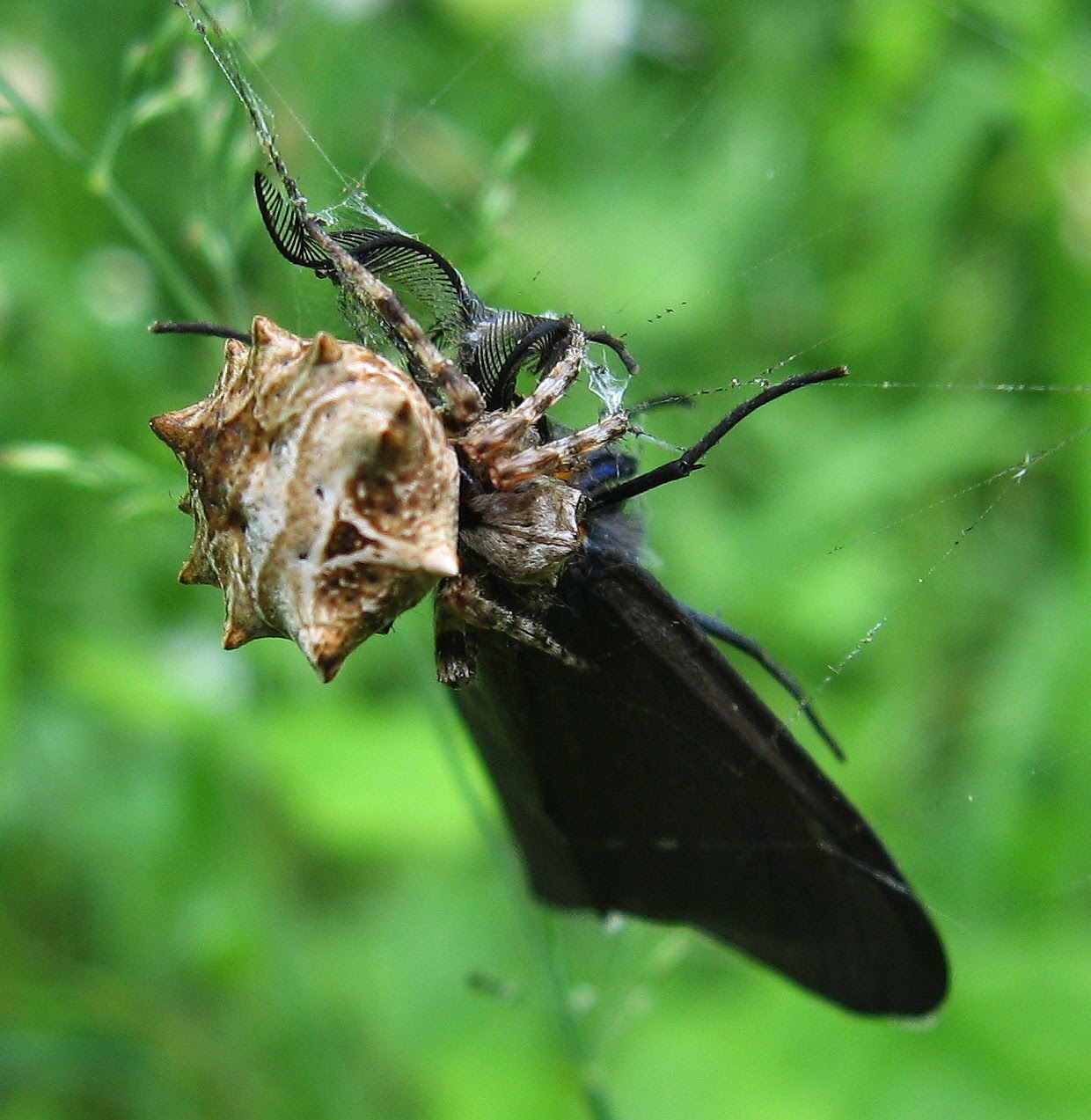
The Star Bellied Orbweaver certainly stands out from the crowd and deserves the "Coolest Local Spider" prize for its offbeat shape if not for size or color.

There are four species in Canada and the United States, and considering the possibilities enumerated at the BugGuide.Net Acanthepeira page it looks like this is Acanthepeira stellata. As their irregular profile and patterning makes them resemble a small piece of dead leaf or other plant debris, Star Bellied Orbweavers don't stand out so easily in the field and the only thing that gave this female away was the brightly colored Virginia Ctenucha moth hanging in her web.


A couple of closeup shots – this individual was about 10 mm long, roughly twice the size of the Star Bellied Orbweaver encountered a couple of weeks ago.


Wednesday, June 11, 2014

"If you wish to live and thrive, let a spider run alive."

The origin of this saying is a bit of a mystery. Is it an Old English nursery rhyme? An American Quaker saying? At least it contains more than a grain of truth (where would the world's ecosystems – and we – be without spiders?), and it's certainly better than the bit of folk nonsense – "Step on a spider and it will rain." One thing for sure, there are plenty of spiders running alive – in the grass, on leaves, on trees, under stones and on the water – almost anywhere you care to look.

The wonder is that spiders aren't noticed more often. True, some have lifestyles that require cryptic colors but many arachnids literally glitter and shine and are as dazzling as any butterfly or flower. Like this female Tutelina similis, for example. The photos simply cannot do justice to this spider, it's body, a whole 5 mm in length, is iridescent but the cephalothorax under the right lighting is a shimmering lilac color. Tutelina similis differs from the closely related Tutelina elegans in not having a white band around the abdomen.


Two tiny male spiders, about 3 mm in length, were in the vicinity of the female. Sure enough there was a connection – they were indeed male Tutelina similis (a male Tutelina elegans would sport black tufts of hair on its first tibia) and no doubt prospective suitors for her hand in marriage, metaphorically speaking, all eight of them ... and him with only seven ...


A male Habronattus decorus ... the name is certainly apropos, how does irridescent pearl grey and glittering rose sound for a color scheme? Again, the image doesn't convey how striking this spider is in reality . All of this is packed into a mere 5 mm ... yes, Jumping Spiders definitely take first prize for appearance and color.


Doing its best to imitate a bit of dead plant debris or a dry seed, Acanthepeira spp makes up in funky form what it lacks in cool colors. This Orbweaver is only about 5 mm long making it very easy to overlook, which of course is the idea from a predator/prey point of view.


Much like the origin of the saying in the title of this post, the identity of this ant-mimicking male arachnid is a mystery ...


... as were, until recently, the names of the following two spiders. But today, whilst researching the enigmatic ant-mimick I identified this male by stumbling across it whilst searching for something else – it's a Two-banded Antmimic (Castianeira cingulata). "Stumbling across" is used in a figurative and not literal sense, the spider is only about 6 mm long.


This pretty girl with the yummy name of Candystripe Spider (Enoplognatha ovata) was also IDed by random find (of the same blog!) on the 'net. Too bad she prefers to hide out in the shadows instead of showing off her colors.


Beautifully patterned in black and white, Neriene radiata, the Filmy Dome Spider, also prefers shady places. It's a male (note the enlarged palps) and it looks like he's molted recently because there's an exuviae in his web (look near the bottom of the first photograph).


It's easy to dismiss spiders and think of them, if not with outright fear and revulsion, as drab and uninteresting creepy-crawlies beneath our notice. Hopefully these photographs and the images elsewhere in this blog have shattered that illusion and illustrated the diversity of color, form, and the fascinating lifestlyes of spiders. They've been "running alive" for a cool 300 million years, that's a lot of time to be sifted though the sieve of natural selection and find their place in the tangled web of life on earth, and it's an ongoing process ...