Friday, August 13, 2010

Dogday Harvestfly or Annual Cicada (Tibicen sp.)

One seldom encounters these large, fearsome looking but completely harmless insects at close range as they generally stay high up in the trees. The singing of the Dogday Harvestfly signals the onset of late summer. According to some sources the saw-like buzzing of the males measures 100 decibels at twenty yards and up to 120 decibels at close range.

Cicadas belong to the order Hemiptera, which includes insects such as aphids and true bugs. The nymphs live underground for three years feeding on the roots of oak and pine, and their exuviae can often be found on the trunks of these trees near the bases. The adults do not eat.

Thursday, August 12, 2010

Black Saddlebags (Tramea lacerata)

An uncommon dragonfly locally, this teneral male is only my second encounter with a Black Saddlebags, my last sighting was in August of 2008. It was found perching on the sidewalk and moved to a safe place in the garden.

Being a teneral (note the luster of the wings in the first image) the dragonfly cannot have roamed far from where it emerged from the water. So ... why aren't these insects more conspicuous, and where are they breeding?

Monday, August 9, 2010

Canada Darner (Aeshna canadensis), Black-tipped Darner (Aeshna tuberculifera) and Shadow Darner (Aeshna umbrosa)

This Canada Darner (Aeshna canadensis) is an immature female, and also a bit cold, so it lacks the depth of color of a mature adult. A large dragonfly, the Canada Darner is about 70 mm long. The photo was taken at Stoco Lake.

Note the styli in this closeup of the terminal abdominal segments.

The notched thoracic stripe is visible in the following lateral views. Also note in the third image that this darner has no facial cross-stripe. The absence or presence of this feature can often be a quick means of sorting out similar darner species in the field.

The exuviae in the next series of images, discovered a few feet away on another tree, likely belongs to the darner above. This find provided an opportunity to obtain pictures of the hinged labium unique to odonate larve.

The colors are pale and the light isn't the best, but the notched thoracic stripe and lack of a facial cross-stripe can be seen in this teneral female, encountered not far from where the female above was photographed.

Darners often forage a fair distance from water and this female lost its bearings and got trapped a window. This is generally game over as the heat will quickly exhaust and kill the insect. The dragonfly was extricated and I took advantage of the chance to capture the beautiful green, turquoise and blue of a mature Canada Darner, after which it was released to continue its journey.

There is a bit of reasonable doubt in my mind as to species and it's possible that these "Canada Darners" are actually the closely related Green-striped Darners (Aeshna verticalis). I haven't had many close encounters with either kind of dragonfly and lack the experience to be proficient at distinguishing the two. Here are a couple of tail end views ... you be the judge.


This male Black-tipped Darner (Aeshna tuberculifera) was the victim of a collision with a vehicle. The thorax was too badly damaged to make out the stripes but enough of the insect's other key field marks remained intact enough to be worth imaging. Black-tipped Darners attain a length of about 70 mm. Note the the cross-stripe on the dragonfly's face.

Views of the claspers and all black terminal segment S10.

This female Black-tipped Darner was encountered along the Eastern Ontario Trail in August of 2008. The female below was photographed perching alongside the trail a few kilometers west of town; again note that S10 is completely black.


I couldn't get any images of the distinctive walking cane shaped thoracic stripes of this male Shadow Darner (Aeshna umbrosa) because it too was hit by a car. The face lacks a cross-stripe although it may show a thin brown line as in this specimen. Shadow Darners are about 75 mm long but relatively slender compared to their other large darner cousins.

The next set of images depicts lateral, dorsal and ventral views of the terminal abdominal segments. In lateral profile the cerci are spatulate with pointed tips, similar to the claspers of the Lance-tipped Darner. However, these organs appear quite different in the two species when viewed from above or below. The Shadow Darner's abdominal spots are greenish and much smaller than in other Aeshna species, giving this dragonfly a dark aspect.

Saturday, August 7, 2010

Common Green Darner (Anax junius)

A large darner with a length of about 80 mm, this immature male's abdomen will turn blue with age (a female's abdomen retains the reddish purple hue). The pictures were taken near the marsh bordering the Eastern Ontario Trail. These beautiful insects are often encountered at the north shore of Stoco Lake, where one has a good chance of seeing ovipositing pairs on emergent vegetation.

It's surprising how well camouflaged the dragonfly is despite its psychedelic color scheme. (Said color scheme having evolved over millions of years of natural selection, yet still appealing to the human sense of esthetics. But then again, some people loathe and fear these harmless, and from our point of view, beneficial insects.)

The target shaped mark on top of the head confirms this is indeed a Common Green Darner (Anax junius) and not a Comet Darner (Anax longipes). The latter species is a vagrant in southern Ontario and unlikely to be encountered in this area in any event.

Here's a dorsal closeup of the head of a different immature male portraying the distinctive "bull's eye".

The striking colors and patterning of the Common Green Darner are unique, making this oblique detail view of the cerci unnecessary for identification. Since the profile of the claspers is often vital to distinguish closely related odonate species, it's second nature to me to acquire an image of the terminal abdominal segments whenever possible.

Saturday, July 17, 2010

Calico Pennant (Celithemis elisa)

At 30 mm in length this dragonfly is smaller than the Halloween Pennant. The Calico Pennant seems to be less common in this area than the Halloween Pennant. In the past I've found Calico Pennant remains on a couple of occasions but this is my first encounter with a live one. Note the distinctly red face ...

... and the large patch at the base of the hindwing. The remaining markings on the wings are spots (compare these to the bands on the wings of the Halloween Pennant).

The bold red triangles on the abdomen and red sides of the thorax indicate this is a male.

Almost one year later ... I stumbled across the Calico Pennant's breeding site. A small sand-and-stone bottomed creek bordered with dense vegetation runs near the intersection of Alexander Street and the Eastern Ontario Trail. And surprise! three females were foraging in the tall grass and wildflowers. So this dragonfly isn't uncommon after all, it's just a matter of being in the right place at the right time ...

Another local Calico Pennant habitat: several males and a female were encountered at a marsh on the Upper Flinton Road, abouyt 150 m east of Moores Road.

Saturday, July 10, 2010

Imitation is the sincerest form of flattery ...

... and for many species it's also a means of ensuring survival. Batesian mimicry is a kind of mimicry where a harmless species has evolved to imitate the warning signals of a stinging, toxic or in other way dangerous species. (This is different than mimesis, where the mimic assumes the colors and/or profile of, for example, a leaf, twig or bark).

Hummingbird moths generally hover while nectaring and are seldom seen sitting as this one is. I'm calling this a Snowberry Clearwing (Hemaris diffinis) but since this is the only image thus far perhaps the name should be left at the genus level. Ventral view(s) would have helped confirm the species. Further reading at BugGuide.Net

This helps. Not the best of pictures since it's hard to aim the camera at a moving target, but the underside of the moth is visible, and it fits the description for Hemaris diffinis. In the field, even while hovering or flying, this clearwing appears smaller and its color is distinctly greenish compared to ...

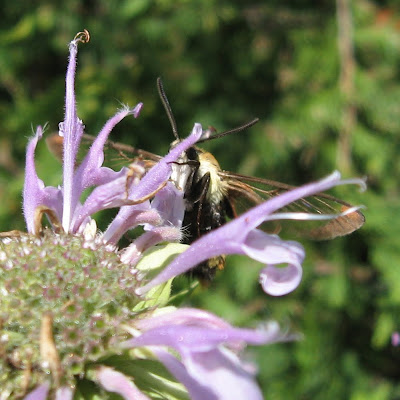
... the Hummingbird Clearwing Moth (Hemaris thysbe), nectaring at wild bergamot. This moth has red on the dorsal surface of the abdomen and whitish legs (compare to the legs of the moth depicted above).

Ventral and dorsal views of another Hemaris thysbe


Its overall solid blue-black colors, habit of flicking its tinted wings, and quick nervous manner of moving about while nectaring ... everything about the appearance and behaviour of this Chalcosyrphus chalybeus indicated it was a solitary spider wasp. This insect is actually a species of flower fly, of the family Syrphidae, related to the ubiquitous little black-and-yellow striped hover flies commonly encountered in fields and gardens.


Here are a few more insect imposters I've stumbled across on my travels through thickets of thistles, nettles, prickly ash and poison ivy.

A Tachinid fly, Cylindromyia sp.


A female Clematis Clearwing Moth (Alcathoe caudata)


A species of Long-horned Beetle, Clytus ruricola


A fly, Macroceromys terminalis (formerly genus Xylomya). Thanks to David Bree for help with the I.D. on this one.


This small wasp-like robber fly is only about 10 mm long. At first I thought it might be a species of Eudioctria but having done more research on the Internet it seems this is more likely a member of the Laphria sicula/canis/winnemana complex. The first image is a bit out of focus but the long proboscis is quite visible. And it wasn't long before the fly put it to use ... it looks like it has captured a small beetle.