Friday, August 13, 2010

Bug eggs on Purple Loosestrife, and other random insect encounters

This clutch of unusual eggs and small insects (?) on a Purple Loosestrife leaf was found along the Eastern Ontario Trail. Inspection with a low power magnifying glass showed that the little red-and-black objects were indeed insects, true bug (Heteroptera) nymphs, and my first thought was that this might be a species introduced to control the unwelcome plants.

Not so. It seems the momma bug is likely a Spined Soldier Bug, or a related species, and used the leaf for convenience and not as a future food source for her offspring. Here's a link to further reading at BugGuide.Net, and searching for "spined soldier bug eggs" at Google Images will return more photos.


Always look twice ... a misplaced patch of brown on a Box Elder (a.k.a. Manitoba Maple) leaf turned out to be the eggs of a Boxelder Bug upon closer inspection. A big thank you to Laurie Campbell of Campbell's One Stop in Tweed for the use of her digital microscope which made it possible to capture the images in such detail. There are also some good photos of Box Elder Bugs ovipositing at Seabrooke Leckie's The Marvelous in Nature.


With a length of only about 5 mm and cryptically colored, this tiny treehopper, Acutalis brunnea, is easy to overlook.


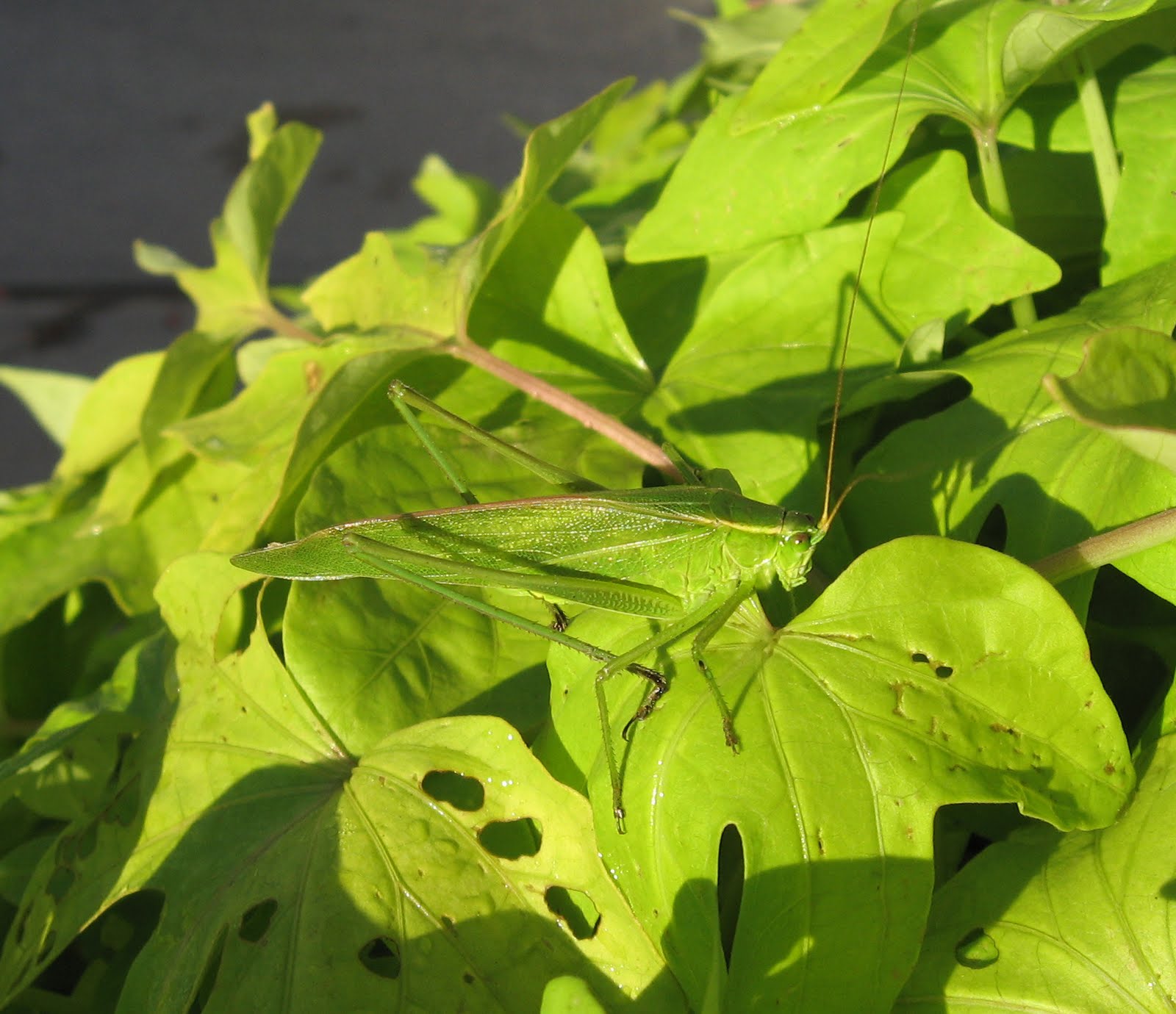
Inconspicuous against the background of foliage, this female Texas Bush Katydid (Scudderia texensis) was found perching in the planters downtown. Here's a link to an instructive web page used to identify the insect (includes range maps) ... Genus Scudderia

Moving on to some flies: the next two images depict a Syrphid fly of the genus Sphaerophoria (length about 10 mm). The larvae are good friends to have in the garden as they prey on aphids. More information on these flies may be found at BugGuide.Net.


Syrphid flies, a.k.a. hover flies or flower flies, form a large family. Many are boldly striped in some variation of black and yellow, imitating bees or wasps. This is a Transverse Flower Fly (Eristalis transversa).


Parhelophilus sp., nectaring on flowers of wapato, is another member of the family Syrphidae. These photos were taken along the shore of Stoco Lake.


Tachinid flies are another interesting and diverse family. The fly with the extraordinary spines on its abdomen in the first group of four photos is Juriniopsis sp.


The tachinid fly in the next four images is Archytas sp. These flies can be wary and hard to photograph but for whatever reason (good taste, maybe?) this one was quite unafraid and landed on my hand.


Various species of soldier flies of the family Stratiomyidae. Or rather various genera ... even for experts many insects can be difficult to narrow down to the species level using only photos. This cool lime green fly is Odontomyia sp.


A more robust soldier fly, Stratiomys sp.
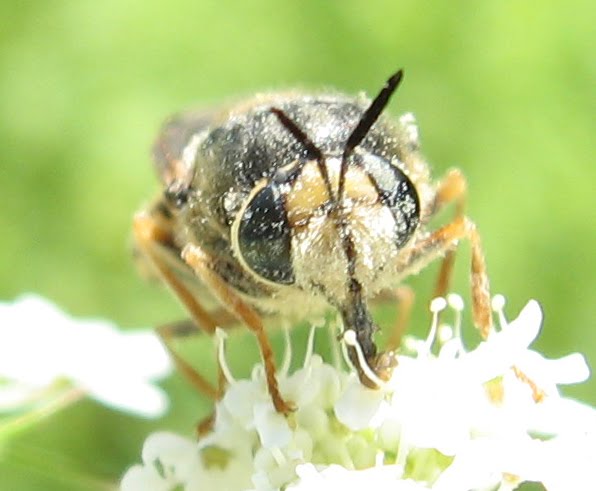

And this fly? I can't decide what name to assign to it ... there are images of both Stratiomys and Odontomyia that look similar.


According to BugGuide.Net there are four different species in the genus Sparnopolius, but only S. confusus occurs in the east. To compare notes have a look at the images of Systoechus from 2008. I've made a judgement as to species based on images, is it correct in one or both cases?


North shore of Stoco Lake ... a mature female Swamp Spreadwing (Lestes vigilax) consuming a male Eastern Forktail (Ischnura verticalis). The colors on older females become obscured and they will often develop some pruinosity on the terminal segments of the abdomen.

A mating pair of Swamp Spreadwings (Lestes vigilax).


Despite the abundance of Blue Dashers (Pachydiplax longipennis) my encounters with mating pairs of this species are few and far between. Male and female odonates can be very different in appearance and prior to owning field guides observing a mating pair was my only means of establishing that a given male and female are the same species.


Last but not least: I don't recall how long ago the images of this pale green Assassin Bug were taken, but I couldn't ID the insect in a reasonable time and the photos ended up being buried in my "unidentified" files. Thanks to the images submitted by Mike Mills, a contributor at BugGuide.Net, I was able to identify my mystery bug as Zelus luridus.

Dogday Harvestfly or Annual Cicada (Tibicen sp.)

One seldom encounters these large, fearsome looking but completely harmless insects at close range as they generally stay high up in the trees. The singing of the Dogday Harvestfly signals the onset of late summer. According to some sources the saw-like buzzing of the males measures 100 decibels at twenty yards and up to 120 decibels at close range.

Cicadas belong to the order Hemiptera, which includes insects such as aphids and true bugs. The nymphs live underground for three years feeding on the roots of oak and pine, and their exuviae can often be found on the trunks of these trees near the bases. The adults do not eat.

Thursday, August 12, 2010

Black Saddlebags (Tramea lacerata)

An uncommon dragonfly locally, this teneral male is only my second encounter with a Black Saddlebags, my last sighting was in August of 2008. It was found perching on the sidewalk and moved to a safe place in the garden.

Being a teneral (note the luster of the wings in the first image) the dragonfly cannot have roamed far from where it emerged from the water. So ... why aren't these insects more conspicuous, and where are they breeding?

Monday, August 9, 2010

Canada Darner (Aeshna canadensis), Black-tipped Darner (Aeshna tuberculifera) and Shadow Darner (Aeshna umbrosa)

This Canada Darner (Aeshna canadensis) is an immature female, and also a bit cold, so it lacks the depth of color of a mature adult. A large dragonfly, the Canada Darner is about 70 mm long. The photo was taken at Stoco Lake.

Note the styli in this closeup of the terminal abdominal segments.

The notched thoracic stripe is visible in the following lateral views. Also note in the third image that this darner has no facial cross-stripe. The absence or presence of this feature can often be a quick means of sorting out similar darner species in the field.

The exuviae in the next series of images, discovered a few feet away on another tree, likely belongs to the darner above. This find provided an opportunity to obtain pictures of the hinged labium unique to odonate larve.

The colors are pale and the light isn't the best, but the notched thoracic stripe and lack of a facial cross-stripe can be seen in this teneral female, encountered not far from where the female above was photographed.

Darners often forage a fair distance from water and this female lost its bearings and got trapped a window. This is generally game over as the heat will quickly exhaust and kill the insect. The dragonfly was extricated and I took advantage of the chance to capture the beautiful green, turquoise and blue of a mature Canada Darner, after which it was released to continue its journey.

There is a bit of reasonable doubt in my mind as to species and it's possible that these "Canada Darners" are actually the closely related Green-striped Darners (Aeshna verticalis). I haven't had many close encounters with either kind of dragonfly and lack the experience to be proficient at distinguishing the two. Here are a couple of tail end views ... you be the judge.


This male Black-tipped Darner (Aeshna tuberculifera) was the victim of a collision with a vehicle. The thorax was too badly damaged to make out the stripes but enough of the insect's other key field marks remained intact enough to be worth imaging. Black-tipped Darners attain a length of about 70 mm. Note the the cross-stripe on the dragonfly's face.

Views of the claspers and all black terminal segment S10.

This female Black-tipped Darner was encountered along the Eastern Ontario Trail in August of 2008. The female below was photographed perching alongside the trail a few kilometers west of town; again note that S10 is completely black.


I couldn't get any images of the distinctive walking cane shaped thoracic stripes of this male Shadow Darner (Aeshna umbrosa) because it too was hit by a car. The face lacks a cross-stripe although it may show a thin brown line as in this specimen. Shadow Darners are about 75 mm long but relatively slender compared to their other large darner cousins.

The next set of images depicts lateral, dorsal and ventral views of the terminal abdominal segments. In lateral profile the cerci are spatulate with pointed tips, similar to the claspers of the Lance-tipped Darner. However, these organs appear quite different in the two species when viewed from above or below. The Shadow Darner's abdominal spots are greenish and much smaller than in other Aeshna species, giving this dragonfly a dark aspect.

Saturday, August 7, 2010

Common Green Darner (Anax junius)

A large darner with a length of about 80 mm, this immature male's abdomen will turn blue with age (a female's abdomen retains the reddish purple hue). The pictures were taken near the marsh bordering the Eastern Ontario Trail. These beautiful insects are often encountered at the north shore of Stoco Lake, where one has a good chance of seeing ovipositing pairs on emergent vegetation.

It's surprising how well camouflaged the dragonfly is despite its psychedelic color scheme. (Said color scheme having evolved over millions of years of natural selection, yet still appealing to the human sense of esthetics. But then again, some people loathe and fear these harmless, and from our point of view, beneficial insects.)

The target shaped mark on top of the head confirms this is indeed a Common Green Darner (Anax junius) and not a Comet Darner (Anax longipes). The latter species is a vagrant in southern Ontario and unlikely to be encountered in this area in any event.

Here's a dorsal closeup of the head of a different immature male portraying the distinctive "bull's eye".

The striking colors and patterning of the Common Green Darner are unique, making this oblique detail view of the cerci unnecessary for identification. Since the profile of the claspers is often vital to distinguish closely related odonate species, it's second nature to me to acquire an image of the terminal abdominal segments whenever possible.