Friday, July 4, 2014

Delta-spotted Spiketail (Cordulegaster diastatops)

Spiketails are particular about their habitat requirements, making them elusive and uncommon, and it's always a treat to stumble across one of these eye-catching dragonflies. It's unfortunate that this Delta-spotted Spiketail was unable to elude a vehicle.

At about 60 mm in length the Delta-spotted Spiketail is a large dragonfly, and although the tip of the abdomen with its characteristic ovipositor – the "spike" – is missing there are no secondary genitalia so we know this is a female.


Basing a dragonfly's distribution on roadkill is chancy as the insect could have been transported from a thousand kilometers away, but this one is fresh, pliable and still has its striking black and yellow colors (odonates tend to fade rather quickly after death). Delta-spotted Spiketails breed in beaver meadows so there's plenty of perfectly good habitat available in the area and no reason to suspect it isn't indigenous to south-central Hastings County.

Too bad my first encounter was with a dead dragonfly but accidents happen. An adult insect is near the end of its life cycle in any event so hopefully she's already mated and oviposited, producing a brood to carry on the species for the future.

Thursday, July 3, 2014

The Slender Bluets of Stoco Lake

In late July of 2013 some Slender Bluets were found to be breeding in Stoco Lake, located in south-central Hastings County. As of that time Enallagma traviatum was only known from southwestern Ontario. The past winter was the harshest in the last twenty years, did the little colony of damselflies survive?

Slender Bluets begin to fly about mid June in the more northern parts of their known range, so late June seemed like a good time to begin looking for them locally. The first 2014 encounter at Stoco Lake occurred on June 26th, and although the photo is out of focus the following features are quite obvious:

– Large blue eyespots
– Lots of blue on the prothorax
– Very narrow shoulder stripe
– Abdomen very thin, mostly black, S8 and S9 blue, S10 black
– Long terminal appendages


June 29, 2014: between 7:30 AM and 8:00 AM – over twenty males and two tandem and/or mating pairs were sighted. The Slender Bluets weren't particularly wary but they were still difficult to photograph because they wouldn't sit still. The males were continuously harassing one another and engaging in territorial combats over a choice leaf. The damselflies were concentrated in two Silver Maples near the shoreline, perching at about eye level or a bit higher. Based on their appearance they have likely been flying for at least a week to ten days.

Judging by their numbers it appears that the Slender Bluets not only survived but are thriving. Perhaps this is not unexpected since they have been recorded at the same latitude from Wisonsin and Michigan. A few images of one of the males, looking at the terminal appendages this is clearly Enallagma traviatum westfalli.


One of the two tandem/mating pairs encountered.


Images of three different males perching in the trees.

Male #1


Male #2


Male #3


June 30, 2014: between 10:00 AM and 10:30 AM – three tandem and/or mating pairs were observed, one of them to the west of the pier. Some photos of a male and two of the pairs, again, it was difficult to find a male actually sitting still. For reasons known only to Slender Bluets some leaves were better than others, and there was a constant power struggle for the best spot.


July 01, 2014: between 8:00 AM and 8:30 AM – still lots of males in the trees, and another two tandem and/or mating pairs were observed. Note the distinctive black mark on female's S8.


Slender Bluets prefer ponds or lakes with plenty of emergent vegetation and treed shorelines, and Stoco Lake fits that description perfectly. These hardy little damselflies have demonstrated they can withstand the rigors of a serious winter and the local predators, and there are definitely more of them than there were last summer – how extensively have they populated the lake, anyway?

It seems that Enallagma traviatum westfalli is no longer a "colonist" but rather a permanent resident and here to stay.


July 04, 2014: about 9:00 AM – over ten male, and one tandem pair, of Slender Bluets were sighted in the rushes and shrubs along the lakeshore. This does not include the usual crowd hanging out in the trees (they have already been counted recently).


July 09, 2014: east of Tweed, along the trans-Canada Trail (44.480417°, -77.301251°) – one male and one female Slender Bluet were perching on the shrubs bordering the trail; this is a fair distance from water and the first encounter not at Stoco Lake.


July 11, 2014: east of Tweed, near intersection of Lajoie Rd. and the trans-Canada Trail (44.48250°, -77.29556°), a wooded area with clearings supporting wildflowers – 2 males, a good distance from Stoco Lake, the lagoon, however, is not far away, perhaps the damselflies are breeding in there?


July 12, 2014: two areas along the north shore of the lake, east of Tweed, were surveyed. Both habitats are similar to where the Slender Bluets are currently present, deciduous woodlands to the north, and the lake – supporting pondweed, water lilies and some emergent vegetation – lies to the south.

44.478348°, -77.299506° – east of the mouth of the Moira River and south of Lakeview Lane.

44.479706°, -77.297234° – a gneiss outcrop on the north shore of Stoco Lake.

There was no evidence of Slender Bluets flying at either of these sites.


July 16, 2014: north shore of Stoco Lake – east of the boat pier (44.474563°, -77.306227°) at about 8:30 AM – two males, in the same tree where a couple of weeks ago there were at least twenty. It appears that the Slender Bluets have had their day in the sun for this year.


July 19, 2014: trans-Canada Trail east of Tweed – deciduous woodland with clearings created by the trans-Canada Trail, Stoco Lake is nearby to the south (44.489945°, -77.288357°). A lone male Slender Bluet was encountered perching on the Poison Ivy along the side of the trail.


August 03, 2014: north shore of Stoco Lake – east of the boat pier (44.474563°, -77.306227°) at about 9:00 AM. It was warm but overcast, and though otherwise there was not much odonate activity two male Slender Bluets were sighted perching in the Silver Maples along the shoreline. I haven't encountered any of these damselflies for a couple of weeks and am surprised they are still flying. One of the insects was captured in order to take photos of the head and thorax, and the claspers.

Slender Bluet male #1 ...


Slender Bluet male #2 ...


August 19, 2014: near the Pavilion – (44.472550°, -77.307777°) shortly after 12:00 noon, the weather was warm and sunny. The habitat is the same as near the boat pier where the majority of these damselflies were encountered earlier this summer ... mud bottom and a marshy shoreline with relatively shallow stagnant water supporting emergent plants such as rushes, water lilies, wapato and pickerelweed.

Over thirty Tule Bluets were foraging for food or searching for a mate among the shoreline rushes, and this female Slender Bluet (as well as a lone male Hagen's Bluet) stood out like a sore thumb among the larger, darker Tule Bluets. It looks like it's anyone's guess how late in the season these damselflies are going to be flying, last year they were none to be found after late July. According to Ed Lam's "Damselflies of the Northeast" Slender Bluets fly until early September in New Jersey, but that's a long way from Stoco Lake in south-central Hastings County, Ontario!


Closeup shots of the head, thorax and terminal abdominal segments.


September 10, 2014: north shore of Stoco Lake – east of the boat pier (44.474563°, -77.306227°), at about 2:00 PM, cloudy, possibly rain on the horizon and very breezy. It's no longer a matter of guesswork whether or not the local Slender Bluets fly in September.


Thursday, June 26, 2014

Maple Callus Borer Moth

Found throughout eastern Canada and the US, Synanthedon acerni has a rather curious color scheme. The moth's shape and size, the patterning on the wings, and the bright orange tuft of hair at the end of the abdomen lend the moth the appearance of a male Scorpionfly.

The larval host plant is maple, Red and Sugar Maple will do although Silver Maple is preferred and there was plenty of the latter growing in the area where the moth was encountered. The larvae bore in the wood and eventually a callus forms where the tree is infested.


Tuesday, June 24, 2014

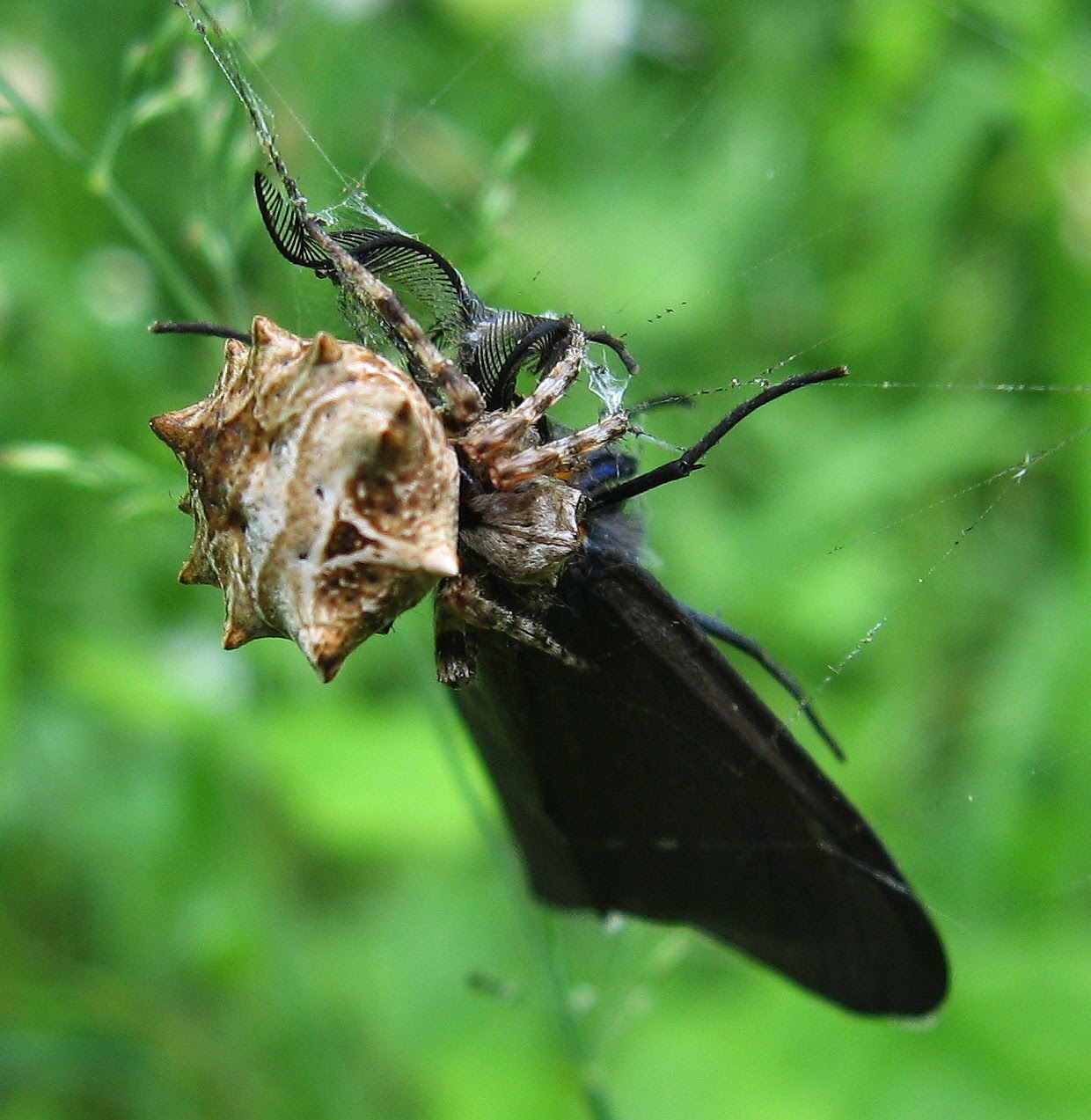
An Off the Wall Orbweaver

The Star Bellied Orbweaver certainly stands out from the crowd and deserves the "Coolest Local Spider" prize for its offbeat shape if not for size or color.

There are four species in Canada and the United States, and considering the possibilities enumerated at the BugGuide.Net Acanthepeira page it looks like this is Acanthepeira stellata. As their irregular profile and patterning makes them resemble a small piece of dead leaf or other plant debris, Star Bellied Orbweavers don't stand out so easily in the field and the only thing that gave this female away was the brightly colored Virginia Ctenucha moth hanging in her web.


A couple of closeup shots – this individual was about 10 mm long, roughly twice the size of the Star Bellied Orbweaver encountered a couple of weeks ago.


Tuesday, June 17, 2014

Megarhyssa atrata

Megarhyssa atrata is one of our largest Ichneumons, here are the stats from BugGuide.Net: "Female: body is 38 mm, ovipositor 130 mm, antennae 24 mm." That remarkable ovipositor is used to drill deep into wood and deposit the eggs on the larvae of Siricid wasps such as Horntails.


Not uncommon and often seen flying in woodlands in late spring or early summer, this Giant Ichneumon is hard to photograph because it always seems to be on a mission. This one found a dead tree to its liking and stopped to pose for a couple of pictures.

Wednesday, June 11, 2014

"If you wish to live and thrive, let a spider run alive."

The origin of this saying is a bit of a mystery. Is it an Old English nursery rhyme? An American Quaker saying? At least it contains more than a grain of truth (where would the world's ecosystems – and we – be without spiders?), and it's certainly better than the bit of folk nonsense – "Step on a spider and it will rain." One thing for sure, there are plenty of spiders running alive – in the grass, on leaves, on trees, under stones and on the water – almost anywhere you care to look.

The wonder is that spiders aren't noticed more often. True, some have lifestyles that require cryptic colors but many arachnids literally glitter and shine and are as dazzling as any butterfly or flower. Like this female Tutelina similis, for example. The photos simply cannot do justice to this spider, it's body, a whole 5 mm in length, is iridescent but the cephalothorax under the right lighting is a shimmering lilac color. Tutelina similis differs from the closely related Tutelina elegans in not having a white band around the abdomen.


Two tiny male spiders, about 3 mm in length, were in the vicinity of the female. Sure enough there was a connection – they were indeed male Tutelina similis (a male Tutelina elegans would sport black tufts of hair on its first tibia) and no doubt prospective suitors for her hand in marriage, metaphorically speaking, all eight of them ... and him with only seven ...


A male Habronattus decorus ... the name is certainly apropos, how does irridescent pearl grey and glittering rose sound for a color scheme? Again, the image doesn't convey how striking this spider is in reality . All of this is packed into a mere 5 mm ... yes, Jumping Spiders definitely take first prize for appearance and color.


Doing its best to imitate a bit of dead plant debris or a dry seed, Acanthepeira spp makes up in funky form what it lacks in cool colors. This Orbweaver is only about 5 mm long making it very easy to overlook, which of course is the idea from a predator/prey point of view.


Much like the origin of the saying in the title of this post, the identity of this ant-mimicking male arachnid is a mystery ...


... as were, until recently, the names of the following two spiders. But today, whilst researching the enigmatic ant-mimick I identified this male by stumbling across it whilst searching for something else – it's a Two-banded Antmimic (Castianeira cingulata). "Stumbling across" is used in a figurative and not literal sense, the spider is only about 6 mm long.


This pretty girl with the yummy name of Candystripe Spider (Enoplognatha ovata) was also IDed by random find (of the same blog!) on the 'net. Too bad she prefers to hide out in the shadows instead of showing off her colors.


Beautifully patterned in black and white, Neriene radiata, the Filmy Dome Spider, also prefers shady places. It's a male (note the enlarged palps) and it looks like he's molted recently because there's an exuviae in his web (look near the bottom of the first photograph).


It's easy to dismiss spiders and think of them, if not with outright fear and revulsion, as drab and uninteresting creepy-crawlies beneath our notice. Hopefully these photographs and the images elsewhere in this blog have shattered that illusion and illustrated the diversity of color, form, and the fascinating lifestlyes of spiders. They've been "running alive" for a cool 300 million years, that's a lot of time to be sifted though the sieve of natural selection and find their place in the tangled web of life on earth, and it's an ongoing process ...