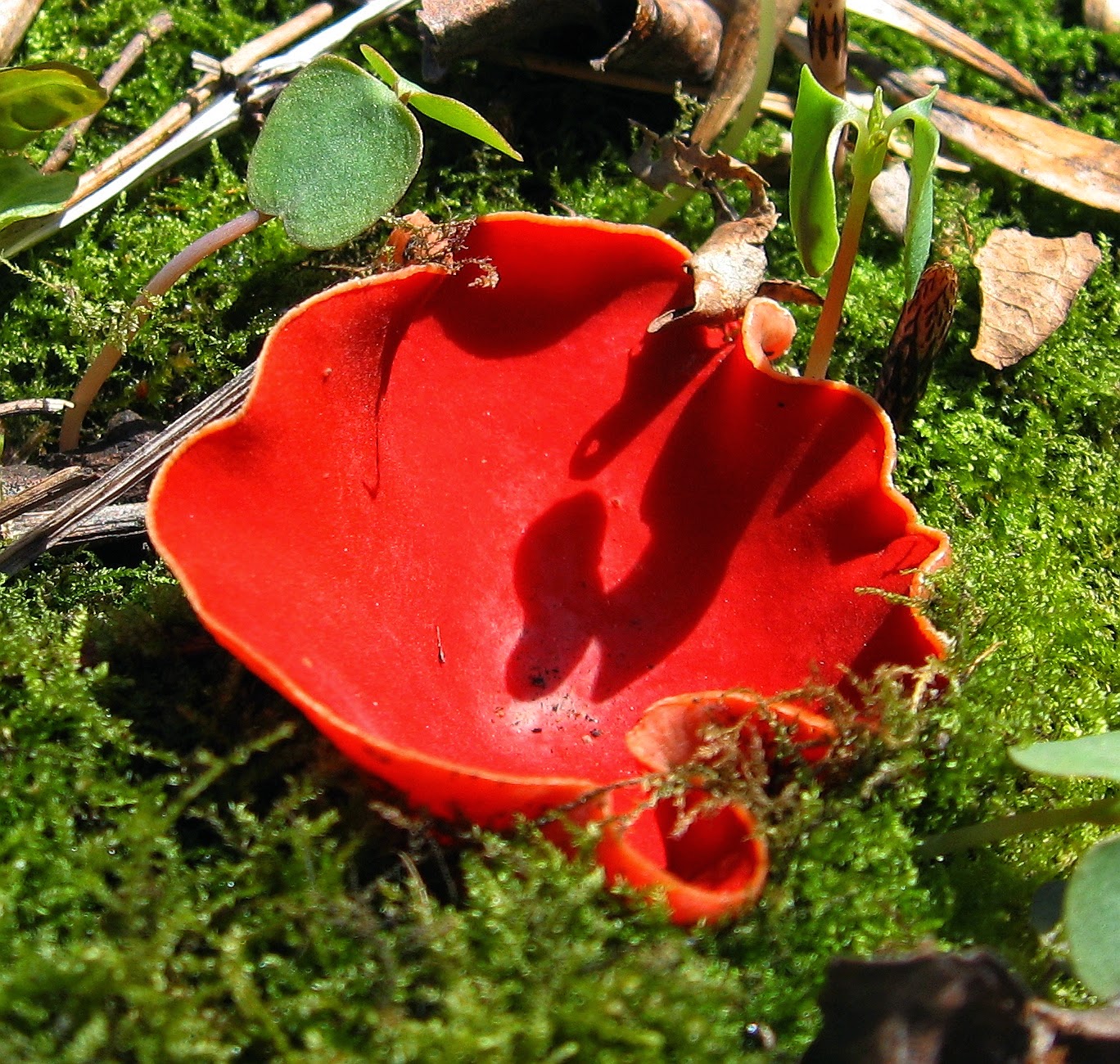
According to Michael Kuo at MushroomExpert.Com, the cup fungus Sarcoscypha coccinea is indigenous to the Pacific Northwest. The striking red woodland floor fungus found in the east in early spring, commonly known as Scarlet Elfcup, Scarlet Elfcap, or Scarlet Cup, is apt to be Sarcoscypha dudleyi or Sarcoscypha austriaca.
Showing posts with label Cinnamon Fern. Show all posts
Tuesday, May 6, 2014
Elfcups and Elfins
The differences aren't visible to the naked eye and a microscopic examination is needed to separate the species. And despite its brilliant color the Scarlet Elfcup is sometimes not visible to the naked eye on a macro scale, as it often grows under drifts of last autumn's dead leaves and easy to miss.
The usual first butterflies of spring have been flying for the past couple of weeks – Mourning Cloaks, Eastern Commas and Spring Azures. May 5th marked my first sighting of a Henry's Elfin (Callophrys henrici) for 2014, and the Eastern Pine Elfins and Juniper Hairstreaks should be out and about any day soon (maybe they already are and I've overlooked them).
Order juxtaposed against chaos, and another sign of spring ... the graceful green spirals of fiddleheads poking their way through the monotonous brown of the random forest floor litter. These look like Northern Lady Fern (Athyrium filix-femina), this makes sense as late last summer this fern was growing along the woodland stream where the fiddleheads were photographed.
Fiddleheads of the Sensitive Fern.
Ostrich Fern rhizome and fiddleheads.
These shapely unfolding fronds may belong to a Cinnamon Fern, but the world of ferns and other non-flowering plants is new to me and I'm still learning, so I'm not sure. I'll keep tabs on them and see what develops over the couple few weeks.
Friday, June 1, 2012
The Ferns of our Fields, Forests and Fens
Ferns don't produce colorful blossoms to catch the eye, so they tend to be overlooked and get relegated to being just a part of the background scenery. The ancestors and relatives of these humble plants grew to the size of trees, and 350 million years ago during the Carboniferous Period they formed the coal beds we use to generate much of our electricity. Although it's still under construction, the Ontario Ferns Website created by Walter Muma is a valuable resource.
A group of Bracken (Pteridium aquilinum), showing their typical growth form. This fairly tall fern – the plants in the photo below were about 100 cm high – prefers an open, relatively dry habitat. The following photographs were taken in late May.
Bracken stems
A Bracken frond still in the process of unfurling.
The underside of the frond – sometimes the margins of the leaflets are inrolled, as seen in the photo below.
Bracken with the leaves fully open.
Closeup of an unfurled frond.
A picturesque group of Cinnamon Fern (Osmunda cinnamomea) growing in a moist field in late May.
The cinnamon colored spike in the middle is the spore-producing fertile frond. This plant is a good 120 cm tall.
Fractals in nature – a Cinnamon Fern fertile frond.
Interrupted Fern (Osmunda claytoniana) found growing in a wet, almost marshy, open habitat in late May – the fronds of this striking fern were about 150 cm high.
The brown lumpy growths on the stems of Interrupted Fern are the fertile spore-producing structures.
Another photo of the stems of Interrupted Fern ... this plant comes by its name honestly, doesn't it?
The leaflets of Interrupted Fern.
Royal Fern (Osmunda regalis), late May, in a moist wooded habitat. A photo can't do this plant justice – the fronds were at least my height, but allowing for their curvature they would have been 180 cm long or better.
Royal Fern – fertile fronds in early June.
The leaflets of Royal Fern are distinctive.
Oak Fern (Gymnocarpium dryopteris) fronds have three main divisions, the middle one being the longest. This plant is about 30 cm high. Photographed in late May in a shady but relatively dry habitat.
Closeup of an Oak Fern frond.
Rattlesnake Fern (Botrychium virginianum) – the overall aspect and growth form are superficially similar to that of the Oak Fern.
Closeup views of a Rattlesnake Fern frond – very different from the frond of an Oak Fern. The fertile fronds of Rattlesnake Fern are also distinctive but this specimen doesn't have one.
A Rattlesnake Fern with a stalked spore-bearing fertile frond, photographed at the Vanderwater Conservation Area in late June.
The typical growth form of New York Fern (Thelypteris noveboracensis), about 60 cm tall, found growing in moist shady woodland in mid-May.
Since the pinnae grow almost to ground level while getting progressively smaller, the frond of the New York Fern appears to taper at both ends.
The sterile fronds of Sensitive Fern (Onoclea sensibilis) are seldom over 60 cm high. Photographed in a moist, open field in mid-June.
The spore-producing fertile fronds of Sensitive Fern – this photo was taken earlier, in mid-May.
A patch of Polypody (Polypodium virginianum) growing in a dry, wooded area in late May. Groups of single fronds, about a 30 cm long, are the typical growth habit of this fern.
Subscribe to:
Posts (Atom)