Showing posts with label Fungi. Show all posts

Saturday, September 13, 2014

A Stinkhorn is Born

Theoretically, in the best of all possible worlds a stinkhorn can expand from its immature "egg" stage to full size within thirty minutes. It actually takes several days to produce the nascent fruitbodies (primordia), but once formed, the fungus can bulk up rapidly by taking in water.

The following series of photos illustrating the growth of a Ravenel's Stinkhorn (Phallus ravenellii) spans about seven hours, maybe not fast enough to win any medals in the Fungal Olympiad 100 mm dash, but still a respectable rate of growth.

10:09 AM


10:52 AM


11:30 AM ... soon enough there were flies were checking out the sticky – and despite its obnoxious odor – sugary goo, which also contains the spores.


12:02 PM


12:37 PM


1:45 PM


2:54 PM


3:21 PM


4:59 PM


There was already an older stinkhorn to growing to the right of the "newborn"; the pair of fetid fungi made their presence known at a distance of a good three meters and no doubt insectile senses could detect the stinkhorn's odorous advertisment from a much greater distance. A carpenter ant and two species of flies paid a visit, and upon departure the insects took tiny samples of the spore mass with them, sowing the genes of the phallic fungi far and wide.


A few other fungi were present on the lawn, such as these Xylaria polymorpha, more commonly called Dead Man's Fingers, and they do indeed resemble four fingers – and a thumb – poking out of the ground.


This cluster of Bird's-Nest Fungi has seen better days and is too old to identify as to species. The "eggs" (periodoles) – each containing thousands of spores – that usually occupy the bottoms of the cups or nests (peridia) are long gone, leaving only their impressions in the bottoms of the cups. Like the stinkhorns, Bird's-Nest Fungi deviate from the usual fungal scheme of relying on the wind for spore dispersal. The "eggs" are ejected when a raindrop hits the "nest"; each egg has a sticky string (funiculus) that latches on to sticks, leaves and other woodland floor litter.


Should you happen to be a nematode worm, fear this fungus! Rather featureless and nondescript, it not only makes up for an unremarkable appearance with a tongue-twisting not so ho-hum handle – Hohenbuehelia angustata – it is also a predator, or more accurately, nematophagous.


Tuesday, May 6, 2014

Elfcups and Elfins

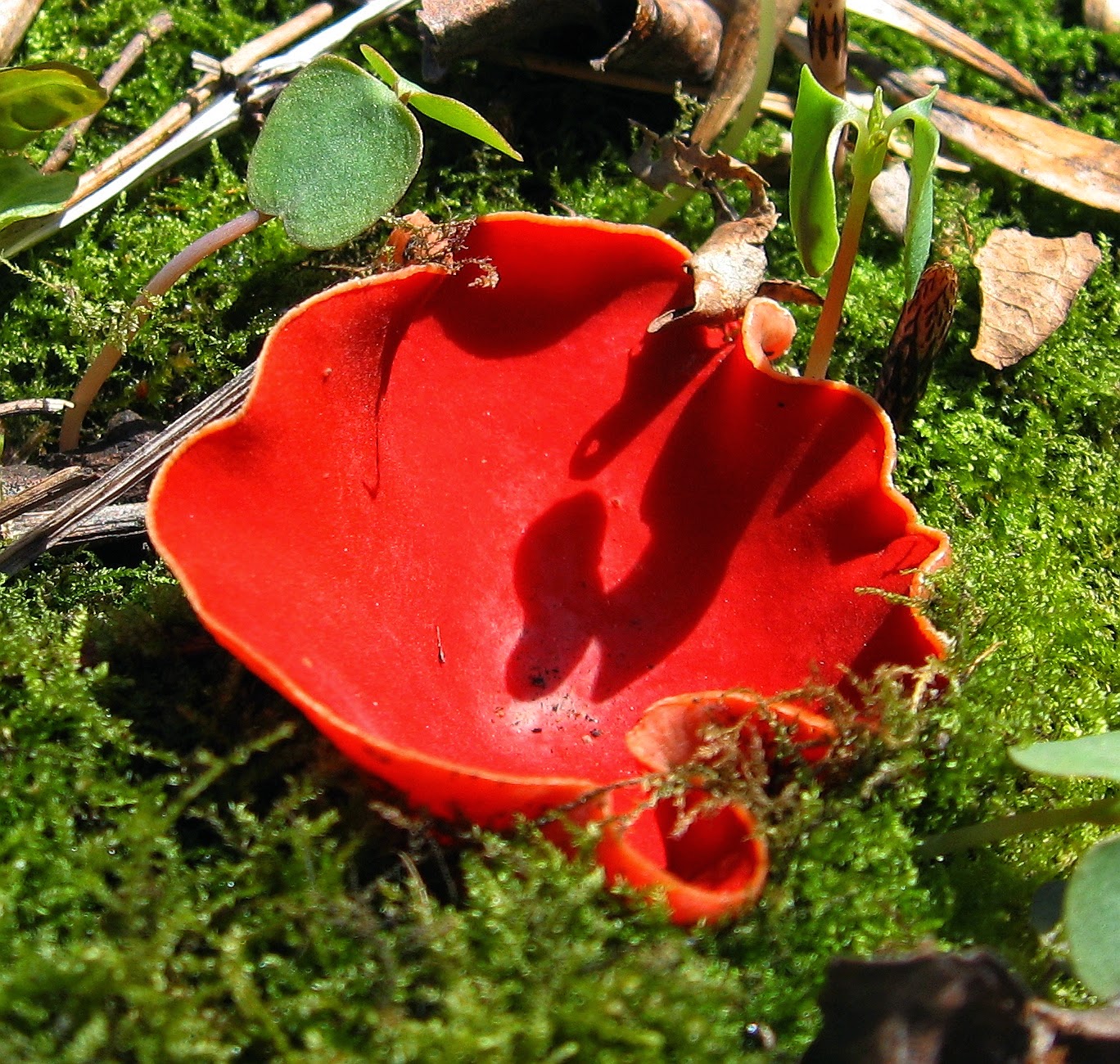
According to Michael Kuo at MushroomExpert.Com, the cup fungus Sarcoscypha coccinea is indigenous to the Pacific Northwest. The striking red woodland floor fungus found in the east in early spring, commonly known as Scarlet Elfcup, Scarlet Elfcap, or Scarlet Cup, is apt to be Sarcoscypha dudleyi or Sarcoscypha austriaca.

The differences aren't visible to the naked eye and a microscopic examination is needed to separate the species. And despite its brilliant color the Scarlet Elfcup is sometimes not visible to the naked eye on a macro scale, as it often grows under drifts of last autumn's dead leaves and easy to miss.


The usual first butterflies of spring have been flying for the past couple of weeks – Mourning Cloaks, Eastern Commas and Spring Azures. May 5th marked my first sighting of a Henry's Elfin (Callophrys henrici) for 2014, and the Eastern Pine Elfins and Juniper Hairstreaks should be out and about any day soon (maybe they already are and I've overlooked them).


Order juxtaposed against chaos, and another sign of spring ... the graceful green spirals of fiddleheads poking their way through the monotonous brown of the random forest floor litter. These look like Northern Lady Fern (Athyrium filix-femina), this makes sense as late last summer this fern was growing along the woodland stream where the fiddleheads were photographed.


Fiddleheads of the Sensitive Fern.


Ostrich Fern rhizome and fiddleheads.


These shapely unfolding fronds may belong to a Cinnamon Fern, but the world of ferns and other non-flowering plants is new to me and I'm still learning, so I'm not sure. I'll keep tabs on them and see what develops over the couple few weeks.


Tuesday, April 22, 2014

Western Chorus Frog (and other signs Spring is finally here)

Often heard early in the spring – even a small chorus of these tiny frogs can be deafening – but seldom seen, Western Chorus Frogs (Pseudacris triseriata) can survive being frozen and are out and about seeking potential mates when there is still snow and ice on the marshes and temporary vernal pools that are their breeding sites.

In addition to its song (reminiscent to running your fingernail along the teeth of a comb), the dark stripe through the eye, white upper lip and long spots or blotches distinguish this species from the Spring Peeper.


Calling for a girl friend ... the frog's vocal sac distends to twice the size seen in this photo.


It looks like this male sang loud enough and long enough to capture the attention of a female, and judging by their numbers these pairings no doubt happen many a time.


There's only one way to capture a close-up image of a 3 cm long frog with a point-and-shoot camera. My pants are wet up to the knees and my shoes still aren't completely dry two days later ...


Also seldom seen (and hopefully never heard, if so, see a psychiatrist) – Sarcoscypha coccinea, better known by the fanciful name Scarlet Elf Cup. This eye-catching early spring Ascomycete is not uncommon but it's often overlooked because it's buried under leaf litter.


Never heard, generally not considered to be eye-catching and frequently overlooked, and wish it was much less often encountered – the Black-legged Tick a.k.a. Deer Tick (Ixodes scapularis). I think I picked up this unwelcome hitchhiker when I bumped my head against a shrub during the incursion into the marsh – on my own head be it, so to speak.

I was onto the little sucker out not long after she started biting me, and while I'm not certain I got the hypostome out, it alone won't transmit Lyme Disease and the tick needs to be attached for several hours in any event. So it seems I'm off the hook, but just to play it safe I'm going to monitor the bite site for the next couple of weeks ...


There's a good reason a tick's hypostome is difficult to remove once it's firmly inserted. Have a look at the macro of the "business end", as it's so nicely put, of Dermacentor albipictus at Macromite's Blog.

Distant cousins of the Deer Tick – and a lot less bloodthirsty, at least from a mammalian perspective – Habronattus spp. are among the first jumping spiders apt to be encountered in spring. The next two images depict a Habronattus calcaratus maddisoni female and male. The spiders were found only a few centimeters from one another, no doubt there was a mating in the offing.


The male Habronattus viridipes closely resembles its cousin, but note the sinuous white line on the cephalothorax and the irregular borders of the black stripes on the abdomen. The first pair of legs of both species have a bright green inner surface, used by the males to signal to a prospective mate.


As always many thanks to the experts at BugGuide.Net for their help. I was fairly certain as to the genus these small Salticids (5 cm, give or take) but I couldn't have identified them to the species (let alone subspecies) level without some guidance. Another great website for identifying Salticidae is Jumping Spiders of North America.

Both of the Habronattus spp. were encountered on open rock outcrops in high and dry pine/oak/blueberry scrub habitat – the home of the Common Five-lined Skink. The little reptiles are still with us, first sighting for 2014 was Sunday April 27th, and a friend managed to get a photo before it scurried for cover.

The stony blueberry scrub is also a good place to look for the Bumble Flower Beetle (Euphoria inda). About the size of a June Beetle, this hairy scarab not only mimics the appearance of a bumblebee, it even drones like one while in flight. The larvae live in dung and decomposing wood, and there's lots of the latter laying around; they mature and fly in late summer and the beetles seen in the spring have overwintered as adults.


It's been a long cold winter and a late cool spring, I wonder if the "immigrant" species from warmer climes that have been extending their ranges northward made it through?

Saturday, October 26, 2013

Popping up like Mushrooms

Well, they are mushrooms. And according to George Barron, the author of Mushrooms of Ontario and Eastern Canada, under optimal conditions a Stinkhorn can expand from its nascent "egg" stage to full size within thirty minutes, an impressively fast rate of growth that certainly qualifies as "popping up".

While looking around for something interesting to photograph at the Tweed Heritage Center gardens, I noticed a smell like rotten carrion and wondered if perhaps a hapless mouse or chipmunk had perished and was decomposing in the late season flower beds. This was how I discovered some Ravenel's Stinkhorns (Phallus ravenelii) peeking out of the grass mulch and sawdust. Stinkhorns are often smelled before they are seen, an attribute that some find less than endearing.


As with other fungi, the purpose of the Stinkhorn's fruitbody is obviously reproduction. Gilled fungi and Boletes simply drop their microscopic spores through their gills or pores, to be wafted away on the slightest breeze. Some Bird's Nest Fungi actively eject their spore packages. Truffles play it safe and hide underground, but when they're good and ready to be fruitful and multiply, they produce an odor that induces animals to eat them and spread their spores via their feces. Perhaps strangest of all, before sporulation, the mycelium of Entomophthora muscae grows into the fly's brain, taking over its behavior and making it crawl to the highest available location to maximize spore dispersal.

Stinkhorns exploit flies, and presumably other insect species attracted to carrion, in a more benign fashion to pass along their genes to the next generation. The sticky, vile smelling sludge at the tip of a Stinkhorn not only contains sugary compounds – a combination of scent and taste that flies find irresistible – it also contains the Stinkhorn's spores, and as the flies crawl around enjoying their dinner the goo sticks to their feet and the insects convey the fungus' spores to new sites.


Compared to the 10 cm of the Ravenel's Stinkhorns in the photos above, this Skirted Stinkhorn (Phallus duplicatus, however, in my field guide it's named Dictyophora duplicata) is a giant. It stood out like a ... hmmm, let's say like a proverbial sore thumb, from the darker background of woodland floor debris. It was easily 20 cm in length and I've included my hand in the photo to impart a sense of scale.

Unfortunately this specimen is past its peak. The depressions in the morel-like tip are reservoirs for the Skirted Stinkhorn's viscid spore mass, which is long gone, but the fetid scent still lingers on and continues to attract flies. This species of Stinkhorn also sports a doily-like "skirt" around the base of the cap, the frayed remnants of which can be seen in the photos.


Also growing amidst the leaf litter along the trans-Canada Trail, only a few feet away from the Skirted Stinkhorn, was a lone Dog Stinkhorn (Mutinus caninus). And sure enough, where there are Stinkhorns, there are flies – note the mating pair in the background. Dog Stinkhorns attain a length of about 10 cm.


Stinkhorns not only pop up out of nowhere, they can vanish almost as quickly. The shelf life of the Ravenel's Stinkhorns was about three days after their prime (albeit they were pretty rough around the edges), but the Dog Stinkhorn in the image above – its goal of spreading the fungus' genes having been served – was little more than a gooey mass by the following morning.

With such a limited "best before" date one is lucky to stumble across opportunities to photograph these fascinating fungi, so I was thrilled when a few days later I encountered a colorful group of about a dozen Dog Stinkhorns. Or so I assumed at the time ... having done some more research, I now think these masses of malodorous mushrooms might be Elegant Stinkhorns (Mutinus elegans). The fruitbodies are longer (about 12 to 15 cm in length), there's no distinct separation of the spore mass and stalk, and more of the fruitbody – one third to one half – is covered in slime.

A student of the natural world soon learns that evolution and natural selection proceed according to their own rules, that life adapts as it must in order to survive and perpetuate itself and doesn't care about our human sensibilities ... nonetheless, I was holding my breath whilst taking these photographs.


Stinkhorns belong to the family Phallaceae, and what these 'shrooms lack (from our human perspective) in the olfactory department they make up for with their vivid colors and bizarre – but not necessarily phallic – shapes. Check them out at The Stinkhorn Hall of Fame at MushroomExpert.Com.

Sunday, July 28, 2013

Stumbling across some Summer 'Shrooms

Fungi make great photographic subjects. They're often colorful and they are always willing to sit still and pose for the camera, the only downside is they often prefer to grow in places where the lighting leaves something to be desired. Above all, they come a an astounding variety of strange and eldritch forms. Given the offbeat shapes assumed by many fungi, their penchant for growing in ill-lit, hidden places and that some bioluminescent species glow in the dark, it's understandable why people in centuries past gave them names like Witch's Butter, Devils Urn, Fairy Ring Fungus and Elfin Saddle.

Fungi are also the foundation upon which other life is built. According to George Barron, in his field guide Mushrooms of Ontario and Eastern Canada (Lone Pine Publishing, 1999), an astonishing 90% of the biomass of a forest floor's soil is fungal. Each tree has thousands of kilometers of symbiotic mycorrhizal fungi associated with its roots that keep the tree supplied with water and nutrients. In fact, I also recall reading somewhere or other that 95% of all plants depend on mycorrhizal fungi for their survival.

The fruitbodies of some 'shroom species are short-lived indeed, and you have to be in the right place at the right time to get a photo. Common and widespread on lawns in the summer, the fruitbodies of Dunce Cap (Conocybe lactea) might last a day.


Gastrocybe lateritia is even more ephemeral ... 9:30 on a July morning and these small mushrooms are already looking rough around the edges.


Many mushrooms change color and form quickly within just a few days, making identification challenging. The photos of this group of Pluteus petasatus were taken two days apart.


Some Xylaria hypoxylon a.k.a Stag's Horn, encountered growing on dead wood in the cedar forest near the Stoco Fen. This is the asexual spore-producing stage of the fungus. Later in the year it will morph to a much different looking sexual phase that produces thick-walled spores and resemble the name it more commonly goes by – Candlesnuff.


Parasola auricoma ... I didn't have to travel far and wide to get these pictures. These small distinctive mushrooms were fruiting the wood chip and bark mulch in the library gardens. The first photo is a younger stage of the mushroom before the caps have fully opened.


A commonly encountered mushroom, Xerula megalospora fruits on lawns, growing from dead wood buried beneath the soil. These two specimens were found in a grassy opening in the forest near the Point.


The stipe often bears a chevron-like pattern, and I was fairly certain I had identified this mushroom correctly based on the other characteristics visible in the photos above. But I has missed a critical identifying feature, something I never thought to look for until I read the species accounts in the Mushrooms of Ontario and Eastern Canada and at MushroomExpert.Com – this species sports a root-like extension up to 8 cm in length.


A few days later whilst out walking at 11:30 PM, I (literally) stumbled across another X. megalospora, so I carefully grabbed the stipe near the ground, pulled firmly upward, and ... wow! The ruler is 40 cm in length and I would guesstimate the length of the "root" to be a good 45 cm.


Last but not least is this crusty, crystalline, cake-like mass about 5 cm in diameter, found growing on a dead stump. Although hard and abrasive to the touch on the outside, the insides were a runny, slimy goo. This is actually a type of slime mold, Mucilago crustacea, and though they are generally included in fungus books and field guides, slime molds also possess the attributes of single-celled animals and scientists aren't sure just how to classify these offbeat organisms.


With the exception of Xylaria hypoxylon and Mucilago crustacea, all of the mushrooms depicted in this post were growing on lawns within a couple of blocks of my place. People often feel that large groups of mushrooms growing amidst the grass on their perfect lawn ruin its appearance and wonder how to get rid of them. Or upon seeing the shelving brackets of a polypore, want to know how to exterminate or remove the fungus from the tree.

The answer is ... forget it. Although the familiar part of a 'shroom that we see – the fruitbody – isn't really a fruit, the analogy still holds. Like an apple or a cherry on a tree, the mushroom we see is only a tiny part of the whole. A fungus mostly consists of a mycelium composed of microscopic threads called hyphae that grow underground in the soil or inside the wood of the tree. Remember that 90% of the forest soil's biomass? At any rate, you can't extricate the mycelium from its substrate any more than you can remove the mold from a piece of bread. So let the mushrooms on the lawn do their thing, and if a tree is at the point where there are brackets growing from it, it's pretty much history ...