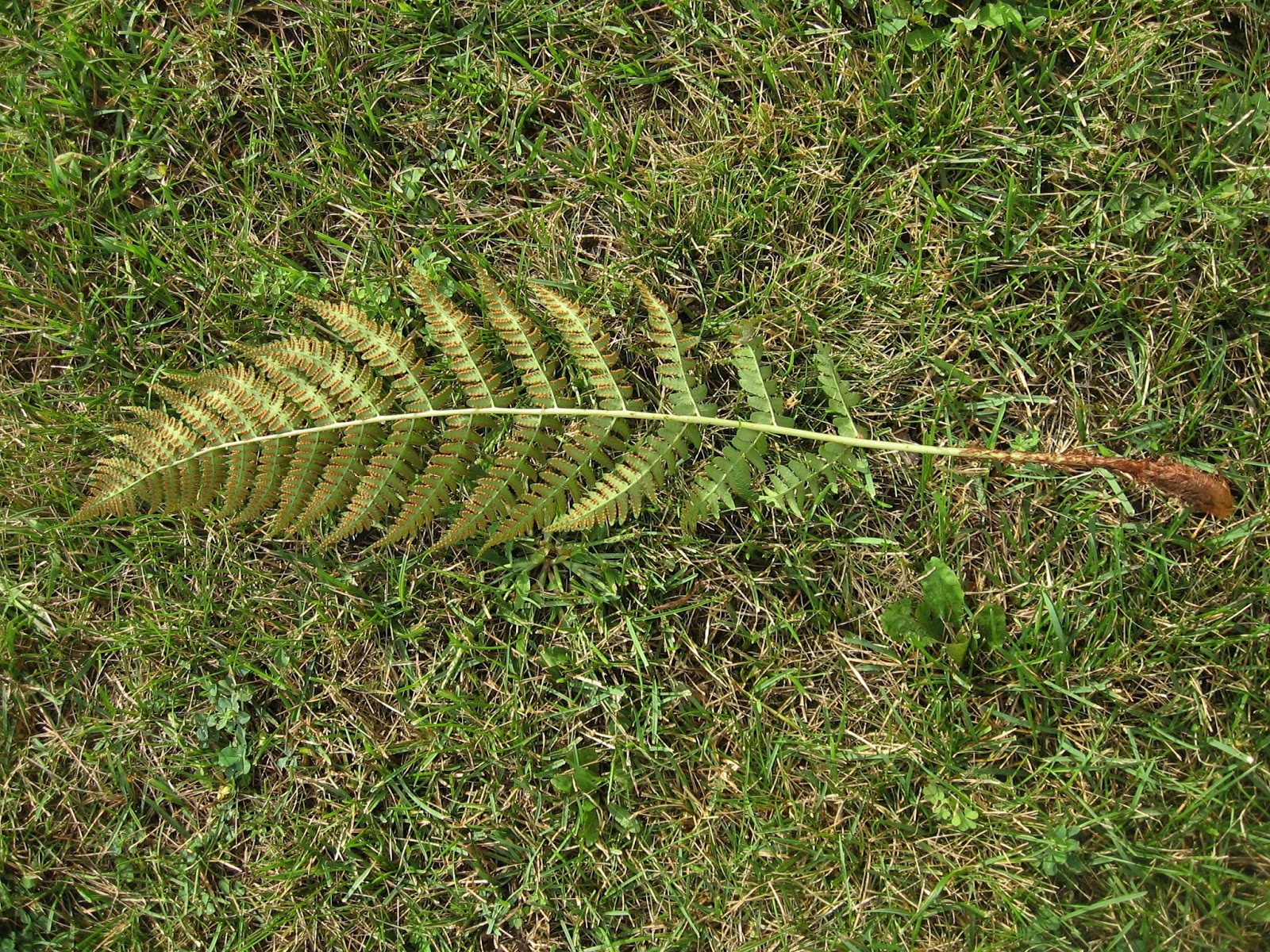
The 627 hectares comprising the Menzel Centennial Provincial Nature Reserve accommodates a variety of habitats ... alvars, wooded areas, marshes, open and treed fens. Plants considered to be fen indicator species are represented, it's reputed to be a refuge to the uncommon Juniper Hairstreak (Callophrys gryneus), and I'm sure I saw a female Ocellated Emerald on a recent visit (but, alas, didn't get a picture of it). And the Menzel Centennial Provincial Nature Reserve is where I found a couple of Wood Fern species that are not at all rare, but are new to me because as far as I know they aren't found closer to home.
The stipe of this fern is chaffy, but other fern species can have scaly stems so this attribute alone isn't good enough to identify our unknown plant. It's tough to get good pictures in constantly changing dappled lighting and only one other photo was worth keeping, sori to say (was that a bad pun, or what?).

But sometimes one key feature is all you need! The sori are situated along the margins of this fern's pinnae, hence its name – Marginal Wood Fern (Dryopteris marginalis).
A combination of characteristics were used to identify this eye-catching Intermediate Wood Fern (Dryopteris intermedia) – the scaly stipe, the thrice-divided frond (the blade is divided into pinnae, which are sub-divided into pinnules, which are themselves further divided into lobes), the spiny tips of the pinnules, and the arrangement of the sori.
The Intermediate Wood Fern, also known as the Evergreen Wood Fern or Fancy Fern, is very similar to and often confused with the Spinulose Wood Fern (Dryopteris carthusiana). However, in the Spinulose Wood Fern the lowest pinnae nearest the stipe are much longer than the remaining pinnae, in the Intermediate Wood Fern the corresponding innermost pinnae are shorter, and the second set out from the stipe are the longest.


Having mentioned the Spinulose Wood Fern and turned the "Duo of Dryopteris" into a trio, might as well post some images. The Dryopteris carthusiana is a natural fertile tetraploid hybrid between the Dryopteris intermedia and an unknown parent (well, as the saying goes ... everyone knows who their mother is). These are the aforementioned innermost – and longest – basal pinnae.
A couple of photos of the undersides of the pinnae and the sori – for all intents and purposes this and the remaining characteristics are identical to the Intermediate Wood Fern.
And that's all on this topic fern now ...