If you're searching for exotic ferns of the Orient, you've come to the wrong place, the ferns featured in this post aren't from that far east. A little closer to home, within the first three kilometer stretch of the trans-Canada Trail running east of Tweed, one can find sixteen species of ferns without really looking too hard. In addition to the photos below, the list includes ...
Northern Lady Fern (Athyrium filix-femina)
Bulblet Fern (Cystopteris bulbifera)
Fragile Fern (Cystopteris fragilis)
Marginal Wood Fern (Dryopteris marginalis)
Intermediate Wood Fern (Dryopteris intermedia)
Spinulose Wood Fern (Dryopteris carthusiana)
Ostrich Fern (Matteuccia struthiopteris)
Sensitive Fern (Onoclea sensibilis)
Royal Fern (Osmunda regalis)
Common Polypody (Polypodium virginianum)
Bracken (Pteridium aquilinum)
Marsh Fern (Thelypteris palustris)
Wet, swampy woodlands are an excellent place to look for the Crested Wood Fern (Dryopteris cristata). This is a fertile tetraploid hybrid of the Southern Wood Fern (Dryopteris ludoviciana) and an unknown diploid parent. (I digress ... I keep reading about an "unknown parent" fern in my Peterson Field Guide. Having done some searching on the Internet, it appears that the aforementioned parent of several Dryopteris hybrids may be a hypothetical and no longer extant species dubbed
Dryopteris semicristata.)
The fronds of the Crested Wood Fern grow in circular groups.
The sterile fronds (toward the back in the image above) are smaller, only about half the length of the fertile fronds.
A lateral view of a fertile frond showing the ladder-like twist of the pinnae, one of the key characteristics of this species.
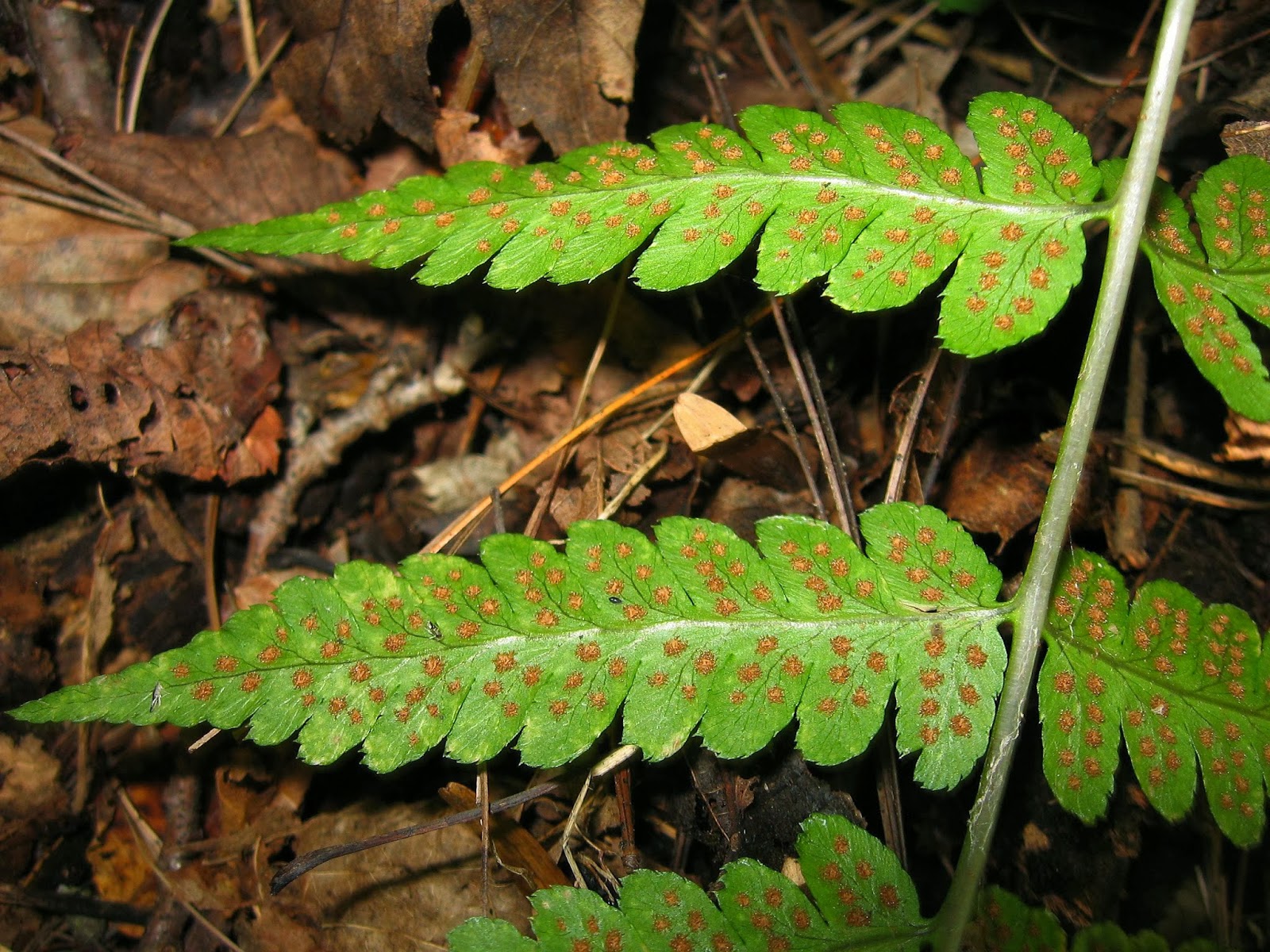
The distribution of the sori on the underside of a fertile frond.
The lowest pinnae of the Crested Wood Fern are broadly triangular and smaller than the pinnae above. The pinnae in general are wider and much less frilly or lacy than other Dryopteris species.
More photos of the undersides of the fertile pinnae – note how the sori are neatly lined up in two rows.
The stipe bears a scattering of pale brown scales. It's not evident in the pictures above, but the stipes of the fertile fronds are quite long, over one-third the length of the blade.
Another inhabitant of cool moist woodlands – although I've called this a Northern Wood Fern (Dryopteris expansa), a couple of the characteristics don't quite conform to the species account in the Peterson Field Guide. The general growth form is the circular clumps so typical of Wood Ferns.
What caught my eye were the lower innermost pinnules of the basal pinnae – they are not only much longer and wider than, but also definitely not opposite, the pinnules on the other side of the costa. This is a strong indicator for either a Mountain Wood Fern (Dryopteris campyloptera), or its progenitor, the Northern Wood Fern (Dryopteris expansa).
The fertile blade – it's on the narrow side for this to be a Mountain Wood Fern, the blade of which is broadly triangular. I would also expect the blades of the Northern Wood Fern to be wider than this, although the other two blades in the first photo look to be about right.
The sori on the underside of the pinnae. I'm not an expert at this and still learning, but the sori seem sparse and don't appear to be well formed.
A closeup shot of the scattered pale brown scales on the stipe. According to the books the scales should have a dark central stripe, and I don't see any, the scales appear to be uniformly brown. Maybe it's best to just call this fern another unidentified Dryopteris hybrid ...
Many ferns are adept at eking out an existence in a harsh habitat. The Ebony Spleenwort (Asplenium platyneuron) makes do in small pockets of soil on rock faces and fissures, and it often has company. The long graceful fronds in the following photo are the fertile fronds of an Ebony Spleenwort. The smaller, more triangular fronds with the dissected leaflets belong to a Fragile Fern, and there's also a young Marginal Wood Fern in the picture. The plants with the rounded leaves (to the right of the photo) are the vernal rosettes of Early Saxifrage. An artistic arrangement tucked into a few square inches of soil lodged in a tiny crevice in the unyeilding granite, courtesy of Mother Nature.
The sterile fronds are smaller, a a paler shade of green, and prostrate.
On the other hand the striking deeper green fertile fronds stand upright and can attain lengths of up to 50 cm.
The fertile pinnae have distinctive lobes.
Mature sori crowd one another until they pretty much cover the ventral surfaces of the fertile pinnae.
The dark glossy rachis that earned this fern its name isn't really ebony, it's more a of deep, rich reddish-brown.
A closer look at a fertile pinna, with its "ears" or lobes.
The stipe is smooth and the same color as the rachis.
Another grouping of Ebony Spleenwort – this beautiful little fern is not very common and to date I've found only four sites on the rock cuts, not far from one another, where it seemed to find conditions suitable to its needs.
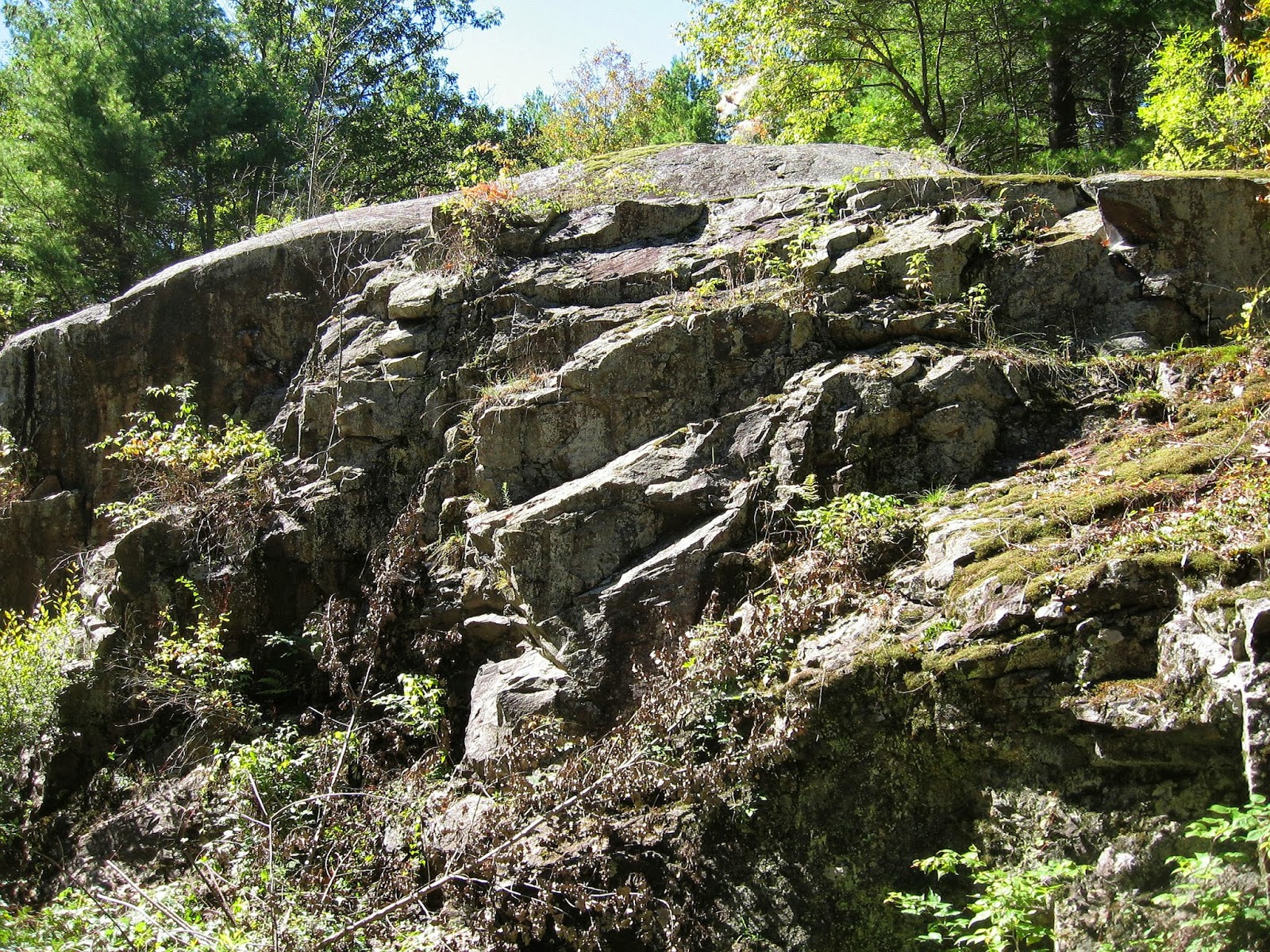
This is the scenic habitat of the Rusty Cliff Fern (Woodsia ilvensis). Ebony Spleenworts, Fragile Ferns and Marginal Wood Ferns also "hang out" on the granite faces where there's a bit of soil to support them, but the aptly named Cliff Ferns occupy the most challenging places of all and get first prize for being the aerialists of the local fern world. I can't see so much as an honest crack in the rocks where many of the ferns are growing, and a lot of the overhangs are angled well beyond vertical.
Growth from previous seasons accumulates around the bases of the clumps. These ferns are often called "Resurrection Ferns" – the entire plant dies down during a dry spell but sprouts new fronds when conditions improve.
Cliff Ferns a.k.a. Woodsias can often be identified as such by looking at the base of the plant under the dead fronds. The stipes of many Woodsia species have an abscission layer – they all shear or break off at about the same level.
The dorsal surfaces of a fertile frond.
The sori are distributed around the margins of the pinnae and are surrounded by whitish hairs that are actually a part of the indusia. Said hairs are barely visible because the entire underside of the frond is woolly; this wool turns rusty brown during an extended dry spell.
The rachis of the Rusty Cliff Fern is also profusely covered with hairs.
A couple more plants of interest to look at before taking leave of the realms of the not-so-far east. It's impossible to overlook the ubiquitous "mosses" tenaciously hanging on to life on the sun-baked surfaces of granite with little or no soil cover.
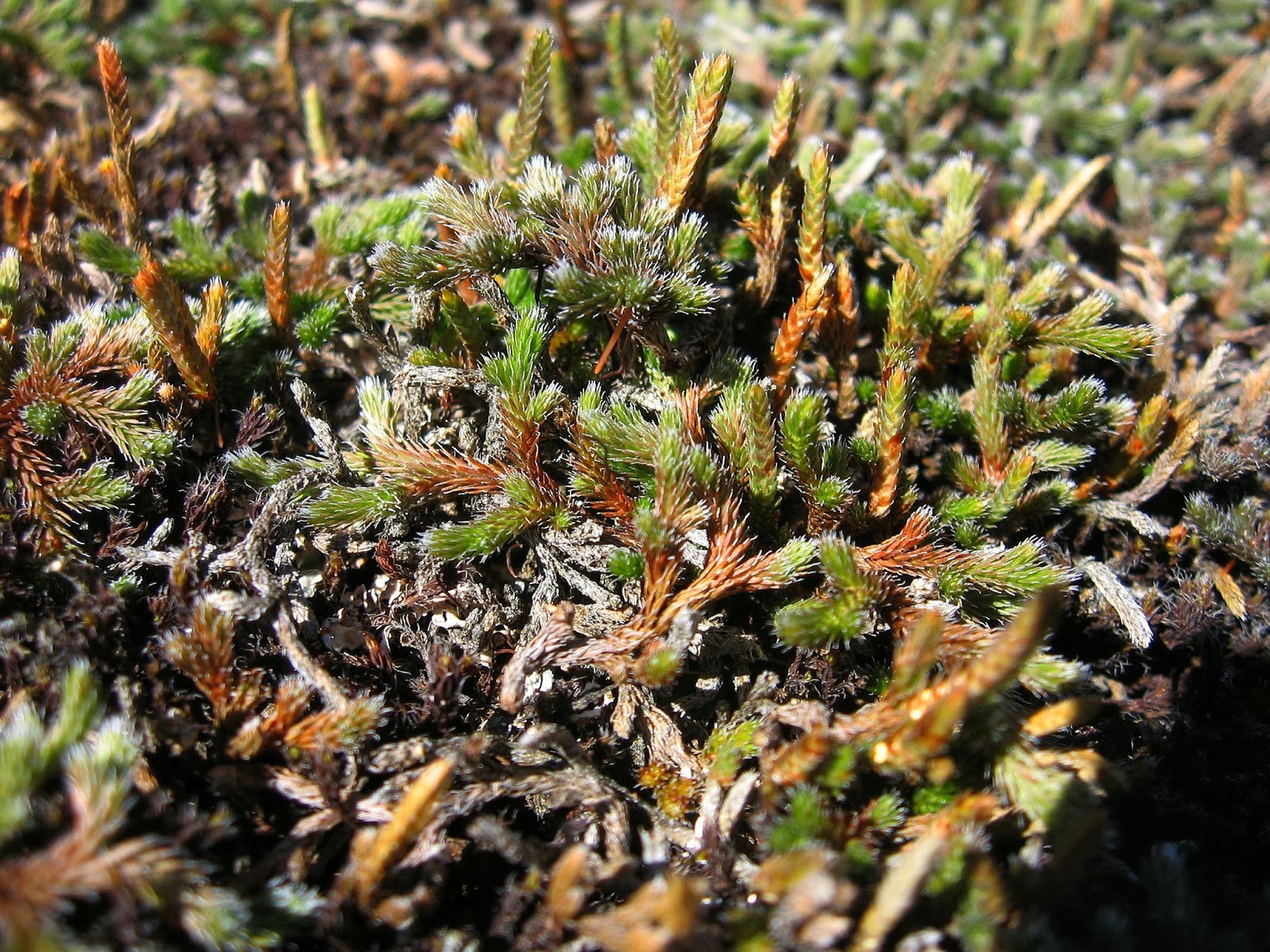
However, my assumption that the plants were some kind of moss turned out to be incorrect. Dwarf Spikemoss or Rock Spikemoss (Selaginella rupestris) is a cousin of Clubmosses, Firmosses and Quillworts. Unlike mosses, but like the aforesaid species and the ferns, Spikemosses have a vascular system.
The visibly square-sided strobilus – the spore-producing structure – of the Dwarf Spikemoss. Whereas Clubmosses only produce one type of spore, Spikemosses produce two types – female megaspores, and male microspores. The leaves of Dwarf Spikemoss bear a long, transparent bristle on their tips.
Another patch of Dwarf Spikemoss.
A closeup, with the sterile leaves in the foreground and the square-sided strobili toward the right and back.
Moving on from a hot, dry habitat to a damp shady haven, where we can find the aptly named Snakeskin Liverwort (Conocephalum conicum). Liverworts are non-vascular plants – they have no veins or roots to transport water and nutrients – and are more akin to true mosses in this respect.
How the Snakeskin Liverwort got its name ... a closer look at the thallus, composed of tissues that are not differentiated into distinct organs such as stem and leaves.